

Furnace tap-changer wear depends on the current, step voltage and direction at each operation. Build that switching-duty spectrum to connect the operation history with manufacturer-supported maintenance evidence. IEEE C57.17-2012 is listed as Inactive-Reserved; use its furnace-transformer scope as a historical reference while specifying the contract acceptance basis. [1]
Calculation basis. Project-specific values and gates in the illustrative screens below are assumptions; cited catalogue values retain their source test conditions.
Identify the actual tap-changer type and winding location. The furnace secondary current is not automatically the current switched by its interrupter or transition path. The manufacturer’s device-specific model must define that relationship.
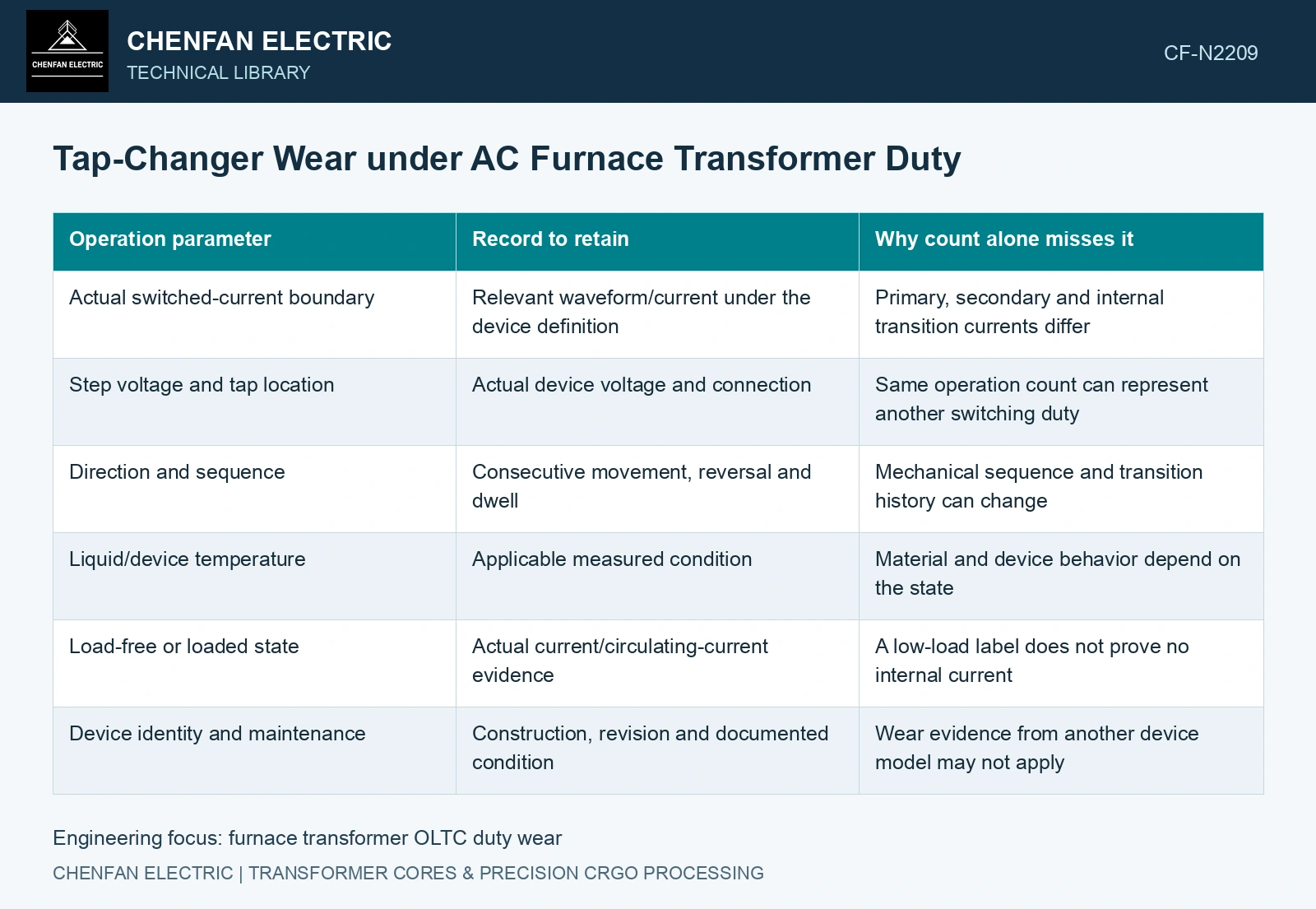
Record an operation-level duty spectrum
| Operation parameter | Record to retain | Why count alone misses it |
|---|---|---|
| Actual switched-current boundary | Relevant waveform/current under the device definition | Primary, secondary and internal transition currents differ |
| Step voltage and tap location | Actual device voltage and connection | Same operation count can represent another switching duty |
| Direction and sequence | Consecutive movement, reversal and dwell | Mechanical sequence and transition history can change |
| Liquid/device temperature | Applicable measured condition | Material and device behavior depend on the state |
| Load-free or loaded state | Actual current/circulating-current evidence | A low-load label does not prove no internal current |
| Device identity and maintenance | Construction, revision and documented condition | Wear evidence from another device model may not apply |
Keep electrical wear and mechanical count separate
A mechanical counter remains useful for its defined maintenance requirement. It does not resolve contact erosion or other current-dependent electrical effects. Manufacturer research for a particular vacuum tap changer explicitly distinguishes actual switched-current profiles; its numerical lifetime claims are not universal.
Likewise, a device-specific electrical wear estimate does not remove the mechanical inspection requirement. The two boundaries can be governed by different evidence. Retain both instead of merging them into one generic remaining-life percentage.
Compare duty classes with supported weights
A spectrum can group operations by the actual variables the manufacturer supports. Any accumulated wear calculation needs an applicable relation or weight for those classes, not an assumed I² rule copied from winding heating. Contact switching and winding copper loss are different mechanisms.
Use the relevant actual load and step conditions when selecting a device or reviewing changed furnace control. A process revision can move operations into a different duty class even when the daily count stays similar. Reevaluate the prior qualification rather than assuming count equivalence.
Check data completeness before trusting a forecast
Align operation timestamps, tap positions and electrical measurements. If a current value is sampled too slowly or from the wrong side, it can misclassify the switching event. Missing events and replaced devices also break the accumulation history unless explicitly reconciled.
Document which maintenance or wear conclusion is supported by the actual device evidence and where uncertainty remains.
Address governing high-current switching and reversals with the supported device assessment. Use the complete operation spectrum to justify maintenance decisions.
Count furnace operations on the actual switching duty
Furnace tap-changer evidence must retain the current and operating history of each switching event [2].
Assume 60 heats per day and 25 loaded tap changes per heat. The duty is 1,500 loaded changes/day and 450,000 changes over an assumed 300 operating days. Assume 60% switch 400 A RMS and 40% switch 800 A RMS on the actual interrupter reference: record 900 and 600 operations/day in those separate classes. Their wear weights require the applicable device model. An assumed 30,000-operation count-based review interval would be reached in 20 days. Obtain the tap-changer manufacturer’s furnace-specific maintenance basis and current spectrum before setting the interval.
References
- IEEE, IEEE C57.17-2012, IEEE Standard Requirements for Arc Furnace Transformers (Inactive-Reserved).
- S. Rehkopf and L. Kirchner, Furnace Applications in the Upper Performance Segment, Maschinenfabrik Reinhausen, F0407400, June 2022.