

Ferrite, nanocrystalline material and cold-rolled grain-oriented electrical steel belong to different magnetic-material systems. Their useful frequency ranges overlap in some applications, but they cannot be ranked by one universal crossover frequency. Selection depends on flux excursion, bias, temperature, loss, material form and the function of the magnetic component.
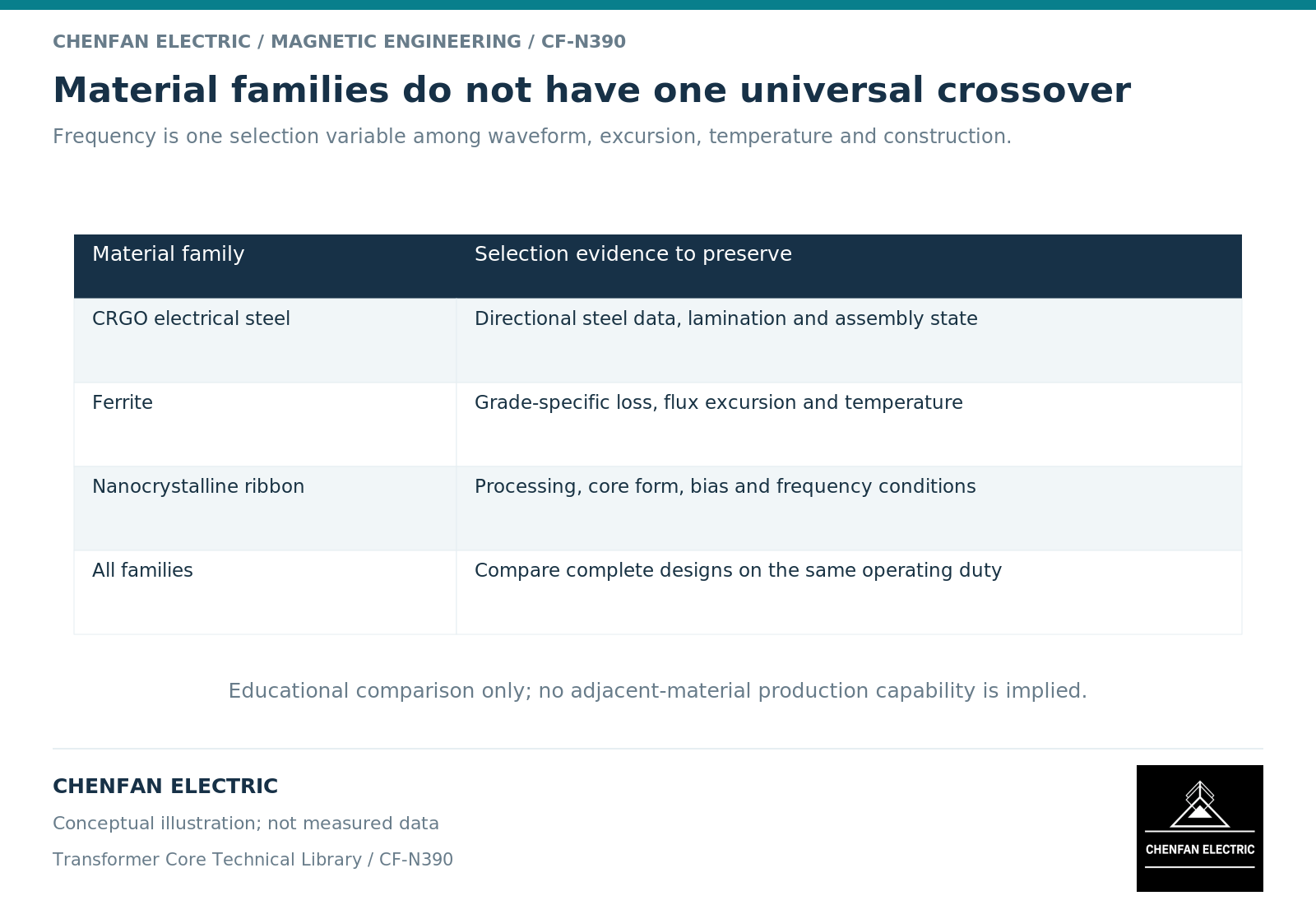
Compare a defined task rather than a family name
A power transformer, an energy-storage inductor and an interference-suppression choke ask different questions of a core. Low power loss, high incremental inductance and deliberately lossy high-frequency impedance are not identical objectives.
Manufacturer ferrite data organize grades by application, frequency and temperature-related behavior. [1] Nanocrystalline product guidance likewise qualifies frequency applicability by processing and material condition. [2] These sources demonstrate why a family-wide statement such as “works up to this frequency” is insufficient for a specific design.
For CRGO, use grade-specific data at the intended excitation rather than extending a line-frequency transformer result into an unrelated high-frequency component. The appropriate comparison is between identified candidate grades and constructions.
Keep saturation, loss and permeability separate
A material can have attractive saturation behavior while incurring excessive loss at the required waveform. Another can provide high initial permeability but a different response under direct-current bias or a large excursion.
Initial, incremental and effective permeability are different definitions. A small-signal catalog value is not automatically the parameter needed for an energy-storage or large-signal transformer calculation.
| Property | Condition that must accompany it |
|---|---|
| Saturation or limiting induction | Temperature and measurement definition |
| Core loss | Flux waveform, frequency, amplitude and material state |
| Permeability | Small-signal or large-signal basis, bias and frequency |
| Impedance | Component geometry, turns and measurement configuration |
| Mechanical suitability | Material form, construction and assembly limits |
The voltage integral still governs flux-linkage change. [3] Higher frequency can reduce the excursion for a given repeated voltage waveform and turns, but it can also increase frequency-dependent losses. Both effects belong in the design.
Include geometry and manufacturing form
A material change may require a different shape, net area, number of turns, gap strategy or support arrangement. A toroidal ribbon core, a shaped ferrite component and a stacked electrical-steel core should not be compared as though only their chemical compositions differ.
The winding also changes the result. Mean turn length, insulation, leakage, parasitic capacitance and alternating-current conductor loss can influence which complete component meets the duty. A core-only ranking can reverse when those effects are included.
Do not reuse a magnetic-property graph from one specimen size as a finished-component guarantee. Identify the supplied core construction and the evidence available for it.
Build a qualified selection map
The useful selection record contains the application, operating waveform, current and bias range, temperature range, required magnetic response and physical constraints. Candidate materials are then assessed against those same inputs.
Where suitable data are unavailable, record the gap and identify the needed material or component verification. Do not fill it with a generic “high-frequency” label or an unsupported numerical limit.
This article is an educational comparison, not a product-catalog expansion. It does not establish that Chenfan Electric supplies ferrite or nanocrystalline components. Its practical purpose is to prevent line-frequency core data, high-frequency material data and complete-component claims from being mixed into one misleading equivalence.
References
[1] TDK Electronics. Ferrite Materials.
[2] VACUUMSCHMELZE. Nanocrystalline Material – VITROPERM.
[3] Lloyd Dixon / Texas Instruments. Magnetics Design 1 – Introduction and Basic Magnetics.