

Solve the DC mean and retained harmonics as one nonlinear periodic problem. In a biased core, the zero-frequency component and even harmonics contribute to the asymmetric waveform reconstructed by harmonic balance.
Calculation basis. Unless a value is explicitly attributed to a cited source, numerical inputs in the demonstrations are assumptions for the stated model. Normalized variables are dimensionless. The examples define their own geometry, excitation and measurement boundary.
Verify those components against the declared bias circuit and a matched time-domain steady state. A small nonlinear residual at one harmonic order does not establish that the chosen truncation resolves the engineering output.
Define the zero-frequency constraint
Write the represented state as x(t) = x₀ + sum from n = 1 to K of [x_cn cos(n omega t) + x_sn sin(n omega t)]. State the Fourier convention, reference phase, fundamental frequency and whether coefficients are peak amplitudes or complex coefficients.
The zero component is part of the nonlinear periodic problem. It must follow the imposed DC current or the model’s actual circuit and magnetic constraints; it is not automatically a freely selected flux offset.
For an ideal lossless flux-linkage branch, v = d lambda/dt. A periodic linkage therefore requires zero mean induced voltage, but that requirement alone does not determine its mean linkage. Conversely, an uncompensated nonzero mean induced voltage produces a ramp rather than a periodic solution. With winding resistance and additional circuit terms, use their complete voltage balance.
Retain the nonlinear harmonic coupling
Keep the DC term, nonlinear constitutive products and Fourier reconstruction in the same harmonic-balance residual. Verify the resulting mean and waveform against an independently resolved periodic solution.
That is different from solving a linear model separately at each frequency and adding the answers. A nonlinear constitutive evaluation couples the retained coefficients through the reconstructed waveform.
The cited method concerns laminated inductors and uses nonhysteretic B–H curves. Its homogenization and time-domain comparison do not qualify a transformer’s history-dependent core. A hysteretic periodic calculation needs a compatible internal-state treatment and genuine periodic state closure.
Start with a transparent reconstruction benchmark
Use an original dimensionless manufactured input B(tau) = 0.5 + cos(tau), where tau = omega t, and a monotone memoryless relation H = B + B³. B and H here are normalized variables, not tesla and A/m or a fitted steel curve.
Expanding the cubic with cos²(tau) = [1 + cos(2tau)]/2 and cos³(tau) = [3cos(tau) + cos(3tau)]/4 gives:
H = 1.375 + 2.5cos(tau) + 0.75cos(2tau) + 0.25cos(3tau)
The even term appears despite an input containing only DC and the fundamental. Its removal would change the waveform. This example prescribes B, so it checks constitutive evaluation and Fourier reconstruction; it is not a coupled harmonic-balance field or circuit solution.
Define H_K by retaining the DC term and harmonics through K. The independent arithmetic comparison is:
| Retained order K | H_K at tau = 0 | H_K at tau = pi | Whole-period RMS error divided by exact H RMS |
|---|---|---|---|
| 1 | 3.875 | −1.125 | 24.218% |
| 2 | 4.625 | −0.375 | 7.658% |
| 3 | 4.875 | −0.625 | 0% in exact arithmetic |
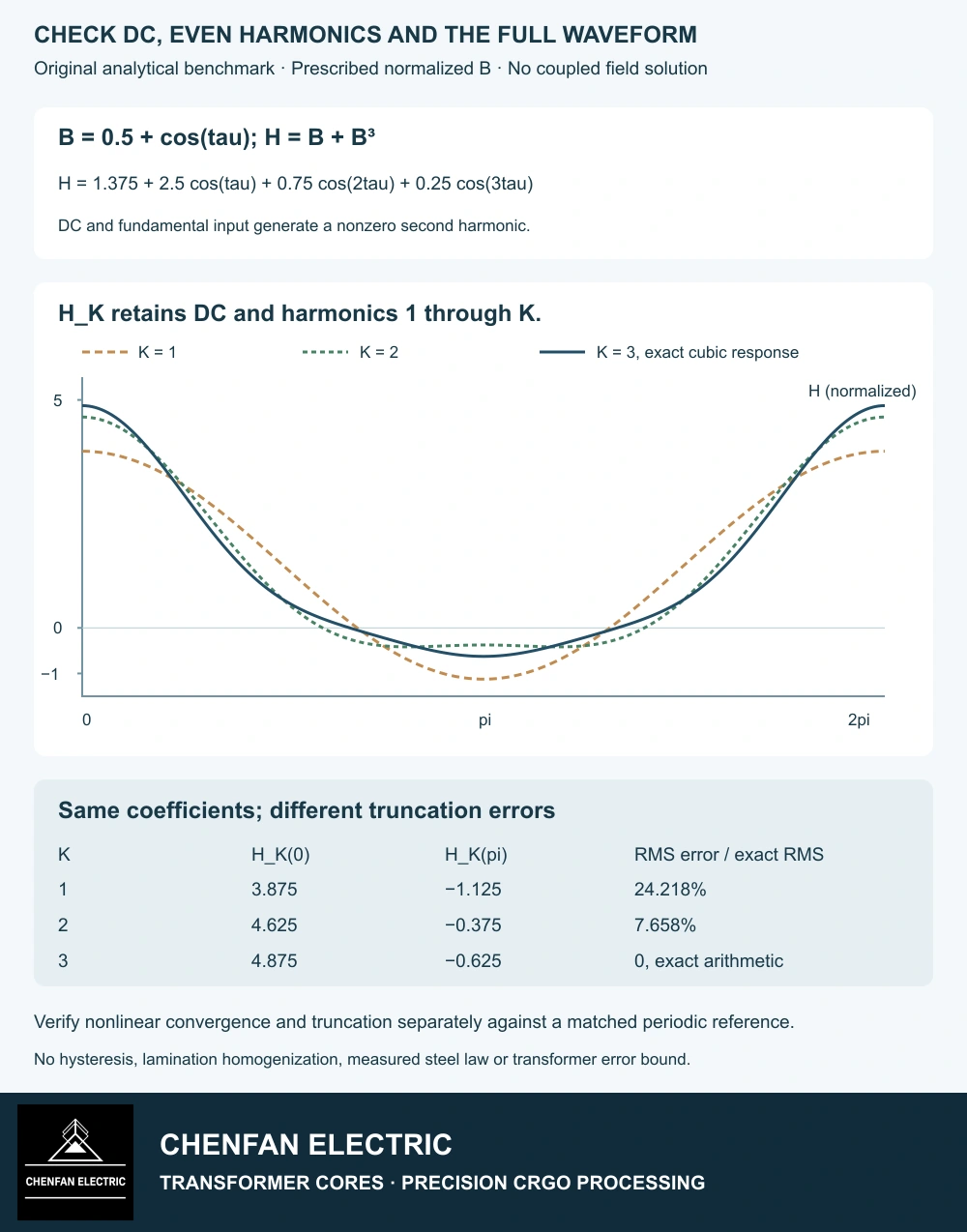
At zero phase, the exact H is 4.875; the K = 1 reconstruction underestimates it by 20.513%. At pi, it overshoots the negative response. The fundamental coefficient itself is unchanged across these reconstructions, illustrating why fundamental agreement does not establish waveform agreement.
Orthogonality independently gives the exact mean-square H as 1.375² + (2.5² + 0.75² + 0.25²)/2 = 5.328125. The omitted-harmonic RMS errors are sqrt[(0.75² + 0.25²)/2] for K = 1 and 0.25/sqrt(2) for K = 2. The plotted curves are these analytical functions, not fabricated finite-element convergence results.
Distinguish truncation from nonlinear convergence
At each K, converge the coupled nonlinear equations to an identified residual criterion. Then raise K and compare the same physical outputs: mean state, positive and negative peaks, phase-resolved waveform and relevant integrated quantities.
A result can be well converged within its truncated space while missing harmonics that affect peaks. Conversely, adding harmonics cannot repair an unconverged nonlinear iteration or an inappropriate constitutive model. Keep these error sources identifiable.
If the algorithm evaluates nonlinear terms on phase samples and transforms them back, verify the sampling and aliasing separately. In the cubic benchmark, the generated signal contains harmonics through order three, so seven uniformly spaced samples can represent its complete DC-through-third-harmonic content. This count applies to this exact polynomial benchmark, not every nonlinear core law or retained order.
Match the time-domain periodic reference
Use the same geometry, source circuit, material relation and preparation in the time-domain comparison. Continue until the relevant fields and internal states repeat over the selected period, rather than comparing harmonic balance with an early transient cycle.
Refine the time step and spatial discretization independently. Align phase and coefficient conventions before comparing peaks or Fourier components. Otherwise a reference-time shift can look like harmonic disagreement.
The original preprint compares its homogenized model with a fine-mesh transient laminated-inductor model and reports deteriorating approximation under stronger saturation at higher investigated frequencies. For the transformer calculation, select harmonic order by convergence over its actual saturation and frequency range.
State which periodic solution was tested
A same-period harmonic representation does not automatically capture a subharmonic, aperiodic or evolving biased state. If the circuit admits a longer response period, the selected basis and comparison window need to reflect that behavior.
Release the retained order, zero-frequency condition, nonlinear residual, phase-sampling check and matched periodic reference together. Name the tested waveform and engineering output, then attach the separate material and thermal evidence required for the intended duty.
Keep the sinusoidal loss reference outside the biased fit
For M-3X, the catalog gives maximum specific losses of 0.305 W/lb at 1.5 T and 0.453 W/lb at 1.7 T, both at 50 Hz on the stated annealed, rolling-direction test specimens. [1] Converting to SI gives 0.672410 and 0.998694 W/kg. For an assumed 100 kg material sample, the corresponding reference powers are 67.241 and 99.869 W, a 48.52% increase. Use these as separate sinusoidal calibration checks. A biased waveform needs its own reconstructed trajectory and loss evaluation; substituting its largest instantaneous B into the sinusoidal catalog entry changes the experiment being represented.
Preserve grade, rolling direction, sheet thickness, cutting stress and annealing condition in the material record. The harmonic model must inherit the processed material state; increasing Fourier order cannot correct a different steel or joint geometry. IEC 60404-8-7 provides the delivery-specification framework for fully processed grain-oriented steel. [2]
References
[1] Cleveland-Cliffs, Grain-Oriented Electrical Steels — LITE CARLITE and Mill-Anneal, October 2023, Tables 1 and 5; Stress-Relief Annealing.
[2] IEC, IEC 60404-8-7:2020, Magnetic materials — Part 8-7: Specifications for individual materials — Cold-rolled grain-oriented electrical steel strip and sheet delivered in the fully-processed state.