

The motor bus loses voltage. An alternate source is available. Those observations do not establish that transfer is permissible: the fault may lie on a part of the circuit that the alternate source would energize again. [1]
The study must identify the fault zone and the isolation boundary. Source-loss detection is an initiating observation; it is not evidence that the retained bus is free of an unisolated fault.
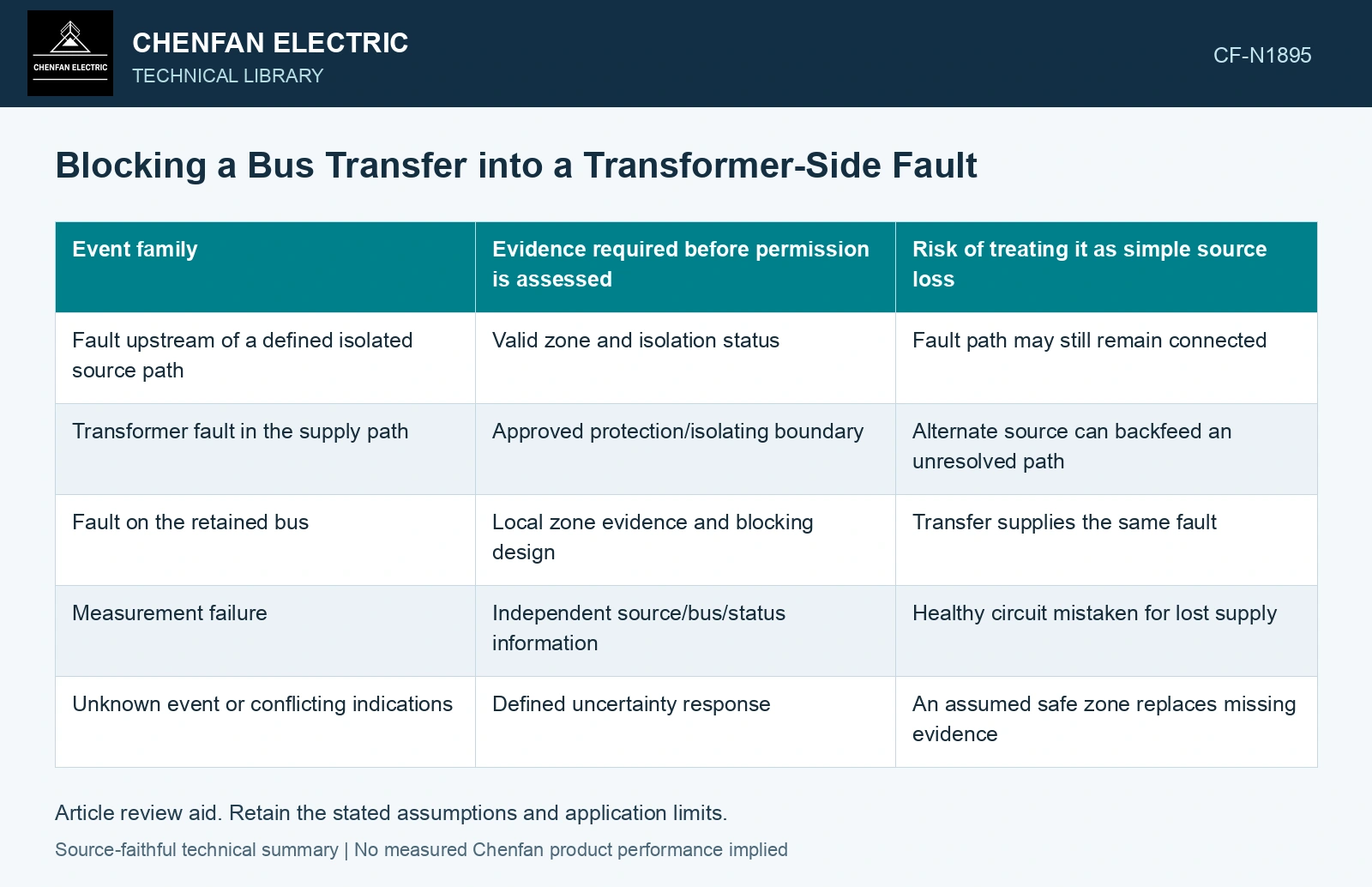
Separate initiating events by location
| Event family | Evidence required before permission is assessed | Risk of treating it as simple source loss |
|---|---|---|
| Fault upstream of a defined isolated source path | Valid zone and isolation status | Fault path may still remain connected |
| Transformer fault in the supply path | Approved protection/isolating boundary | Alternate source can backfeed an unresolved path |
| Fault on the retained bus | Local zone evidence and blocking design | Transfer supplies the same fault |
| Measurement failure | Independent source/bus/status information | Healthy circuit mistaken for lost supply |
| Unknown event or conflicting indications | Defined uncertainty response | An assumed safe zone replaces missing evidence |
This is a review matrix, not executable logic. Actual permissions and priorities depend on the station’s protection architecture and approved study.
Trace what the alternate source can energize
Draw the circuit after the proposed isolation, including couplers, transformer connections and any parallel paths. The relevant question is whether the faulted component remains inside the energized boundary. A breaker-open indication needs its validated meaning and timing.
A transformer-side fault can be outside or inside that boundary depending on the circuit and isolation. Avoid the equally incomplete rules always transfer and never transfer for every upstream transformer indication. The physical zone must decide the assessment.
Give blocking evidence its defined priority
Review how local fault, source protection, breaker failure and ambiguous status signals interact. A communication delay or missing input can change the information available when permission would otherwise be issued. The design needs a verified handling of that state.
The SEL implementation paper uses upstream initiation with local fault supervision in a particular refinery arrangement. It illustrates why initiation and blocking are separate functions. It does not supply a universal site logic or setting.
Loss-of-potential supervision addresses a separate failure path: invalid VT information can imitate source loss while the power circuit remains energized. Keep that validity result distinct from fault-zone and isolation evidence. [2]
Test the fault boundary as a graph
Assume the transfer output can energize bus B and cable C after breaker A opens. A fault on C therefore remains within the alternate-source boundary even if the initiating transformer indication disappears. The test must retain the fault block until the approved isolation evidence changes that graph; disappearance of low voltage is not equivalent to isolation.
Test contradictory cases
Verification should include a source-loss request accompanied by local fault evidence, a delayed isolation indication and a missing or invalid measurement. Test the actual approved logic and output behavior, preserving time stamps and expected results.
References
- P. Muralimanohar, D. Haas, J. R. McClanahan, R. T. Jagaduri and S. Singletary, Implementation of a Microprocessor-Based Motor Bus Transfer Scheme, IEEE PCIC, 2016, DOI: 10.1109/PCICON.2016.7589248.
- S. R. Sathu, D. Finney, S. Samineni and D. J. Hawaz, Loss-of-Potential Detection for Generator Relays, Schweitzer Engineering Laboratories, Georgia Tech Protective Relaying Conference, April 2024.