

An autotransformer shares part of its winding electrically between primary and secondary and therefore does not provide the same galvanic separation as an isolating transformer. That difference affects grounding, transferred surges, common-mode behavior and some protection assumptions. The comparison should start by asking whether electrical isolation is a functional requirement; only after that should size, losses, impedance and cost be compared.
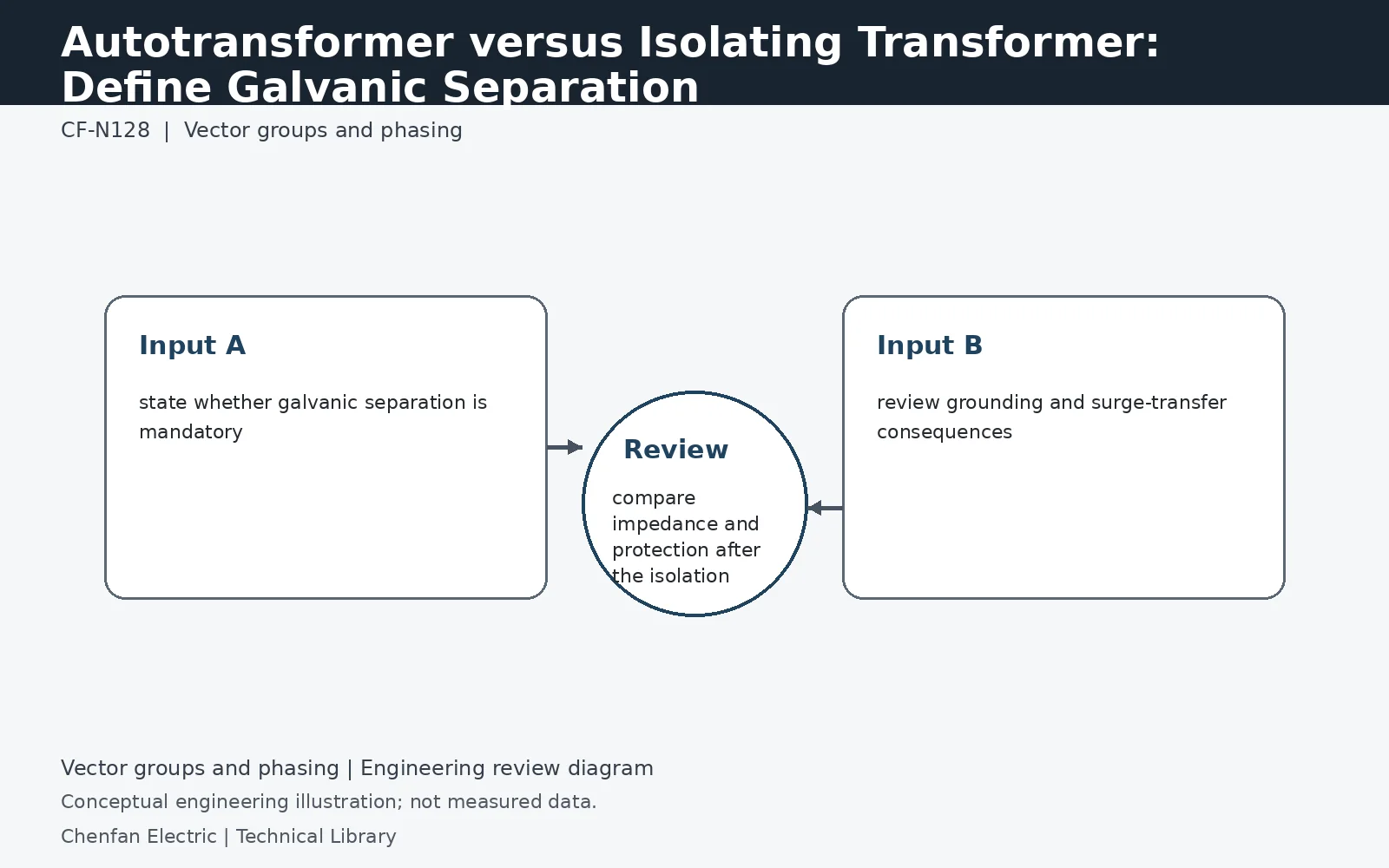
Define what must be electrically separate
An autotransformer transfers power partly through a direct conductive connection and partly by induction. A two-winding isolating transformer does not contain that shared winding connection, although external grounding arrangements can still reference both systems to earth. Specify the required separation between circuits and the applicable insulation tests, not merely the word “isolation.” A two-winding design is not a guarantee that no high-frequency surge can couple across it: interwinding capacitance and the terminal installation also affect transient transfer.
Why close voltage ratios can favor an autotransformer
With relatively close input and output voltages, only part of the terminal power is transformed electromagnetically in the ideal autotransformer representation. This can reduce required winding material and dimensions relative to an isolating design for the same terminal duty. The benefit is not a license to ignore impedance or fault-current consequences. Compare supplier designs at the actual ratio, MVA, tap range and insulation requirements. Do not extrapolate a generic percentage saving from one voltage ratio to a substantially different application.
Review the common electrical path in fault studies
Grounding, zero-sequence behavior, transferred disturbances and differential-protection zones require the autotransformer connection to be represented explicitly. A tertiary may introduce another circuit with a separate duty and insulation basis. For replacement, verify that equipment expected to remain electrically separated is not inadvertently connected through the common winding. Obtain the complete terminal and protection diagrams before comparing commercial offers. If galvanic separation is mandatory, reject a non-isolating alternative on that functional requirement rather than trying to compensate for it with a lower purchase price.
Technical reference framework
[1] IEC 60076-8:1997 — Application guide.
[2] IEEE C57.105-2019 / Cor 1-2023 — Three-phase transformer connections.