

Furnace taps set the available voltage range while electrode control adjusts the arc within it. Map those authorities with travel and network state to choose resolution that supports the feasible process regions. IEEE C57.17-2012 is listed as Inactive-Reserved; use its furnace-transformer scope as a historical reference while specifying the contract acceptance basis. [1]
Calculation basis. Project-specific values and gates in the illustrative screens below are assumptions; cited catalogue values retain their source test conditions.
Define the process target in electrical and operating terms. A desired current, arc power or impedance target can require different feasible regions as the short-network and arc state change. One nominal secondary voltage does not describe that region.
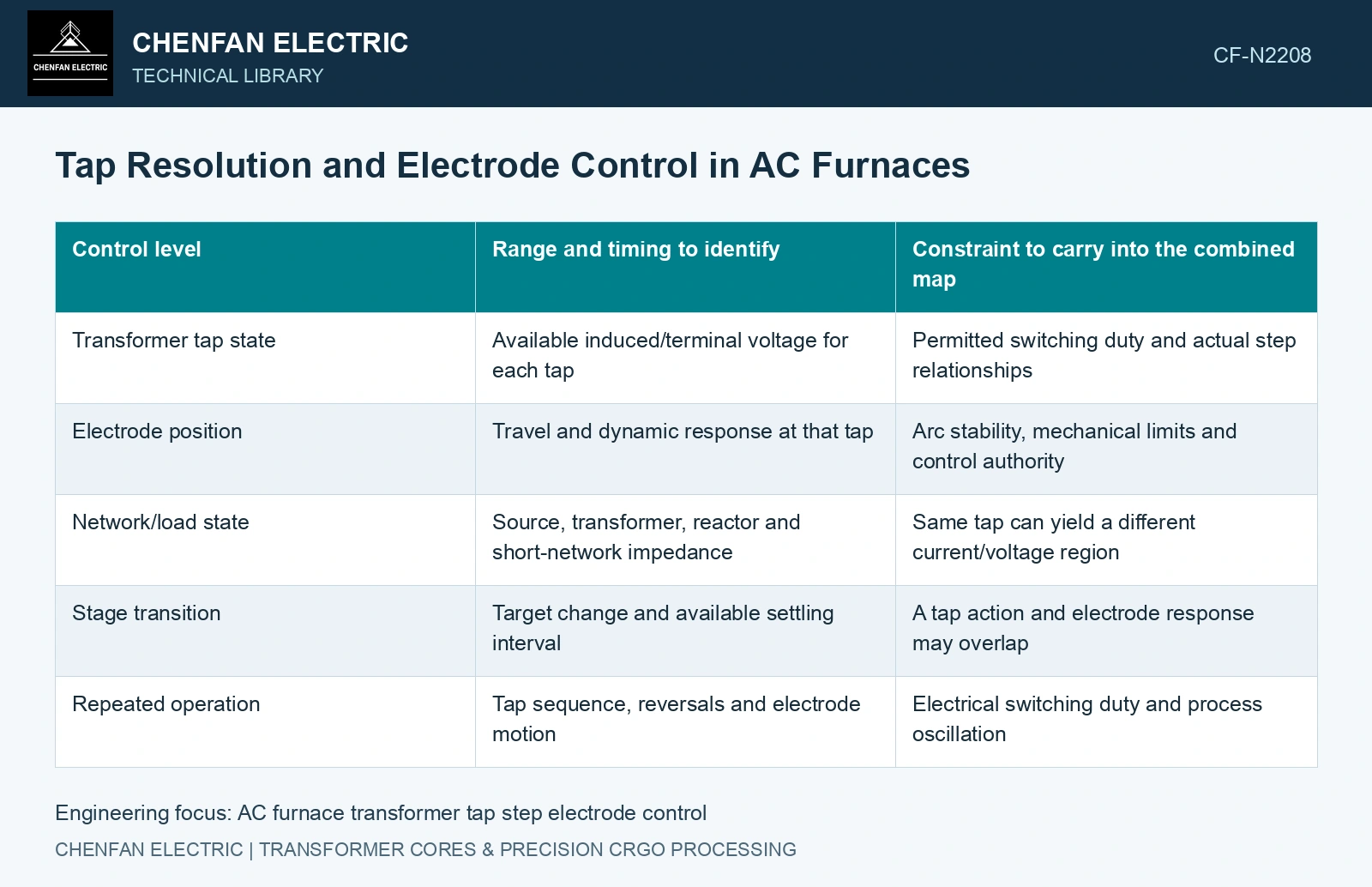
Draw the two-level control range
| Control level | Range and timing to identify | Constraint to carry into the combined map |
|---|---|---|
| Transformer tap state | Available induced/terminal voltage for each tap | Permitted switching duty and actual step relationships |
| Electrode position | Travel and dynamic response at that tap | Arc stability, mechanical limits and control authority |
| Network/load state | Source, transformer, reactor and short-network impedance | Same tap can yield a different current/voltage region |
| Stage transition | Target change and available settling interval | A tap action and electrode response may overlap |
| Repeated operation | Tap sequence, reversals and electrode motion | Electrical switching duty and process oscillation |
Compare reachable process regions across tap states
For each tap, determine the supported process region over the allowed electrode travel and relevant network states. Adjacent regions may overlap, leave a gap or overlap only where another constraint is exceeded. A percentage step table cannot establish those relationships by itself.
In a purely numerical nearest-step voltage comparison, a uniformly spaced step ΔE can leave up to ΔE/2 mismatch inside the covered range. That statement assumes the target is a scalar voltage with no other constraint. It is not a residual furnace-current error or proof that the electrode can absorb the mismatch.
Separate slow range selection from fast correction
Assign each control action its actual response and permitted duty. Tap changes should not be used as an assumed instantaneous correction for every arc disturbance. Electrode travel likewise has a measured response and may reach a limit before the requested process state becomes feasible.
Review how the two controllers interact. A target change or electrode-limit response can trigger repeated tap movements if the logic treats a transient state as a settled range problem. Record commands, actual tap position, electrode motion and process response on the same timeline.
Carry switching consequences into the choice
More available taps do not automatically mean a better operating duty. The actual sequence and current at each operation affect the tap changer, while electrode movement and arc behavior determine process stability. Use device-specific switching evidence when the resolution proposal increases operation frequency.
Identify whether voltage range, electrode travel, dynamic response or network state controls the gap. Qualify that change against feasible process regions and permitted switching duty.
Compare the tap step with the arc-voltage range
Use a common winding-current reference in the electrical calculation [2]. Furnace tap-changer evidence must retain the current and operating history of each switching event [3].
Assume adjacent secondary settings of 400 V and 410 V line-to-line and an operating arc-control band of 5 V on the same defined basis. The 10 V tap step is twice that band. At an assumed unchanged 20 kA RMS line current, the apparent-power step is √3 × 10 V × 20 kA = 0.346 MVA. Coordinate discrete taps with electrode motion at the actual operating point.
References
- IEEE, IEEE C57.17-2012, IEEE Standard Requirements for Arc Furnace Transformers (Inactive-Reserved).
- U.S. Department of Energy, DOE-HDBK-1011/4-92, Electrical Science, Volume 4, 1992.
- S. Rehkopf and L. Kirchner, Furnace Applications in the Upper Performance Segment, Maschinenfabrik Reinhausen, F0407400, June 2022.