

Trace each delivered core packet back to the coil segment and certificate that support its material identity. Preserve the links through splitting, cutting and subcontract processing, so an affected segment can be located in the actual core sets.
Build the physical chain
Follow certificate and tested segment → received coil identity → issued segment → cutting work order → lamination group → delivered packet → core set. Retain each relationship where material is divided or combined. Use identifiers that survive the relevant manufacturing and shipping stages. [1]
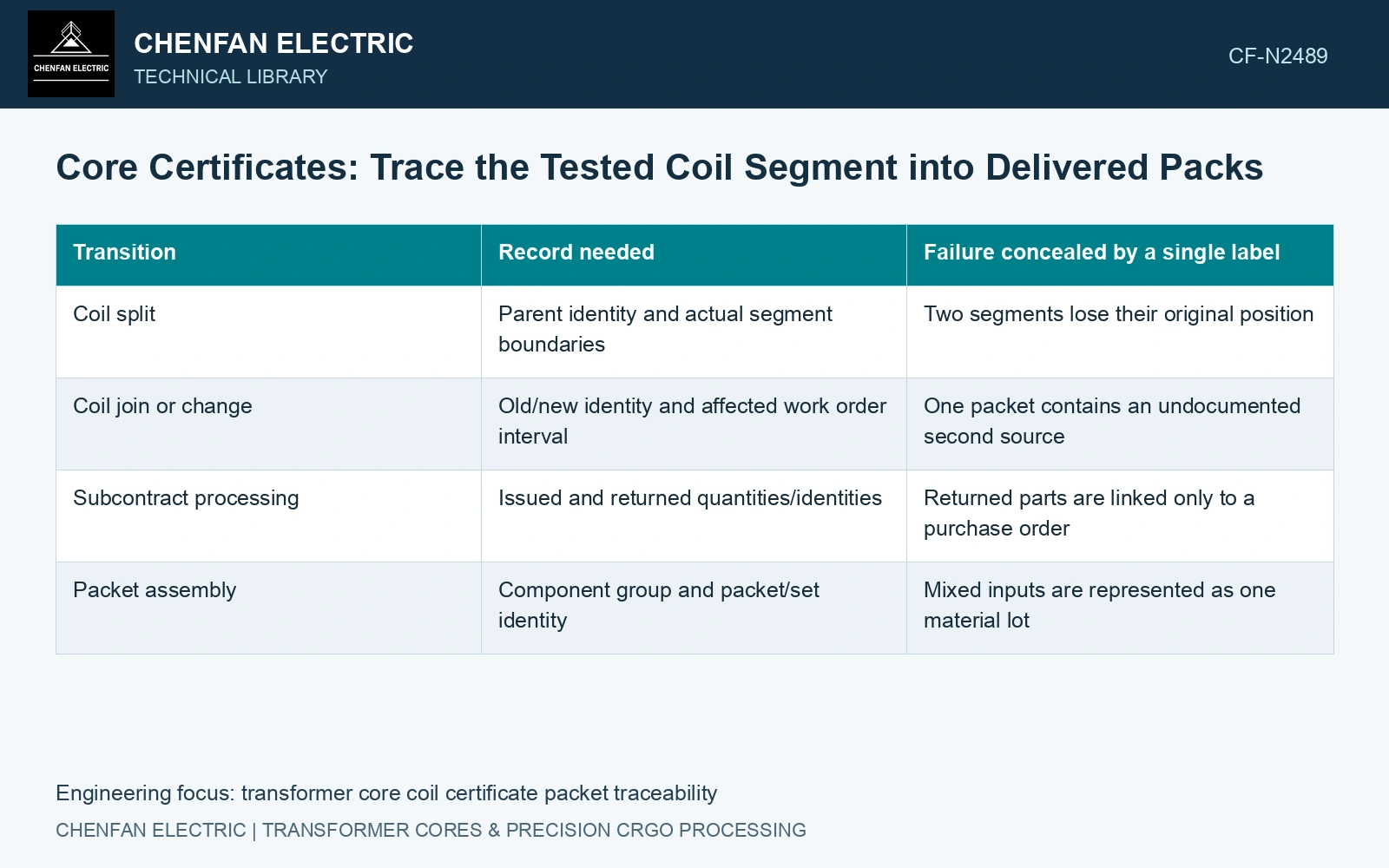
| Transition | Record needed | Failure concealed by a single label |
|---|---|---|
| Coil split | Parent identity and actual segment boundaries | Two segments lose their original position |
| Coil join or change | Old/new identity and affected work order interval | One packet contains an undocumented second source |
| Subcontract processing | Issued and returned quantities/identities | Returned parts are linked only to a purchase order |
| Packet assembly | Component group and packet/set identity | Mixed inputs are represented as one material lot |
Check reconciliation without mistaking it for identity
Compare issued material, returned parts, scrap and remaining stock on a defined mass or quantity basis. A reasonable balance can reveal missing records, but it does not prove that the correct pieces occupy the intended packet. Keep physical identification and quantity reconciliation as complementary checks.
If identification is lost during cutting, define how the controlled process preserves the link and where it is re-established. An operator’s recollection after several work orders is weak evidence for a particular delivered set.
Keep certificate representativeness visible
Record the certificate’s actual sampling and reporting scope. A tested coil segment may represent a declared material population under the mill’s method; it does not mean every cut lamination was individually tested. Retain this limit rather than rewriting the certificate as a finished-core report.
Processing and assembly introduce separate evidence needs. Steelmaker product data describe material properties under stated preparation, while the core manufacturing route adds cut, coating and joint conditions. The material certificate cannot establish those later states.
Resolve exceptions at packet level
For mixed or uncertain packets, identify affected physical positions and hold the traceability disposition open until supported. A replacement packet needs its own source link and revision record. Adding another certificate without identifying the replaced pieces leaves the same gap.
Reconcile the mass while preserving the physical identity
At the catalogue nominal 0.23 mm gauge and assumed density 7.65 kg/dm³ [2], an assumed 400 kg issue corresponds to 400/(7,650 × 0.00023) = 227.34 m² of steel. Assume returned parts weigh 380 kg, scrap 18 kg and remaining stock 2 kg. The balance closes at 400 kg, and part yield is 95%. A perfectly balanced substitution would produce the same totals. Accept the quantity reconciliation only alongside segment-to-work-order and packet identifiers that locate the material in the delivered set.
Cutting nesting, scrap segregation, coil-change records and packet labelling control the traceability chain. Preserve source identity through outsourced cutting and yoke reconstruction.
Verify traceability in both directions: from a delivered packet to its source records, and from a suspect segment to every affected set. Use that graph for containment, then retain cutting, coating, joint and assembled-core evidence as the separate records needed for the later manufacturing states.
References
- NASA, NASA Systems Engineering Handbook, section 6.5, Configuration Management, official online text.
- Nippon Steel Corporation, Grain-Oriented Electrical Steel Sheets, catalogue D004je, April 2020, specification tables, size tolerances and Annealing by Customers.