

Compare core-loss guarantees on a defined test object, mass basis and excitation condition. Material watts per kilogram and assembled-core total watts describe different obligations; align those bases before procurement ranks the offers or accepts a performance commitment.
Put the guarantee beside its physical object
Identify whether the result belongs to a prepared sheet specimen, a model core, a completed magnetic assembly or an entire transformer. Record the material treatment and assembly state represented. Tests at these levels answer different questions, even when their reported units can be made to look alike. [1]
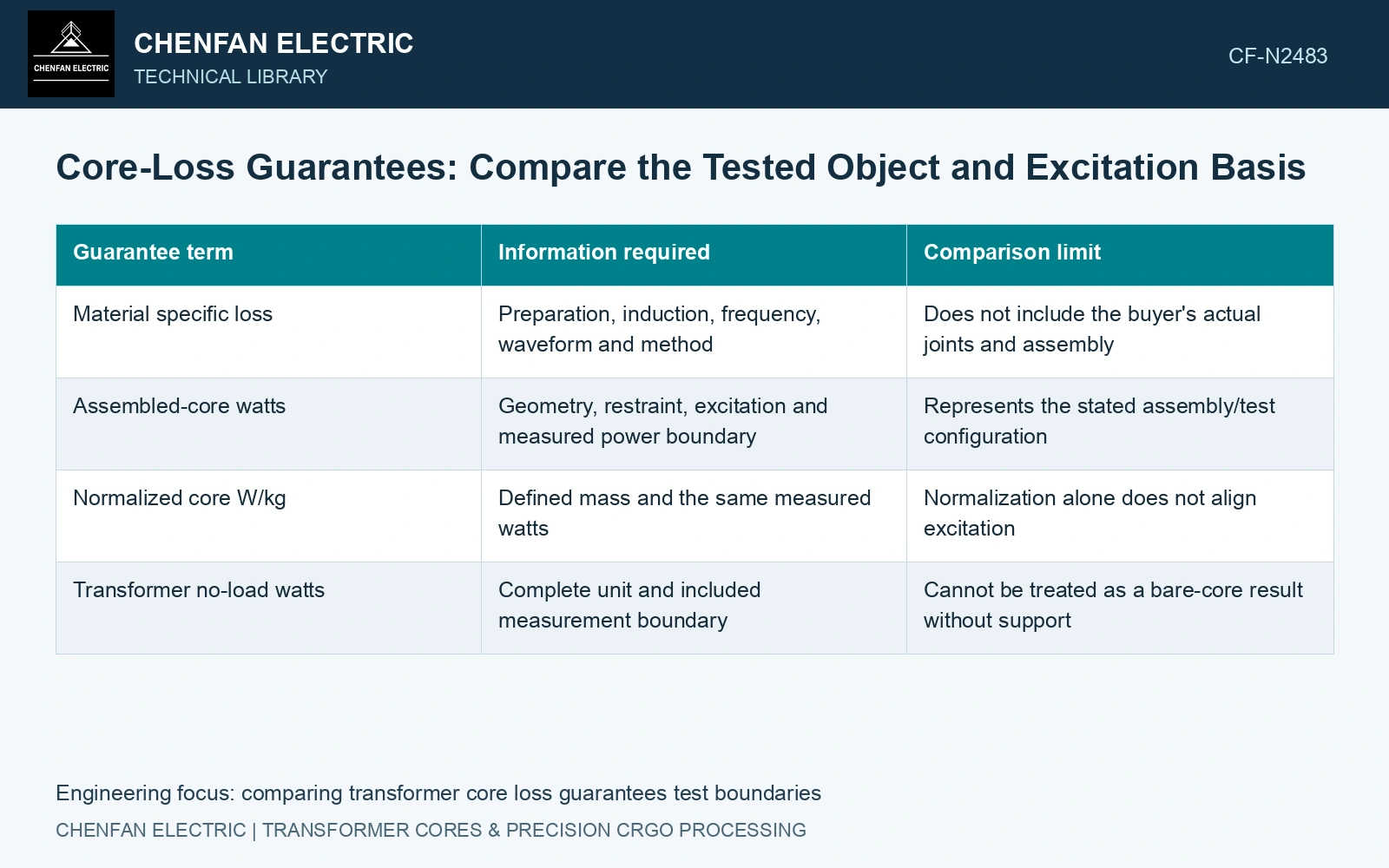
| Guarantee term | Information required | Comparison limit |
|---|---|---|
| Material specific loss | Preparation, induction, frequency, waveform and method | Does not include the buyer’s actual joints and assembly |
| Assembled-core watts | Geometry, restraint, excitation and measured power boundary | Represents the stated assembly/test configuration |
| Normalized core W/kg | Defined mass and the same measured watts | Normalization alone does not align excitation |
| Transformer no-load watts | Complete unit and included measurement boundary | Cannot be treated as a bare-core result without support |
Align the electrical conditions
Compare frequency, actual voltage waveform, excitation winding and how the stated induction is derived from turns and effective section. A nominal supply setting does not establish equal flux conditions. Differences in waveform or section assumptions can prevent direct ranking at an apparently common induction.
Retain instrument corrections and uncertainty relevant to the low-power measurement. A guarantee limit, an individual result and its uncertainty are separate entries; one should not be substituted for another.
Show the bias introduced by a changed mass denominator
For catalogue 23ZH90, 0.90 W/kg is a material maximum at 1.7 T and 50 Hz under its specified specimen preparation [2]. Assume a core test produces 1,000 W at those nominal excitation conditions and contains 1,000 kg of electrical steel plus a 50 kg fixture. Steel-only normalization gives 1.000 W/kg; including the fixture gives 1,000/1,050 = 0.9524 W/kg, 4.76% lower without changing watts. Reject that denominator change as evidence of a material-efficiency improvement. Preserve the actual assembly and measurement boundary, then compare its own guarantee and uncertainty [3].
Steel weighing, fixture tare, joint state and final clamp configuration control the reported core result. A material limit supplies no universal material-to-core building factor.
Request a matched test for any comparison whose object, mass or excitation basis remains incompatible. Where separate tests are appropriate, retain separate guarantee obligations and acceptance evidence, with the valid conversions documented beside the results.
References
- NASA, NASA Systems Engineering Handbook, section 6.5, Configuration Management, official online text.
- Nippon Steel Corporation, Grain-Oriented Electrical Steel Sheets, catalogue D004je, April 2020, specification tables, size tolerances and Annealing by Customers.
- B. N. Taylor and C. E. Kuyatt, NIST Technical Note 1297, Guidelines for Evaluating and Expressing the Uncertainty of NIST Measurement Results, 1994, sections 5 and 6.