

Control a temporary design deviation through its affected population, technical conditions and verified end state. Keep the approved departure linked to the baseline and to every unit or part that carries it.
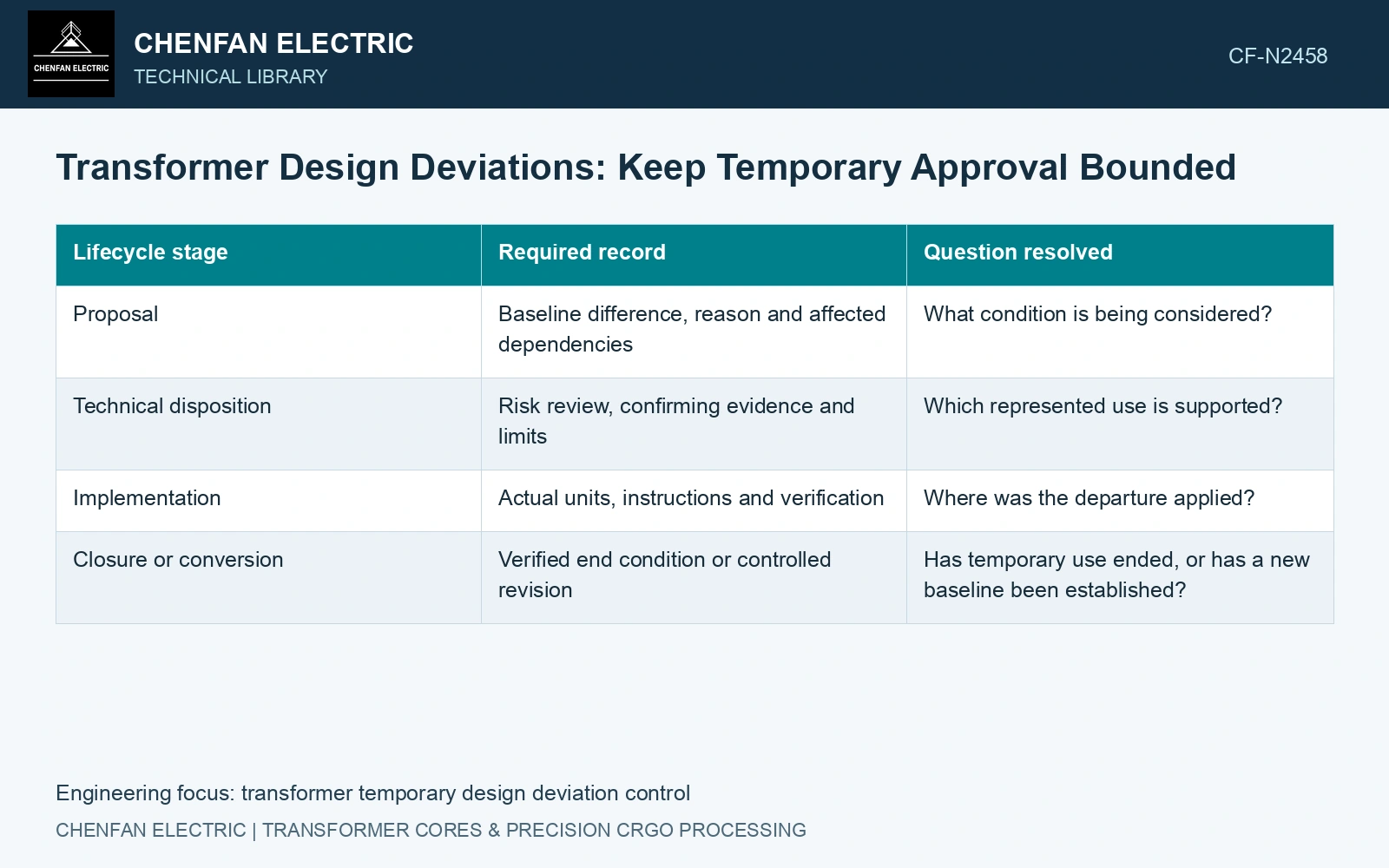
Describe the departure precisely
Compare the proposed condition with the controlled baseline at the affected feature. Record material, geometry, process or test differences in terms an independent reviewer can verify. Phrases such as equivalent substitute or minor adjustment leave the actual technical departure undefined. [1]
Assign coverage by serial number, batch or another unambiguous population identifier. Add quantity and time limits where they govern use, but do not treat a date alone as proof of physical restoration. Identify unfinished work, spare parts and replacement components that could carry the departure beyond its intended scope.
| Lifecycle stage | Required record | Question resolved |
|---|---|---|
| Proposal | Baseline difference, reason and affected dependencies | What condition is being considered? |
| Technical disposition | Risk review, confirming evidence and limits | Which represented use is supported? |
| Implementation | Actual units, instructions and verification | Where was the departure applied? |
| Closure or conversion | Verified end condition or controlled revision | Has temporary use ended, or has a new baseline been established? |
Keep compensating evidence attached
If a departure changes a consequential interface, name the additional observation or verification needed for that interface. An unrelated successful test does not compensate for a missing mechanical, dielectric or thermal assessment. Record who owns the unresolved evidence and what equipment remains affected. [1]
Review any compensating restriction together with the supported operating or assembly condition. A restriction written in an engineering note but absent from the relevant controlled records may not reach the people implementing it. The disposition needs a traceable path to the actual unit.
Verify the end condition
Closure can require confirmed restoration, exhaustion and segregation of affected stock, or another specifically defined end state. Check the physical outcome and the associated drawings, instructions and unit records. A closed ticket does not demonstrate that every affected part has been corrected. [1]
If continued use is desired, review it as a permanent change with the evidence and baseline updates that entails. Do not repeatedly extend a temporary record to avoid reassessing its accumulating scope. Retain the earlier limited approvals as historical unit evidence rather than rewriting them as unlimited qualification.
Bound a deviation with a numerical acceptance check
Assumptions: the qualified joint requires 25 kN preload with a permitted ±10% range, and the proposed temporary hardware produces 28 kN in its representative test. The allowed interval is 22.5–27.5 kN; the measured value exceeds its upper end by 0.5 kN. A limited serial-number range does not cure that technical departure. Obtain a supported joint assessment or revise the hardware before issuing approval. Configuration control records the affected units and disposition [1]; measurement uncertainty remains part of the conformity decision [2].
Use baseline control, change records and physical verification to show the departure and its closure, following the structure described in NASA’s configuration guidance. Present that traceable lifecycle to the applicable project acceptance authorities with any remaining affected equipment identified.
References
- NASA, NASA Systems Engineering Handbook, section 6.5, Configuration Management, official online text.
- B. N. Taylor and C. E. Kuyatt, NIST Technical Note 1297, Guidelines for Evaluating and Expressing the Uncertainty of NIST Measurement Results, 1994, sections 5 and 6.