

Trace every revised rating-plate value to its qualified configuration. Cooling state, tap range, voltage and frequency conditions must remain connected when individual ratings are presented together.
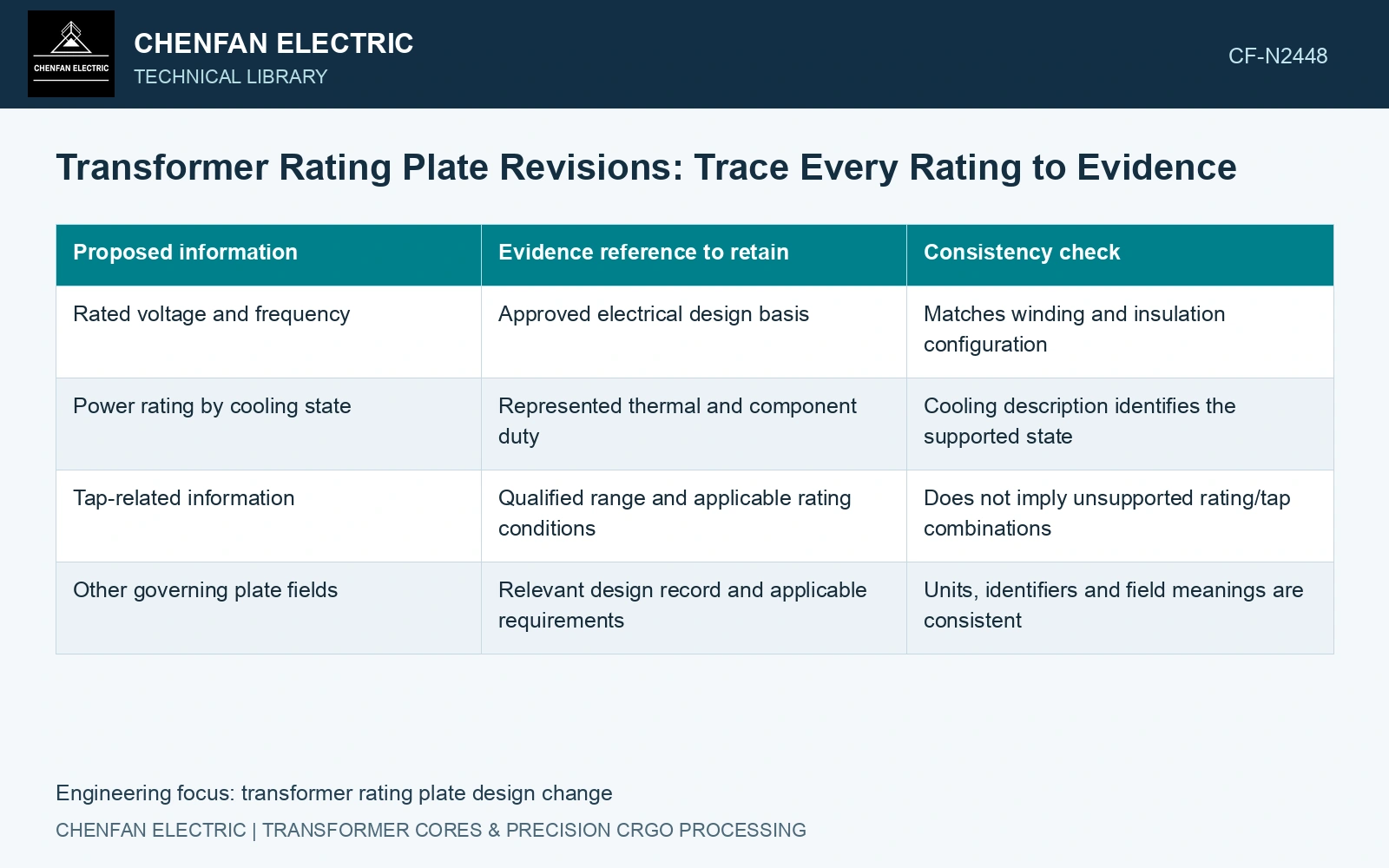
Start with the engineering configuration register
Identify the design revision and the conditions attached to each proposed rating: frequency, voltage basis, tap range, cooling state and any other consequential duty assumptions. Keep the source calculation or test reference beside the value it supports. A later drawing update should not break that connection. [1]
All numerical inputs in this comparison are assumptions. For an illustrative document case, call two supported cooling configurations A and B. If a rating is qualified in A and a separate tap endpoint is evaluated in B, their combination A-at-that-endpoint remains an open question unless the evidence covers it. Neither value becomes invalid simply because the combination is unresolved.
| Proposed information | Evidence reference to retain | Consistency check |
|---|---|---|
| Rated voltage and frequency | Approved electrical design basis | Matches winding and insulation configuration |
| Power rating by cooling state | Represented thermal and component duty | Cooling description identifies the supported state |
| Tap-related information | Qualified range and applicable rating conditions | Does not imply unsupported rating/tap combinations |
| Other governing plate fields | Relevant design record and applicable requirements | Units, identifiers and field meanings are consistent |
Keep restrictions readable in their proper place
Determine which information the governing requirements place on the rating plate and which belongs in the operating documentation. Do not attempt to solve every condition by adding a dense engineering paragraph to the plate. At the same time, a restriction hidden in an unrelated document can make a prominently displayed rating ambiguous. [1]
Cross-check plate wording, drawings, test reports and operating information as a set. A cooling-state label should refer to the same configuration in all four. If an operational limitation is essential to interpreting a rating, preserve a clear, controlled connection to it.
Separate data revision from approval status
A successful thermal result can support one represented duty but does not authorize unrelated plate claims. Conversely, an unchanged field can retain its established evidence when the design revision leaves its dependencies represented. Record both cases rather than describing every field as newly qualified. [1]
Use only markings and claims whose approval basis has actually been established for the equipment. A revised layout or a document template cannot create that status. The public temperature-rise catalogue describes the scope of thermal testing; it does not decide rating-plate content for every market.
Check the current implied by a larger displayed rating
Assumptions: a three-phase 11 kV line-to-line winding was qualified at 10 MVA and is proposed for a 12.5 MVA plate entry at the same voltage. I = S/(√3V) gives 524.86 A and 656.08 A, respectively, a 25% rise. Keeping resistance constant would increase that winding’s I²R contribution by 56.25%. The old thermal result therefore needs a coverage assessment at the proposed cooling state [2]; a revised plate value alone cannot establish the new current duty. Link the supported combination to its controlled configuration [1].
Release the rating plate with its configuration register and synchronized drawing, test and operating-document revisions. Check each displayed combination against its supporting evidence, and keep essential restrictions readable through the controlled documentation link.
References
- NASA, NASA Systems Engineering Handbook, section 6.5, Configuration Management, official online text.
- IEC, IEC 60076-2:2011, Power transformers — Part 2: Temperature rise for liquid-immersed transformers.