

Compare a new insulation supplier in the processed winding system. Thickness and thermal designation are starting data; compression, shrinkage, impregnation and interfaces determine whether the substitute preserves the qualified assembly.
Match the meaning of each reported value
Request the test method, specimen conditioning, orientation, sample count and reporting basis behind both suppliers’ values. A minimum, a typical value and the average from one lot answer different questions. Converting units does not make those three reporting bases equivalent.
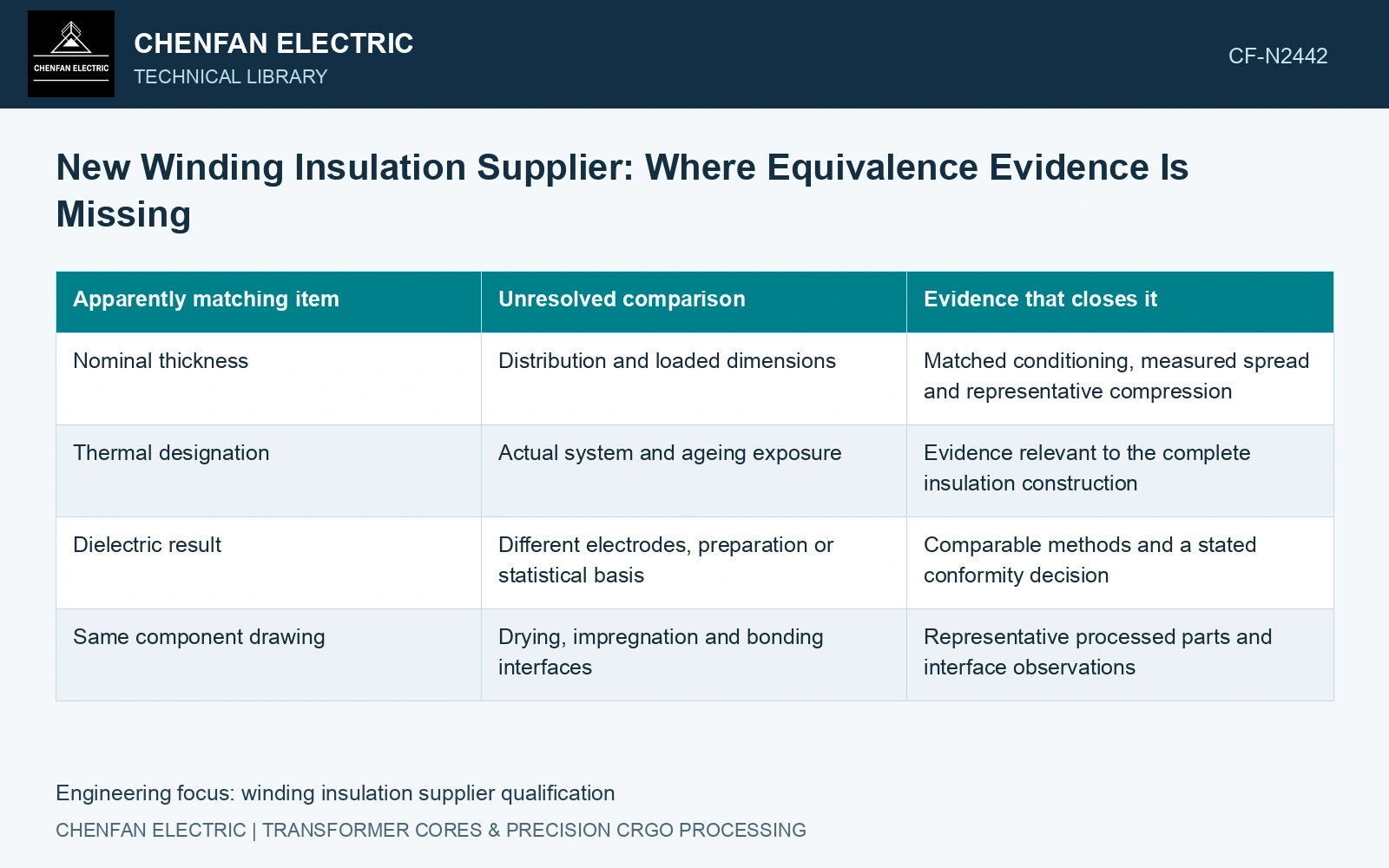
| Apparently matching item | Unresolved comparison | Evidence that closes it |
|---|---|---|
| Nominal thickness | Distribution and loaded dimensions | Matched conditioning, measured spread and representative compression |
| Thermal designation | Actual system and ageing exposure | Evidence relevant to the complete insulation construction |
| Dielectric result | Different electrodes, preparation or statistical basis | Comparable methods and a stated conformity decision |
| Same component drawing | Drying, impregnation and bonding interfaces | Representative processed parts and interface observations |
Qualify the material where it touches the process
Use parts that represent consequential thicknesses, edges, machined features and contact surfaces. A flat coupon may characterize a material property while missing a folded edge, adhesive interface or loaded spacer stack. Identify which assembly feature each specimen represents.
Track dimensions before and after the qualified process, along with the moisture or other conditioning evidence appropriate to that material. A substitute that reaches the same nominal endpoint through a different shrinkage history can alter clearances or contact pressure. Process compatibility therefore needs its own record rather than being inferred from an incoming dielectric test.
Keep lot variability visible
A successful first lot is evidence for the tested population. It does not establish the supplier’s entire production distribution. Plan the sampling coverage around the property that controls the design, distinguishing within-lot variation from differences between lots. Retain the actual material identity so that a later process adjustment cannot silently extend the qualified population.
State which old results remain applicable and why. Unchanged geometry may preserve one dimensional calculation, while altered compressive behaviour affects preload and support. Similarly, a material-level electrical result cannot replace verification of an interface it did not include.
Propagate processed spacer shrinkage into the stack
Assumptions: a winding has 20 axial spacers initially 5.0 mm thick. Under the same processing and load, source A retains 4.90 mm each and source B 4.75 mm. Their stack contributions are 98.0 and 95.0 mm, a 3.0 mm difference. Recheck preload and end clearance; incoming thickness does not establish processed equivalence. IEC 60243-1 covers solid-material power-frequency strength tests [1], not this loaded stack. IEC 60505 concerns the insulation system [2]; the changed interfaces need corresponding evidence.
Give procurement the demonstrated equivalences, unresolved differences and conditions of approval for the supplied sheet, processed part and winding assembly. Require the controlling interface or lot-coverage evidence before extending approval beyond the population tested.
References
- IEC, IEC 60243-1:2013, Electric strength of insulating materials — Test methods — Part 1: Tests at power frequencies.
- IEC, IEC 60505:2011, Evaluation and qualification of electrical insulation systems.