

Interpret a normal post-fault result against the defect signature the test was designed to detect. Its connections, excitation and physical state determine which persistent faults it constrains and which transient histories need other evidence. [1]
Define what the test could detect
State the measured property, connections, excitation, temperature, tap position and processing. Identify the proposed defect’s expected effect on that property. Without that link, normal becomes a broad adjective rather than an evidentiary result.
A defect may depend on voltage, temperature, vibration or mechanical position not reproduced after shutdown. Fault movement may remove a contact, and an arc may destroy the conductive path that initially formed.
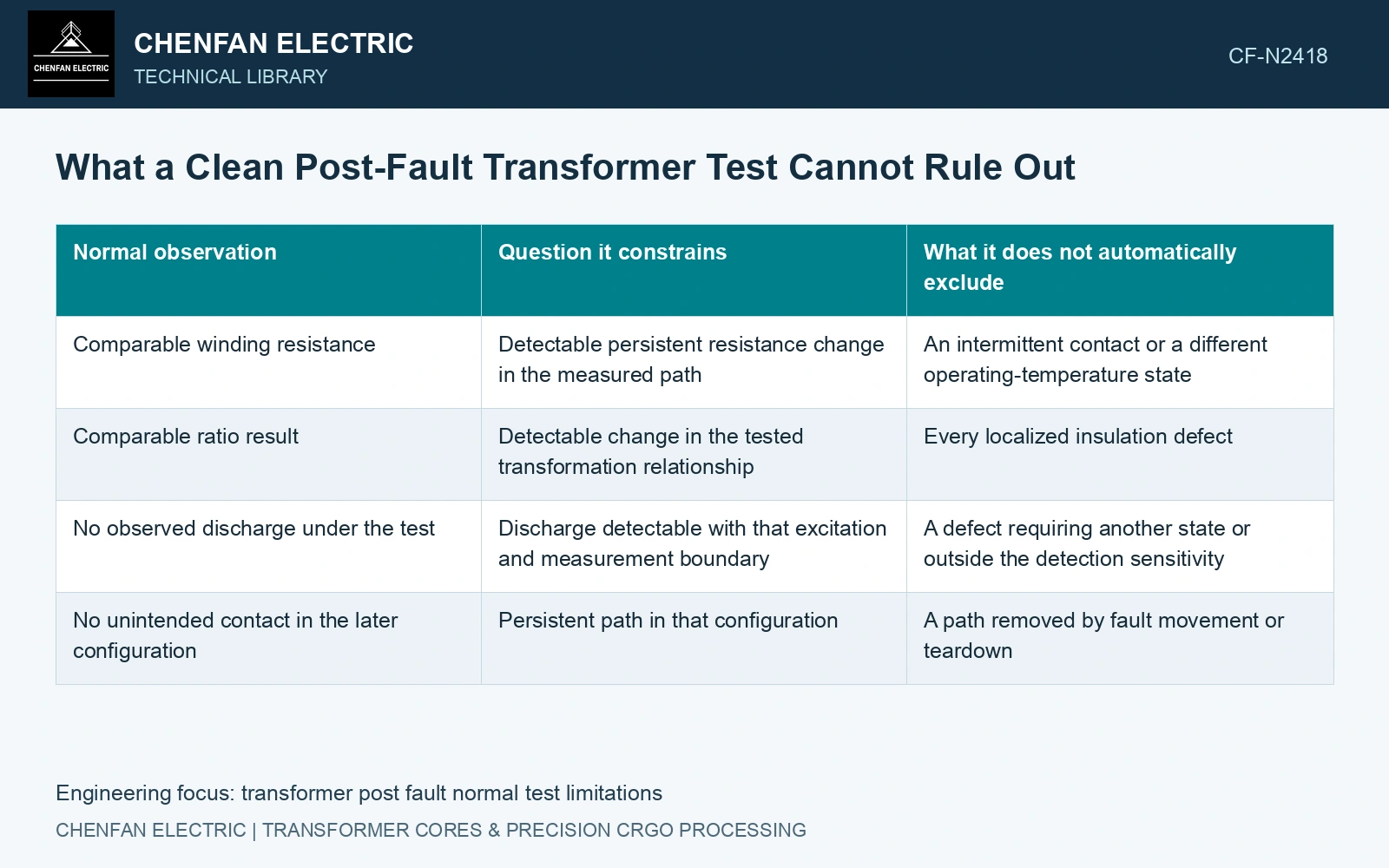
Use a negative-test interpretation table
| Normal observation | Question it constrains | What it does not automatically exclude |
|---|---|---|
| Comparable winding resistance | Detectable persistent resistance change in the measured path | An intermittent contact or a different operating-temperature state |
| Comparable ratio result | Detectable change in the tested transformation relationship | Every localized insulation defect |
| No observed discharge under the test | Discharge detectable with that excitation and measurement boundary | A defect requiring another state or outside the detection sensitivity |
| No unintended contact in the later configuration | Persistent path in that configuration | A path removed by fault movement or teardown |
Compare like with like
Historical comparisons can be invalid when connections, tap position or temperature differ. The Bureau of Reclamation guide emphasizes consistent winding-resistance connections and as-found tap records. Apparent normality after a changed arrangement may not test the earlier condition.
Record interventions before the test: oil treatment, component movement, cleaning, disconnection or replacement. Those changes may eliminate an observable signature without disproving its earlier presence.
NASA’s failure-analysis presentation notes that severe damage can remove the original failure evidence [2]. A normal test of the surviving configuration must therefore be compared with the persistent signature the hypothesis requires, not with an assumed unchanged accident state.
Test the signature required by the hypothesis
Assume explanation A requires a permanent 2% turns-ratio change in the tested winding, and a correctly matched post-fault comparison resolves differences only above an assumed 0.5%. An unchanged result meaningfully constrains A. It does not equally constrain explanation B, an intermittent path destroyed by the event. Document the sensitivity and changed state before updating either explanation.
Use the result to update a defined hypothesis
Suppose a hypothesis requires a permanent shorted section that would produce a measurable ratio change in the tested winding. A well-controlled unchanged result can weaken that hypothesis. It does not equally weaken a hypothesis involving a transient insulation path that burned away.
The distinction is mechanism-specific. Avoid turning one successful test into a global no-defect conclusion or, in the opposite direction, dismissing all normal results as meaningless.
References
- U.S. Bureau of Reclamation, FIST Volume 3-31, Transformer Diagnostics, June 2003.
- L. Ochs, NASA Goddard Space Flight Center, Basics of Failure Analysis, NASA Parts 101, December 4, 2024.