

Sample transformer paper to separate accident alteration from earlier deterioration. Charred material near the fault and preserved material elsewhere represent different locations and exposures, even when both aging and fault heating occurred in the same unit. [1]
Make location part of the laboratory result
Record winding, elevation, radial position, conductor relationship and visible damage zone for each sample. A result labeled transformer paper discards the geometry needed to interpret it.
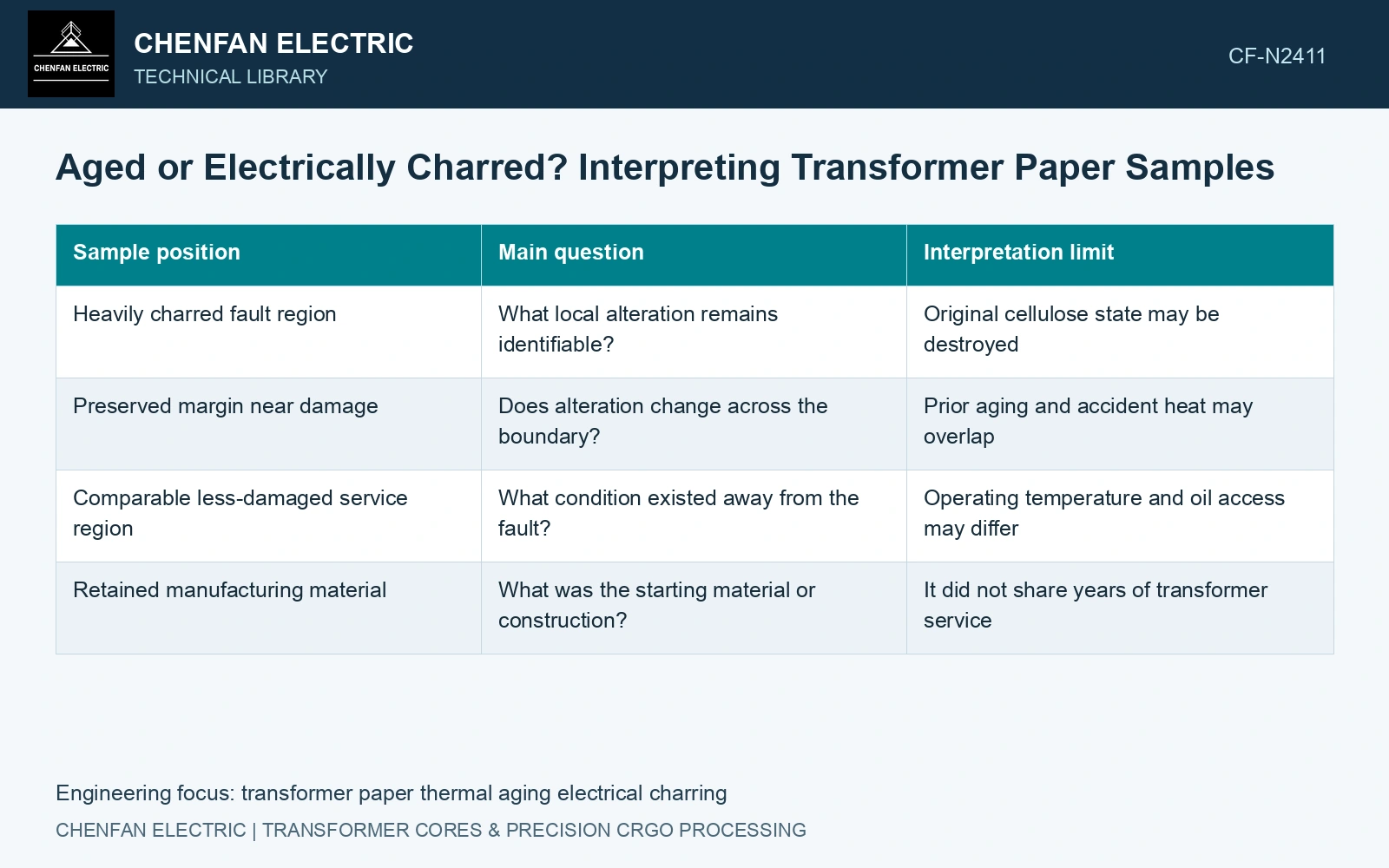
Plan samples across preserved and altered regions. An unaffected-looking area adjacent to the fault may share the same service exposure but still have received accident heat. A more distant comparison may avoid that heat while differing in original operating temperature.
| Sample position | Main question | Interpretation limit |
|---|---|---|
| Heavily charred fault region | What local alteration remains identifiable? | Original cellulose state may be destroyed |
| Preserved margin near damage | Does alteration change across the boundary? | Prior aging and accident heat may overlap |
| Comparable less-damaged service region | What condition existed away from the fault? | Operating temperature and oil access may differ |
| Retained manufacturing material | What was the starting material or construction? | It did not share years of transformer service |
Combine material condition with spatial pattern
Degree of polymerization characterizes the sampled cellulose’s molecular chain length under the stated analytical method. The Bureau of Reclamation guide describes chain deterioration from heat, acids, oxygen and water. That finding does not identify which one caused a particular sample’s condition.
A spatial gradient can support localized exposure, but the gradient must be evaluated against the original cooling and insulation arrangement. Broad aging is not necessarily uniform, and local heating can precede an electrical accident.
Use microscopy, material chemistry and documented physical condition as complementary observations. They should answer defined questions rather than become a list of laboratory numbers attached to one preferred explanation.
The water-content review identifies moisture as an ageing influence and distinguishes the oil and paper inventories [2]. Reconstruct that exposure for preserved comparison samples; a contemporaneous oil-water result cannot by itself date the cellulose damage or represent each local paper region.
Keep the destroyed specimen outside a bulk-life claim
Assume the only collected paper is charred at the arc path while all distant insulation remains unsampled. The evidence covers that altered region and provides no direct sampled chain-length value for the retained population. Obtain preserved, position-matched material before estimating wider insulation condition; accident alteration cannot be treated as an unbiased service-age sample.
Keep oil markers at their own scale
Furan results describe compounds in sampled oil and reflect transport, oil history and cellulose processes. They are not a direct measurement of the precise paper specimen later removed. Oil treatment and accident contamination can change the relationship.
References
- U.S. Bureau of Reclamation, FIST Volume 3-31, Transformer Diagnostics, June 2003.
- S. R. Arsad et al., Water Content in Transformer Insulation System: A Review on the Detection and Quantification Methods, Energies 16, 1920, 2023. DOI: 10.3390/en16041920.