

Trace a suspected shipping contribution from the recorded transport event to the failed feature. The logger response, mechanical load path, resulting damage and later deterioration form separate links, each with evidence to establish. [1]
The proposed explanation needs several links: the recorded event represented a load on the transformer, that load reached a vulnerable feature, damage was created, and the damage developed into the later failure. Each link can have different evidence and uncertainty.
Translate the record into a mechanical question
Identify logger location, axes, mounting, measurement range and event-processing behavior. A sensor on packaging records its local response. It does not directly measure force in a winding support or lead connection.
Map restraints, support interfaces and the transport configuration. The mechanical load path must connect the measured region to the proposed damaged component. A high local acceleration without that connection is a clue rather than an internal stress calculation.
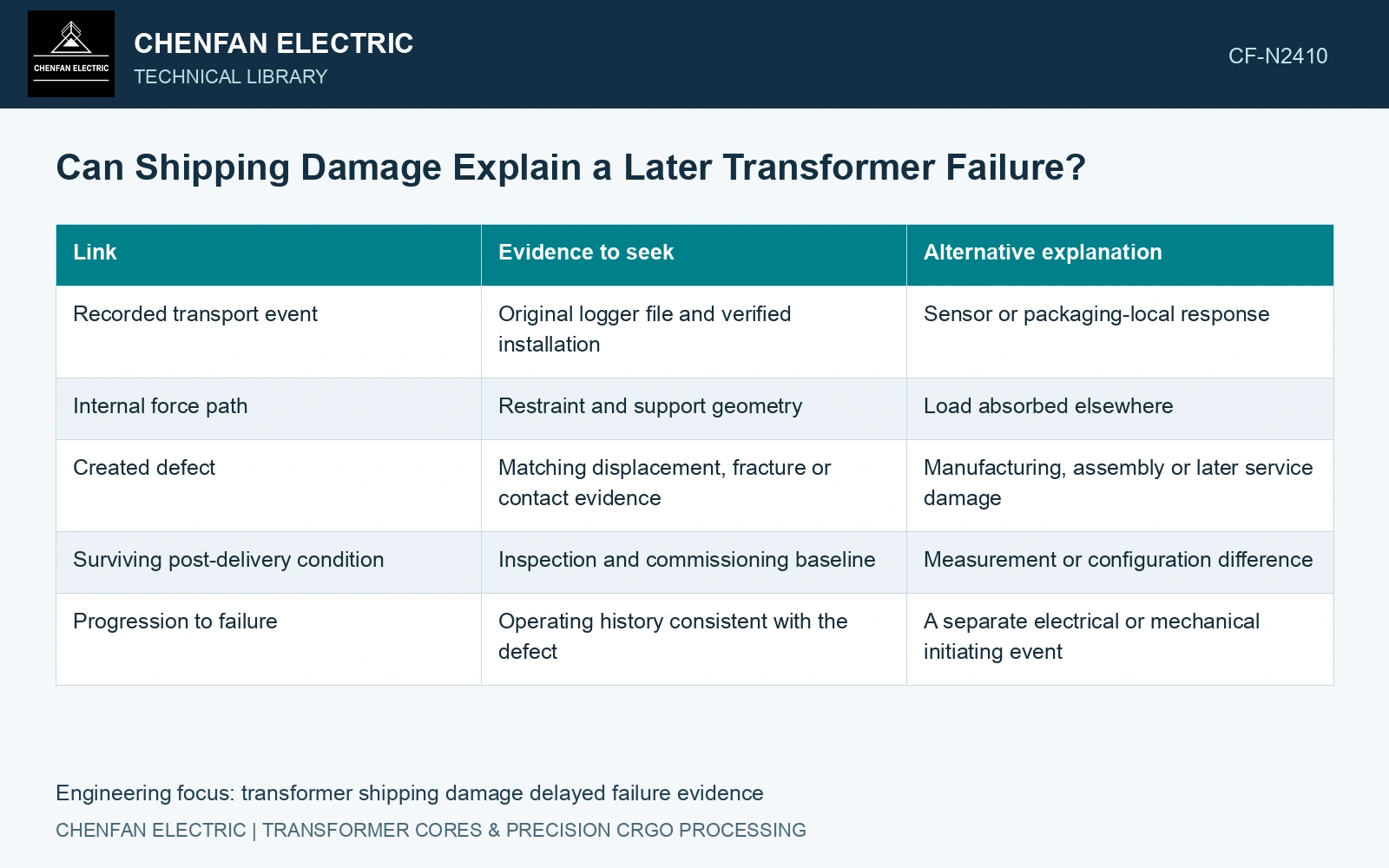
Build the causal chain
| Link | Evidence to seek | Alternative explanation |
|---|---|---|
| Recorded transport event | Original logger file and verified installation | Sensor or packaging-local response |
| Internal force path | Restraint and support geometry | Load absorbed elsewhere |
| Created defect | Matching displacement, fracture or contact evidence | Manufacturing, assembly or later service damage |
| Surviving post-delivery condition | Inspection and commissioning baseline | Measurement or configuration difference |
| Progression to failure | Operating history consistent with the defect | A separate electrical or mechanical initiating event |
Read commissioning tests within their sensitivity
A measurable change between factory and commissioning records can support a changed condition, provided the test arrangements and processing are comparable. A clean commissioning result does not exclude every localized transport defect. It excludes only changes detectable by that test under those conditions.
Record storage, installation and subsequent maintenance as additional opportunities for change. If the transformer moved through several custody stages without comparable observations, the exact time of damage may remain unresolved.
The pylon investigation ties fracture interpretation to load history and preserves relevant surfaces [2]. Apply that evidence discipline to the proposed shipping damage: retain opposing marks and original orientation, and distinguish accident features from surfaces changed during examination.
Translate a logger pulse only at its supported boundary
Assume a calibrated logger records 5 g at its mounting point, take g = 9.81 m/s² for this illustration, and assume a justified rigidly coupled 100 kg mass. The local inertial force scale is 4.905 kN. Winding-support force needs the intervening restraints and dynamics; without that path, the calculation cannot link the shipping event to a later internal failure.
Look for a mechanically consistent failed feature
Compare the observed fracture or displacement with the proposed force direction and constraints. Damage pointing to a different load path weakens the hypothesis. A later internal fault may also deform the same support, so final geometry alone cannot date the damage.
References
- U.S. Bureau of Reclamation, FIST Volume 3-31, Transformer Diagnostics, June 2003.
- J. A. Newman, R. S. Piascik and R. A. Lindenberg, Failure Analysis of a Helicopter External Fuel-Tank Pylon, NASA/TM-2002-211645 and ARL-TR-2711, April 2002.