

Trace the collection and contamination history of post-fault transformer oil before using its chemistry to explain service condition. Firewater, rain, cleaning liquids, storage and damaged seals can change what reaches the laboratory. [1]
The relevant question is not simply whether the laboratory result is accurate. It is whether the material tested represents the condition used in the proposed explanation.
Give each sample a history
Record recovery location, elevation or depth, compartment, time and the interventions that preceded collection. Note whether the oil was taken from a relatively undisturbed region, a drained mixture or an external containment area. Those are different sample populations.
Identify known external liquids and retain their identity where practical for laboratory comparison. An unknown cleaner cannot be corrected by subtracting a guessed percentage from the transformer result.
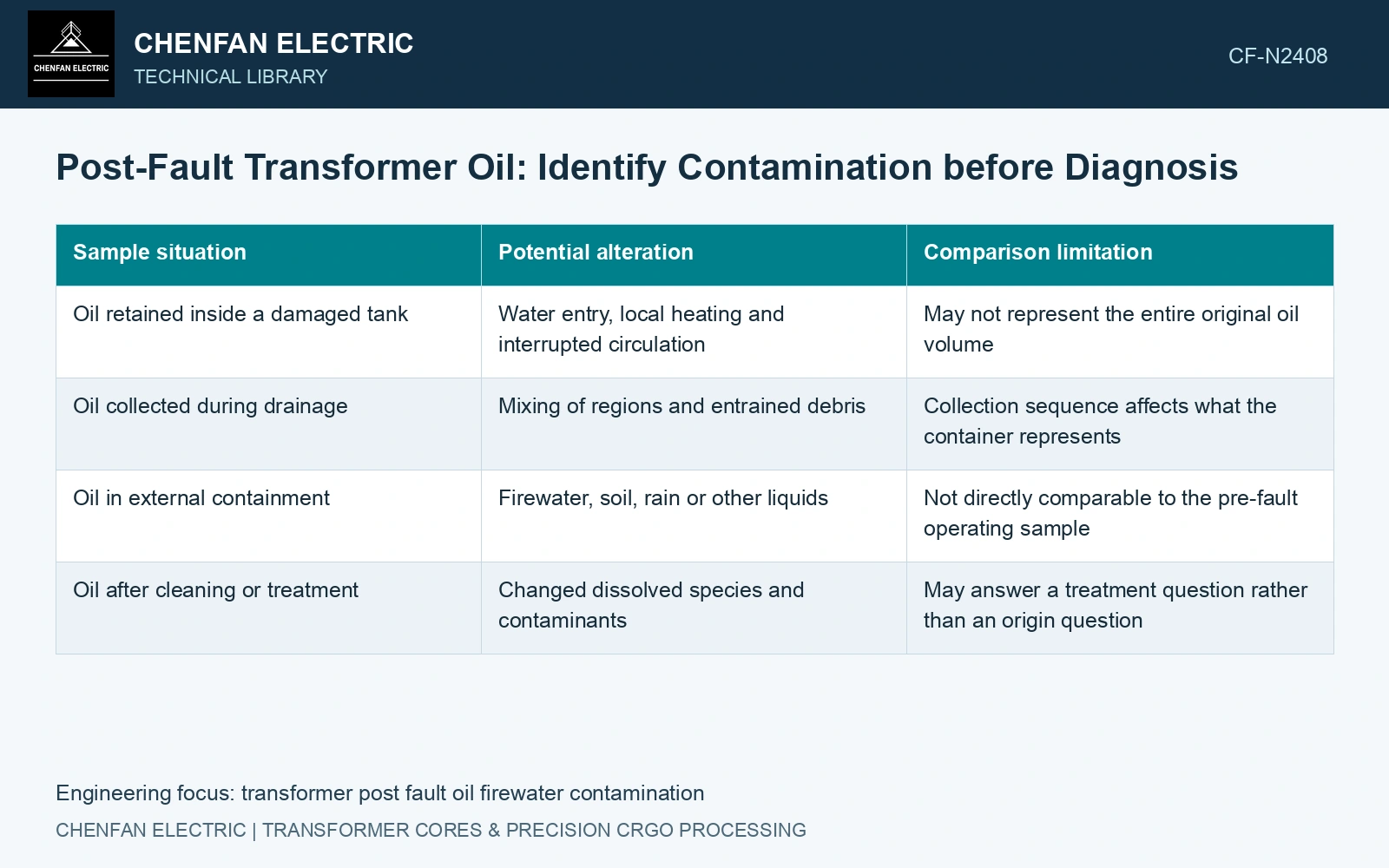
| Sample situation | Potential alteration | Comparison limitation |
|---|---|---|
| Oil retained inside a damaged tank | Water entry, local heating and interrupted circulation | May not represent the entire original oil volume |
| Oil collected during drainage | Mixing of regions and entrained debris | Collection sequence affects what the container represents |
| Oil in external containment | Firewater, soil, rain or other liquids | Not directly comparable to the pre-fault operating sample |
| Oil after cleaning or treatment | Changed dissolved species and contaminants | May answer a treatment question rather than an origin question |
Check phase separation and mixing conditions
Separate liquid phases, suspended matter and local deposits can make results depend strongly on the sampling position and laboratory preparation. A simple dilution equation requires known initial volumes, a conserved analyte and a sufficiently mixed system. These conditions cannot be assumed after a fire.
Even where a dilution estimate is defensible for one analyte, it does not restore every diagnostic quantity. Water distribution between oil and cellulose, gas loss and newly generated decomposition products follow different processes.
The water-content review distinguishes oil and cellulose inventories and temperature-dependent transfer [2]. Post-fire oil dilution therefore cannot reconstruct paper moisture from one liquid concentration; establish medium, distribution and prior temperature separately.
Apply dilution only when its assumptions hold
Assume a conserved tracer initially at 100 mg/L in 1 L oil is mixed uniformly with 1 L verified tracer-free compatible liquid, with additive volumes. The ideal mixture is 50 mg/L. Phase separation, decomposition and gas escape violate that premise for many post-fire quantities. Identify the actual populations before applying a correction.
Compare only commensurate records
Use the pre-fault oil history as a separate evidence stream. Record analytical method, sampling location and oil treatment between dates. A difference between old and new results may reflect the fault, response work, treatment or sampling differences.
References
- U.S. Bureau of Reclamation, FIST Volume 3-31, Transformer Diagnostics, June 2003.
- S. R. Arsad et al., Water Content in Transformer Insulation System: A Review on the Detection and Quantification Methods, Energies 16, 1920, 2023. DOI: 10.3390/en16041920.