

Map debris where it was recovered before proposing a parent component. Treat arc transport, oil movement, gravity and drainage as candidate routes to check against the actual geometry and recovery history. Composition and proximity alone may leave several parents possible.
Make the first map a recovery map
Use a fixed transformer coordinate system tied to identifiable tank features. For each recovery region, record elevation, orientation, the surrounding components and whether the scene had already changed. A location described as bottom of tank becomes ambiguous once the tank has been tilted.
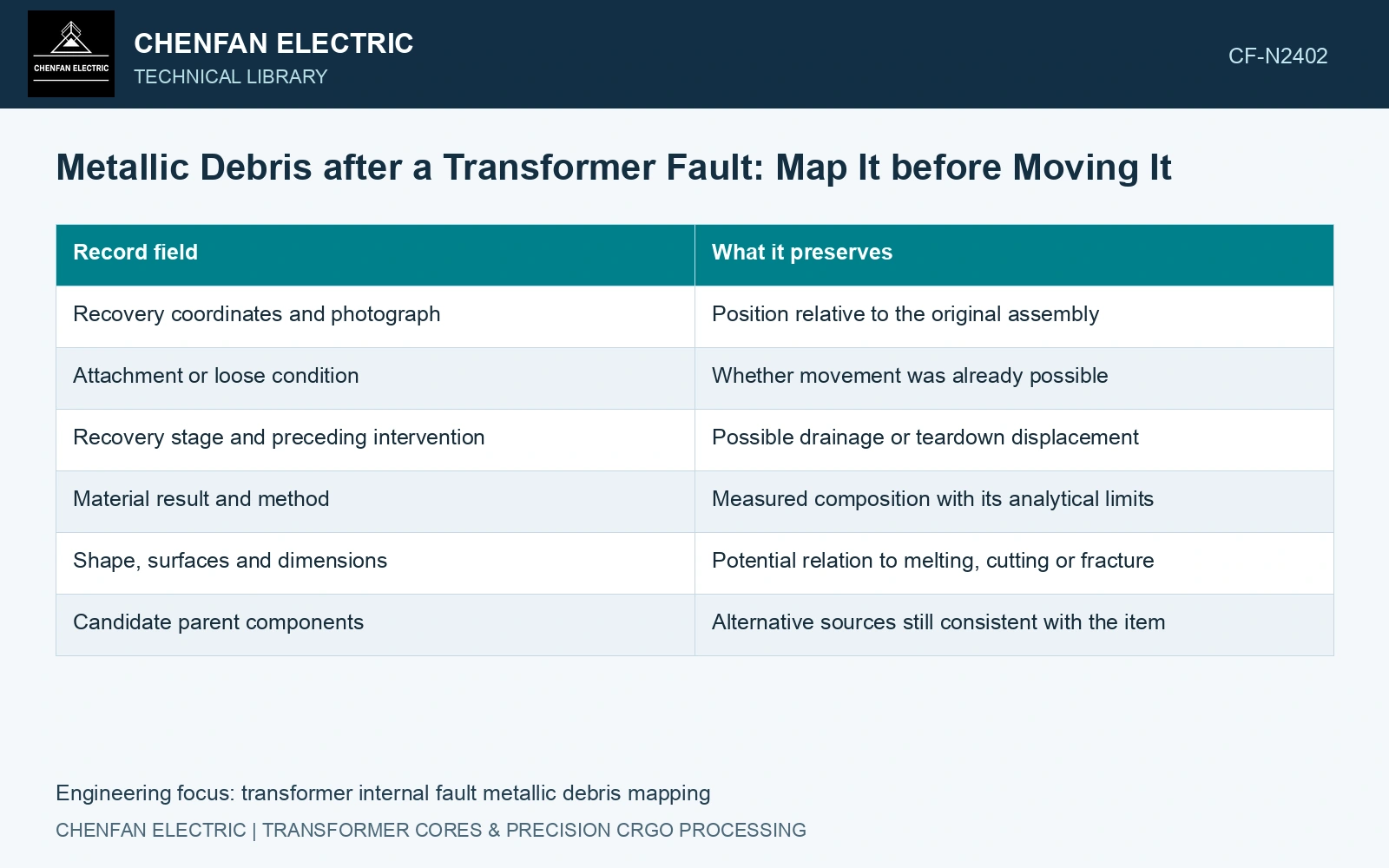
Assign a particle or collection identifier before analysis. Keep a group recovered together identifiable as a group, but do not assume every member shares an origin. Record whether the item was attached to a surface, embedded in insulation, settled loose or collected from drained liquid.
| Record field | What it preserves |
|---|---|
| Recovery coordinates and photograph | Position relative to the original assembly |
| Attachment or loose condition | Whether movement was already possible |
| Recovery stage and preceding intervention | Possible drainage or teardown displacement |
| Material result and method | Measured composition with its analytical limits |
| Shape, surfaces and dimensions | Potential relation to melting, cutting or fracture |
| Candidate parent components | Alternative sources still consistent with the item |
Put transport between the particle and the proposed source
Construct a separate hypothesis layer. Could material travel from the candidate component to the recovery region through an open oil passage? Did intervening barriers remain intact? Could draining oil collect fragments from several elevations in one container?
These questions do not require a speculative flow simulation. They establish whether the route is possible and whether an observed barrier contradicts it. If a route depends on a barrier destroyed later in the fault, that timing also belongs in the hypothesis.
NASA’s failure-analysis workflow includes microscopy and SEM/EDS [1]. In an assumed case, a copper-rich globule lies below a copper lead and shield. Composition constrains the material class; matching missing geometry or a distinctive coating would be needed to discriminate those candidate parents.
Keep the collection or particle identifier linked to its recovery map and each documented intervention [2]. A material result must stay associated with the recovered specimen, rather than silently inheriting the identity of the preferred parent component.
Keep recovery completeness separate from source identity
Assume documented cleanup recovers 8 g of metallic particles while a reconstructed missing-part estimate is 20 g with its own uncertainty. The recovered fraction is 40%, leaving 12 g unaccounted for under that model. Do not label unsurveyed regions clear or choose a parent solely by composition; preserve coordinates, complementary geometry and feasible transport routes.
References
- L. Ochs, NASA Goddard Space Flight Center, Basics of Failure Analysis, NASA Parts 101, December 4, 2024.
- NASA, NASA Systems Engineering Handbook, section 6.5, Configuration Management, official online text.