

Assess a switching surge by its peak, wavefront, oscillation bands and repeated pulses, then trace that waveform into the relevant winding insulation. Equal terminal peaks can accompany different local voltage stresses.
Popov’s prototype study shows that terminal and internal waveforms are distinct quantities. [1] Rao and Gajjar model chopping, dielectric recovery and high-frequency quenching separately; these define excitation mechanisms, rather than insulation acceptance limits. [2]
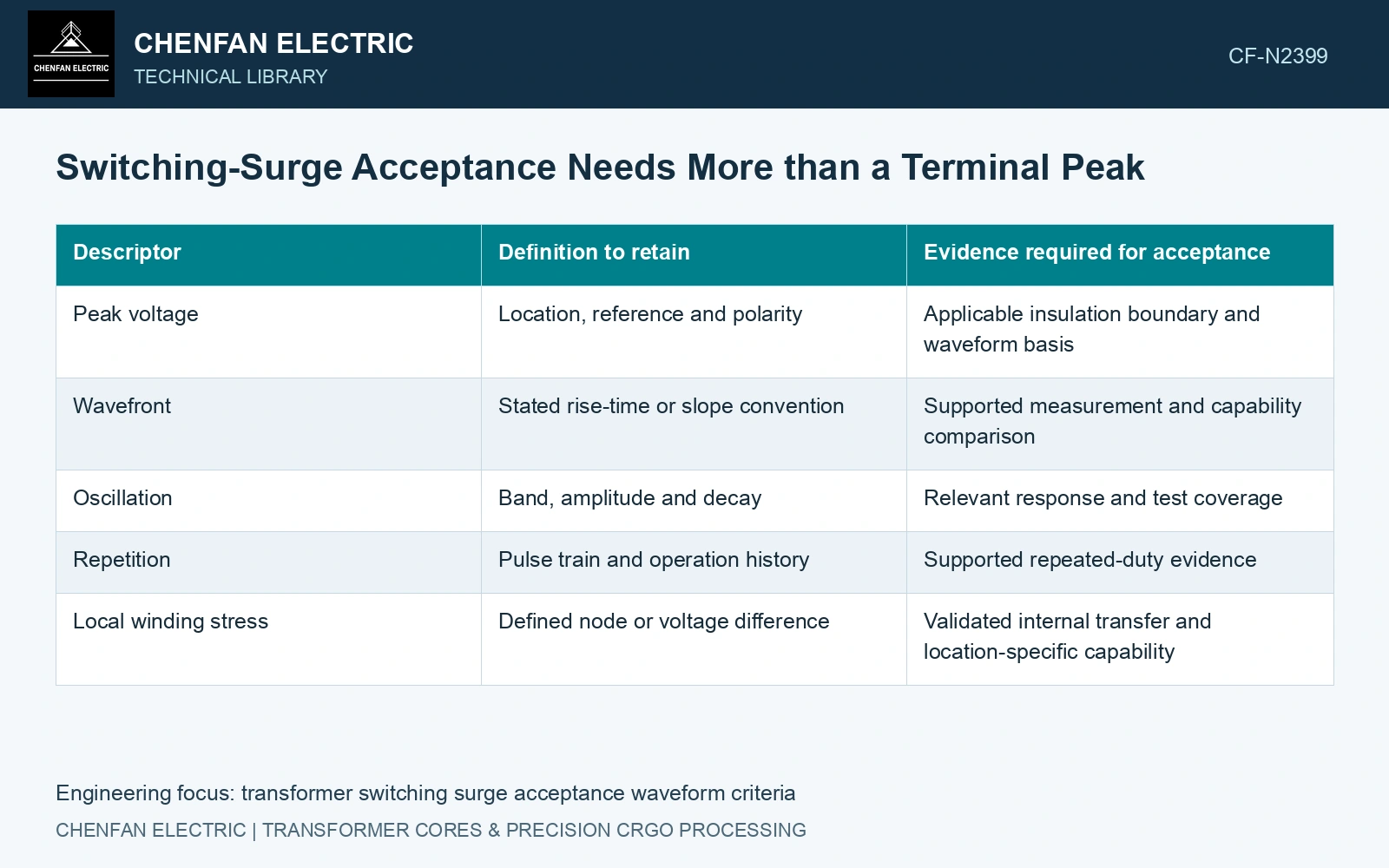
Keep a stress record with defined metrics
| Descriptor | Definition to retain | Evidence required for acceptance |
|---|---|---|
| Peak voltage | Location, reference and polarity | Applicable insulation boundary and waveform basis |
| Wavefront | Stated rise-time or slope convention | Supported measurement and capability comparison |
| Oscillation | Band, amplitude and decay | Relevant response and test coverage |
| Repetition | Pulse train and operation history | Supported repeated-duty evidence |
| Local winding stress | Defined node or voltage difference | Validated internal transfer and location-specific capability |
Use a reproducible wavefront convention and state it explicitly. A slope calculated from noisy samples can depend strongly on filtering. Compare the same processed quantity in model and measurement, with its bandwidth limitation retained.
Relate the applied waveform to capability evidence
Identify the source of each criterion: applicable project requirements, equipment test evidence or a supported manufacturer assessment. Distinguish a standardized test waveform from the actual switching waveform rather than assuming equal peaks imply equivalent stress.
For oscillatory or repetitive input, examine the transfer into the relevant insulation region. A nominal terminal withstand result does not automatically characterize every local turn-to-turn response under an arbitrary train of fast waves.
Do not create a universal maximum ring frequency from one historical application. Frequency describes a response band; its significance depends on amplitude, duration, damping and the transformer.
Keep source and model uncertainties in the decision
Retain measurement clipping, missing bandwidth and uncertain initial states. A peak reported below a criterion cannot support acceptance if the acquisition system could not resolve the governing feature.
Separate terminal observations from internal predictions. Where an internal network is unvalidated, report that gap rather than fill it with a uniform voltage-per-turn estimate.
Check whether the selected acceptance comparison covers the required event family, including credible repeated and changed-topology cases. One favorable operation is not the entire switching duty.
Tie each acceptance conclusion to the waveform feature, insulation region and capability evidence that supports it. Close the missing bandwidth, internal-transfer or repeated-event cases before releasing the corresponding duty. Keep measured terminal exposure distinct from validated internal predictions.
References
- M. Popov, R. P. P. Smeets, L. van der Sluis, H. de Herdt and J. Declercq, Experimental and Theoretical Analysis of Vacuum Circuit Breaker Prestrike Effect on a Transformer, IEEE Transactions on Power Delivery 24, 2009. DOI: 10.1109/TPWRD.2009.2013383.
- B. Kondala Rao and G. Gajjar, Development and Application of Vacuum Circuit Breaker Model in Electromagnetic Transient Simulation, IEEE, 2006. DOI: 10.1109/POWERI.2006.1632503.