

Reassess a controlled-switching target when cable topology or protection changes. Popov’s prototype tests compare switching waveforms with and without the cable [1]. That circuit sensitivity motivates checking the old target; the paper does not qualify a controller setting for the revised installation.
A target chosen to limit one quantity, such as an initial transient, may also differ from one chosen to limit later reignition or another port’s voltage. The optimization objective must remain visible.
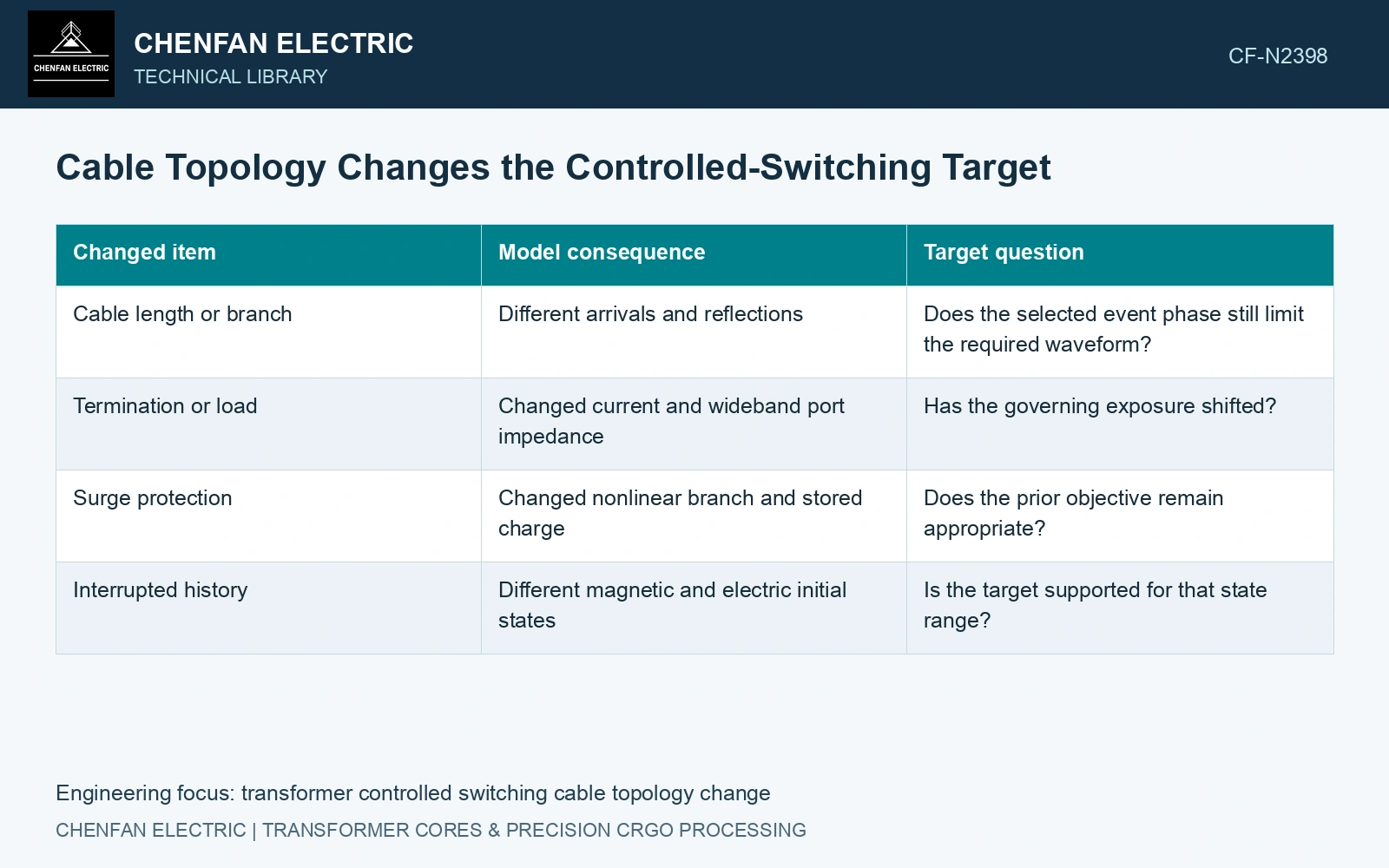
Map topology changes to the relevant response
| Changed item | Model consequence | Target question |
|---|---|---|
| Cable length or branch | Different arrivals and reflections | Does the selected event phase still limit the required waveform? |
| Termination or load | Changed current and wideband port impedance | Has the governing exposure shifted? |
| Surge protection | Changed nonlinear branch and stored charge | Does the prior objective remain appropriate? |
| Interrupted history | Different magnetic and electric initial states | Is the target supported for that state range? |
Distinguish command timing from the electrical event
The controller issues a command; the mechanism responds; the gap then conducts or interrupts under its actual conditions. Record those stages separately. Compensation for mechanical delay does not establish the timing of every prestrike or current interruption. [2]
Retain the supported scatter and environmental dependence of the breaker response. A narrow optimal region in a model may be unattainable consistently with the device’s actual timing uncertainty.
Compare the old target with the updated circuit
Use a validated breaker-cable-transformer model and the required initial-state range. Evaluate the former target first as a case, not as an assumption that the circuit must satisfy.
Scan the supported timing region with the actual optimization metric. Compare terminal and relevant internal or other-port stresses, breaker duty and protective-component energy where required. A timing change that improves one metric can worsen another.
Retain parameter and numerical sensitivity near the selected region. Do not report an optimum to more precision than the characterization supports.
Verify feedback against the intended outcome
Controller confirmation that a command was sent does not establish that the desired electrical event occurred. Compare measured event timing and the resulting waveform using the supported acquisition boundary.
When topology changes, update the configuration record and its validation basis before carrying the target into an approved control decision. A reusable setting is justified only within the supported circuit family and timing uncertainty.
Test the former target in the updated circuit, then select the supported timing region through the approved control assessment. Record the topology, timing scatter and governing waveform with the chosen target so the next configuration change triggers the right review.
References
- M. Popov, R. P. P. Smeets, L. van der Sluis, H. de Herdt and J. Declercq, Experimental and Theoretical Analysis of Vacuum Circuit Breaker Prestrike Effect on a Transformer, IEEE Transactions on Power Delivery 24, 2009. DOI: 10.1109/TPWRD.2009.2013383.
- B. Kondala Rao and G. Gajjar, Development and Application of Vacuum Circuit Breaker Model in Electromagnetic Transient Simulation, IEEE, 2006. DOI: 10.1109/POWERI.2006.1632503.