

Assess repeated transformer switching from the energy absorbed by the arrester and its thermal recovery between operations. Shorter intervals can carry an elevated starting temperature into the next event.
A surge count is useful event information, but it does not specify the energy or temperature associated with each operation.
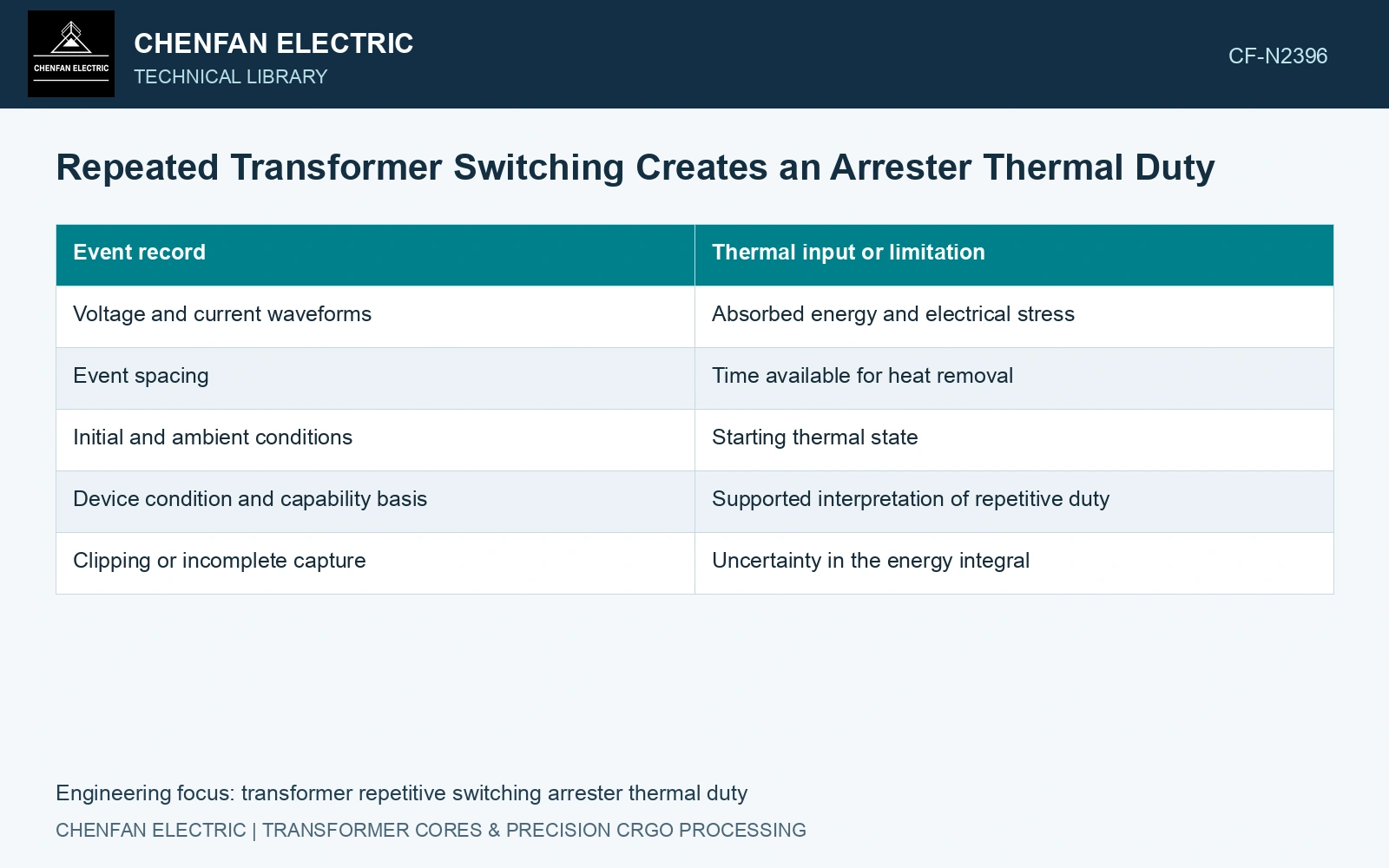
Calculate absorbed energy at the device
For event n, absorbed energy is En = ∫vA(t)iA(t)dt over the relevant conduction interval, with a consistent passive sign convention. Use arrester-terminal voltage and current rather than the transformer’s voltage multiplied by an unrelated source current.
Keep complete repeated pulses within the event boundary. Separating a reignition train into isolated peaks can miss accumulated energy during one operation.
| Event record | Thermal input or limitation |
|---|---|
| Voltage and current waveforms | Absorbed energy and electrical stress |
| Event spacing | Time available for heat removal |
| Initial and ambient conditions | Starting thermal state |
| Device condition and capability basis | Supported interpretation of repetitive duty |
| Clipping or incomplete capture | Uncertainty in the energy integral |
Carry thermal memory between events
A simplified instantaneous-energy node can illustrate the accounting. If its effective heat capacity is Cth and cooling time constant is τ, an event increases its temperature increment by En/Cth. During an interval Δt with unchanged surroundings, the remaining increment is multiplied by exp(−Δt/τ). [1]
This recurrence explains why equal-energy events at shorter intervals can accumulate a higher state. Real arresters need their supported spatial and thermal behavior; the illustrative node does not define a permissible operating rate.
Retain changes in energy as device temperature or the circuit evolves where they are relevant. Treating every event as identical merely because the command is identical can hide a changed waveform or protective state.
Compare the complete duty with actual capability evidence
Use the manufacturer’s relevant energy, current, temporary-overvoltage and repetitive-duty information under its stated conditions. A rating associated with one waveform cannot be extended automatically to another train of pulses.
Check recovery and sustained electrical conditions between switching events. Thermal exposure may include more than brief surge conduction if the system imposes another relevant voltage duty.
The manufacturer’s application guide separates thermal energy/charge capability from cool-down and thermal stability [2]. Successive impulses accumulate energy; recovery depends on construction, ambient temperature and applied voltage. Temperature-dependent electrical losses must also remain below the heat-removal capability. A constant-time-constant node cannot demonstrate that nonlinear stability condition.
Compare two repetition intervals on the same thermal model
All waveform and thermal inputs here are assumptions. A constant 25 kV arrester voltage during a triangular 0–100–0 A pulse lasting 8 ms gives E = 25,000 × 100 × 0.008/2 = 10 kJ. With Cth = 5 kJ/K, τ = 600 s and fixed ambient, each pulse adds 2 K. The periodic immediate post-event rise is 2/[1 − exp(−Δt/600)]: 21.02 K at 60 s spacing and 3.16 K at 600 s, a 6.64-fold difference. For an assumed 10 K node-rise review gate, 60 s fails and 600 s passes this linear screen; the calculated minimum spacing is −600 ln(0.8) = 133.89 s [1]. Before setting real duty, verify the arrester’s applicable energy/charge, temporary-overvoltage and thermal-recovery evidence [2].
Identify the governing event train, its absorbed-energy history and the arrester’s starting and recovery conditions. Compare that duty with the manufacturer’s relevant repetitive-duty evidence. Where only peak current is recorded, obtain the voltage-current waveform needed to calculate energy.
References
- U.S. Department of Energy, DOE-HDBK-1012/2-92, Thermodynamics, Heat Transfer, and Fluid Flow, Volume 2, 1992.
- B. Richter, Hitachi Energy, Metal-oxide surge arresters in medium-voltage systems: Application guidelines, sixth edition 2018, document 1HC0075561 EN2 AC, May 2022, sections 3.3–3.5.