

Installed cable lengths, types and switching states determine the capacitance in a ferroresonance study. Reconcile the design inventory with added branches and replacement sections, then bound the uncertainty that affects response selection. [1]
Ferracci’s examples include cable capacitance in nonlinear configurations. The parameter should retain its connection and uncertainty, rather than become one unquestioned nominal number. [2]
Convert length into the correct capacitance quantity
For a supported lumped branch, C = c′l, where c′ is capacitance per unit length and l is installed length. Use the required phase-to-ground or mutual quantity with its connection basis. A catalogue capacitance defined for one test connection cannot be substituted blindly into another matrix entry. [2]
As an illustration, assume c′ = 0.20 μF/km, connected length between 1.6 and 2.0 km, and another 0.04 μF of supported shunt capacitance. The scalar total spans 0.36–0.44 μF. These teaching values do not describe an actual cable.
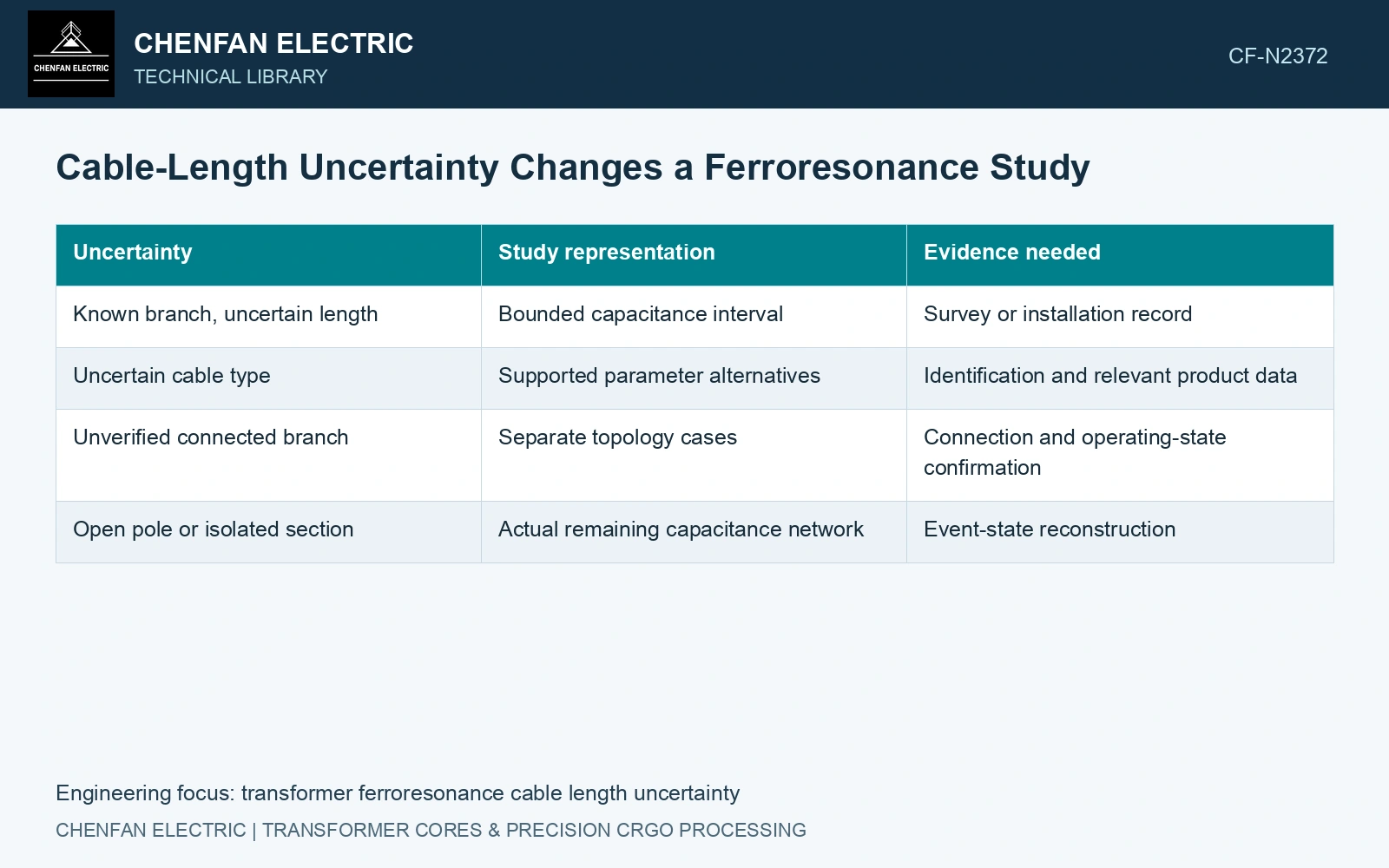
Keep parameter uncertainty separate from missing topology
| Uncertainty | Study representation | Evidence needed |
|---|---|---|
| Known branch, uncertain length | Bounded capacitance interval | Survey or installation record |
| Uncertain cable type | Supported parameter alternatives | Identification and relevant product data |
| Unverified connected branch | Separate topology cases | Connection and operating-state confirmation |
| Open pole or isolated section | Actual remaining capacitance network | Event-state reconstruction |
A branch whose connection is unknown cannot be represented honestly by adding a small percentage to every capacitance. Its presence may change the network structure and accessible states, not just the total. [2]
Scan the uncertainty through the nonlinear response
Evaluate relevant parameter and topology cases with credible initial conditions. The response can jump between states, so interpolation between two normal endpoints does not prove that the intervening range is normal. [2]
Refine near observed transitions and retain unresolved cells. Combine source, load and magnetic uncertainties where the study requires them; a precise cable survey cannot remove an unsupported loss or saturation model.
Check the lumped approximation’s frequency and spatial boundary. If the response being investigated requires distributed cable behavior, a total capacitance alone may not preserve the relevant dynamics.
Close inventory gaps that move the operating case across a transition. Keep surveyed connections, bounded estimates and unresolved topology visible in the response map.
References
- D. A. N. Jacobson, Examples of Ferroresonance in a High Voltage Power System, IEEE PES General Meeting, 2003. DOI: 10.1109/PES.2003.1270499.
- P. Ferracci, Schneider Electric, Ferroresonance, Cahier Technique No. 190, March 1998.