

Remanent flux, initial capacitor charge and switching instant can select different ferroresonant responses in the same circuit. Ferracci’s technical explanation identifies these state-selection inputs. Map the credible initial histories to assess the circuit’s response range. [1]
Separate initial state from circuit parameters
Fix the network topology, capacitances, source impedance, load and magnetic model for one response map. Then vary the initial states within supported bounds. If grounding or an open pole changes between runs, that is a different circuit case and should receive a separate map.
Define flux linkage or the corresponding magnetic state for every relevant phase. A hysteretic model may need more information than one flux value. Initialize its internal state consistently rather than assigning a remanent flux that contradicts the model’s history.
Likewise, capacitor voltage represents stored charge under a defined conductor connection. Mutual capacitances and grounding constraints can prevent arbitrary independent voltages from being physically achievable.
Map feasible histories to observed responses
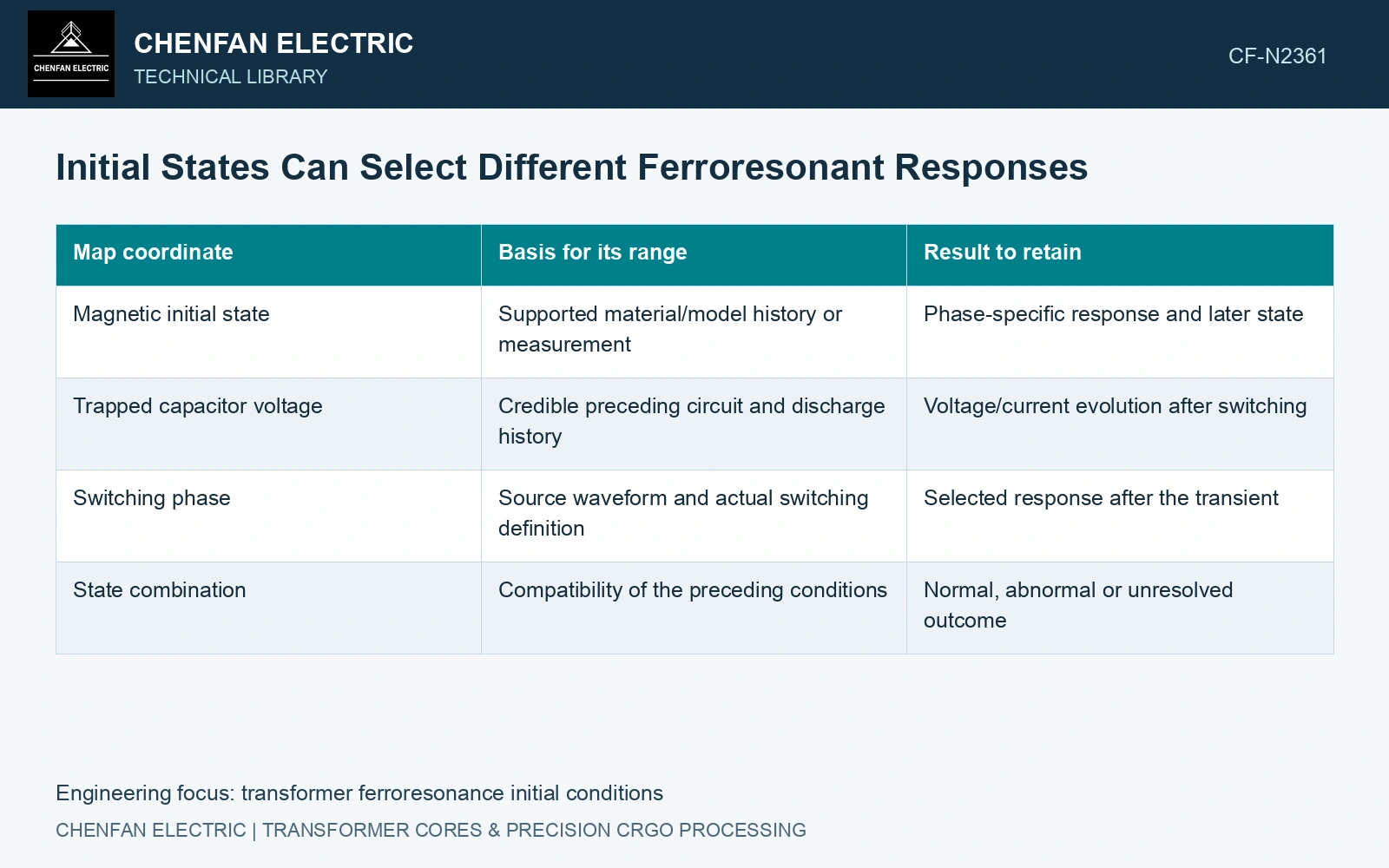
| Map coordinate | Basis for its range | Result to retain |
|---|---|---|
| Magnetic initial state | Supported material/model history or measurement | Phase-specific response and later state |
| Trapped capacitor voltage | Credible preceding circuit and discharge history | Voltage/current evolution after switching |
| Switching phase | Source waveform and actual switching definition | Selected response after the transient |
| State combination | Compatibility of the preceding conditions | Normal, abnormal or unresolved outcome |
Keep an infeasible-state flag. A dramatic result from an impossible charge/flux combination may be mathematically valid but cannot establish exposure under the studied operating history. Conversely, excluding a credible pre-energized state merely because a cold start is simpler can miss an accessible response.
Classify after an adequate observation interval
Retain the initial transient and enough later data to distinguish a decaying oscillation from a persistent response. Record the classification method and unresolved cases near a transition. A high first peak alone does not determine the eventual mode.
Near a state boundary, refine the scan and check numerical convergence. Small input changes can select different responses, so a coarse grid may hide a narrow accessible region.
Preserve the initial capacitor-energy state
Use feasible charge and magnetic histories when mapping multiple accessible nonlinear responses [2].
Assume the same 1 nF capacitor starts at 0 kV in one run and 100 kV in another. Initial stored energies are 0 J and 5 J. Those are different initial states even with identical circuit parameters. Run each feasible charge state with its compatible magnetic history; the energy comparison alone does not select a ferroresonant mode.
References
- P. Ferracci, Schneider Electric, Ferroresonance, Cahier Technique No. 190, March 1998.
- D. A. N. Jacobson, Examples of Ferroresonance in a High Voltage Power System, IEEE PES General Meeting, 2003. DOI: 10.1109/PES.2003.1270499.