

Cooling an elevated cascade stage crosses a high-potential boundary. Include fluid, pipe walls, fittings and controls in the electrical-isolation assessment while checking their heat-removal duty.
HIGHVOLT describes elevated transformer stages on insulated frames. It does not publish a generic cooling connection suitable for every stack. The interface must be assessed for the actual stage potential and approved cooling design. [1]
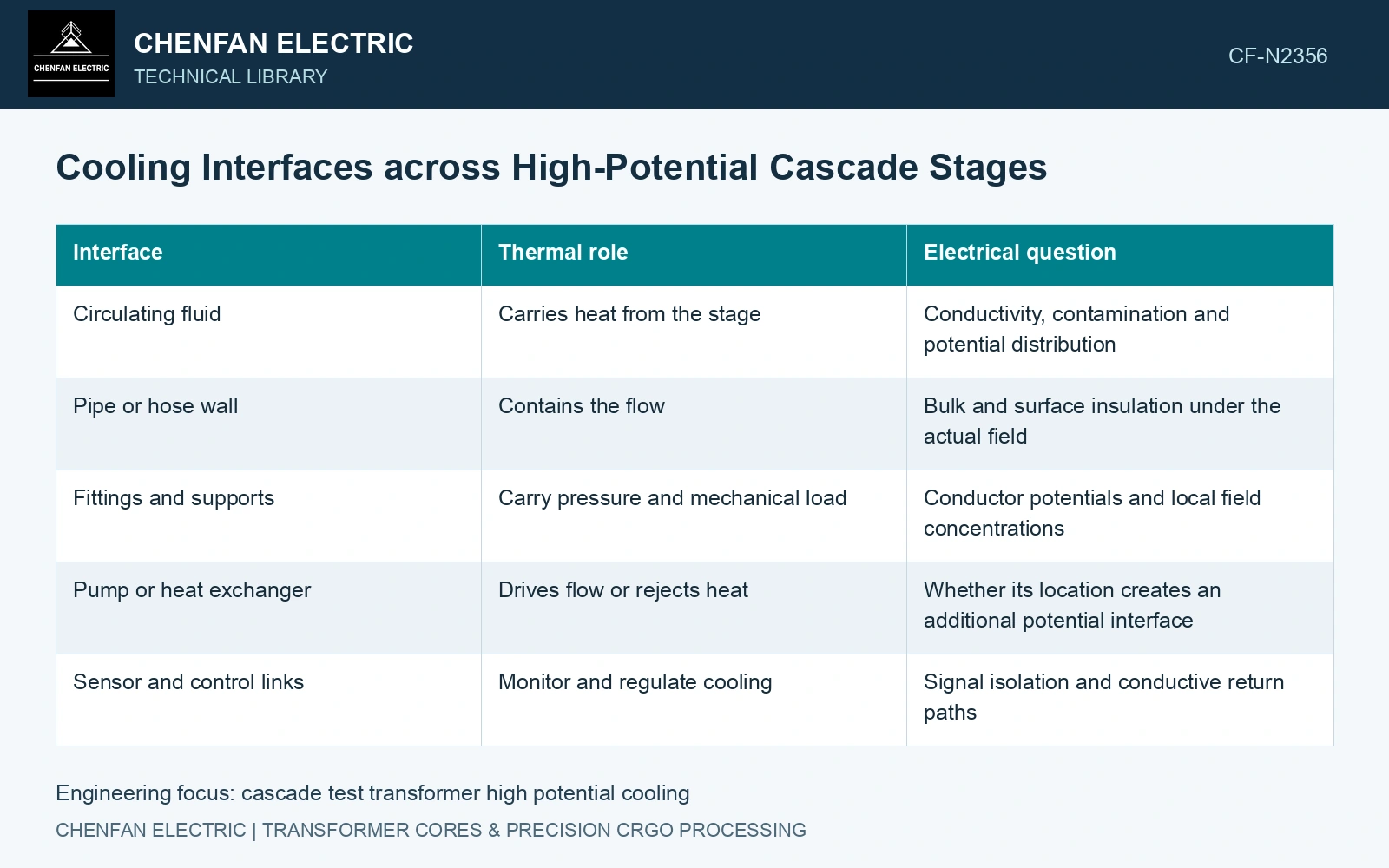
Map every path that crosses the boundary
| Interface | Thermal role | Electrical question |
|---|---|---|
| Circulating fluid | Carries heat from the stage | Conductivity, contamination and potential distribution |
| Pipe or hose wall | Contains the flow | Bulk and surface insulation under the actual field |
| Fittings and supports | Carry pressure and mechanical load | Conductor potentials and local field concentrations |
| Pump or heat exchanger | Drives flow or rejects heat | Whether its location creates an additional potential interface |
| Sensor and control links | Monitor and regulate cooling | Signal isolation and conductive return paths |
Do not stop the boundary at an insulating hose. Conductive fluid or an overlooked sensor connection can create another path. Conversely, a locally mounted cooling unit may shift the relevant isolation boundary to its power or control supply.
Verify heat removal under the supported operating state
For a steady single-stream energy balance, transported heat is approximately mass flow multiplied by specific heat and the fluid temperature increase. Retain inlet temperature, flow, fluid properties and the loss actually removed. This relation does not establish local winding temperature by itself.
Assess pressure drop, permitted pressure, flow-loss detection and the temperature response after a credible cooling interruption. The relevant response time depends on the equipment’s thermal storage and local hot spots, not merely the fluid volume.
Check isolation with the fluid in its credible condition
A simplified uniform fluid column has resistance proportional to length and inversely proportional to conductivity and cross-section. That relationship illustrates sensitivity to contamination; it is not a complete HV insulation model. Actual fields, fittings, surfaces and transients require the corresponding design assessment.
Use specified fluid properties and credible changes from moisture, temperature or aging where applicable. A clean-fluid laboratory value does not establish the condition after service. Retain both electrical and thermal property limits because a fluid change can affect the two functions differently.
Evaluate the actual platform voltage and required transient cases, including the potential of every connected conductor. No universal hose length or fluid choice can be derived from the heat-flow calculation.
Verify heat removal and electrical isolation for the same physical interface and operating state. Recheck both duties whenever the fluid route, fittings or controls change.
Screen heat transport and liquid-column leakage together
Use the same loss and heat-transfer boundary when checking coolant delivery [2].
Assume fluid flow 0.050 kg/s, specific heat 2,000 J/(kg·K) and a 10 K rise: transported heat is 1.0 kW. Separately assume a uniform 2 m liquid column of area 100 mm² at 100 kV, with conductivity 10⁻⁸ S/m. Its ohmic leakage is 50 nA; a thousandfold conductivity increase gives 50 μA. Verify thermal delivery and the complete dielectric interface at the same credible fluid condition.
References
- HIGHVOLT Prüftechnik Dresden GmbH, HVAC Test Systems Based on Transformers, 1.10/5 WP, November 2020.
- U.S. Department of Energy, DOE-HDBK-1012/2-92, Thermodynamics, Heat Transfer, and Fluid Flow, Volume 2, 1992.