

Partial-discharge measurements include the test object, source, terminal arrangement, coupling equipment and external interference. Use controlled comparisons to locate the discharge and establish the test system’s background and sensitivity.
HIGHVOLT’s conventional-system brochure includes source filters, a blocking impedance and coupling equipment for sensitive PD measurements. Their presence does not prove that the actual assembled system has negligible background at the required voltage and load. [1]
Establish a comparable source baseline
A source-only observation is useful, but removing the object changes capacitance, voltage regulation and the pulse-transfer circuit. Compare at the actual source and terminal voltages, not merely the same regulator setting.
Where the approved procedure uses a reference or replacement load, its own background and electrical characteristics need to be known. An uncharacterized replacement can introduce another source while appearing to isolate the original object.
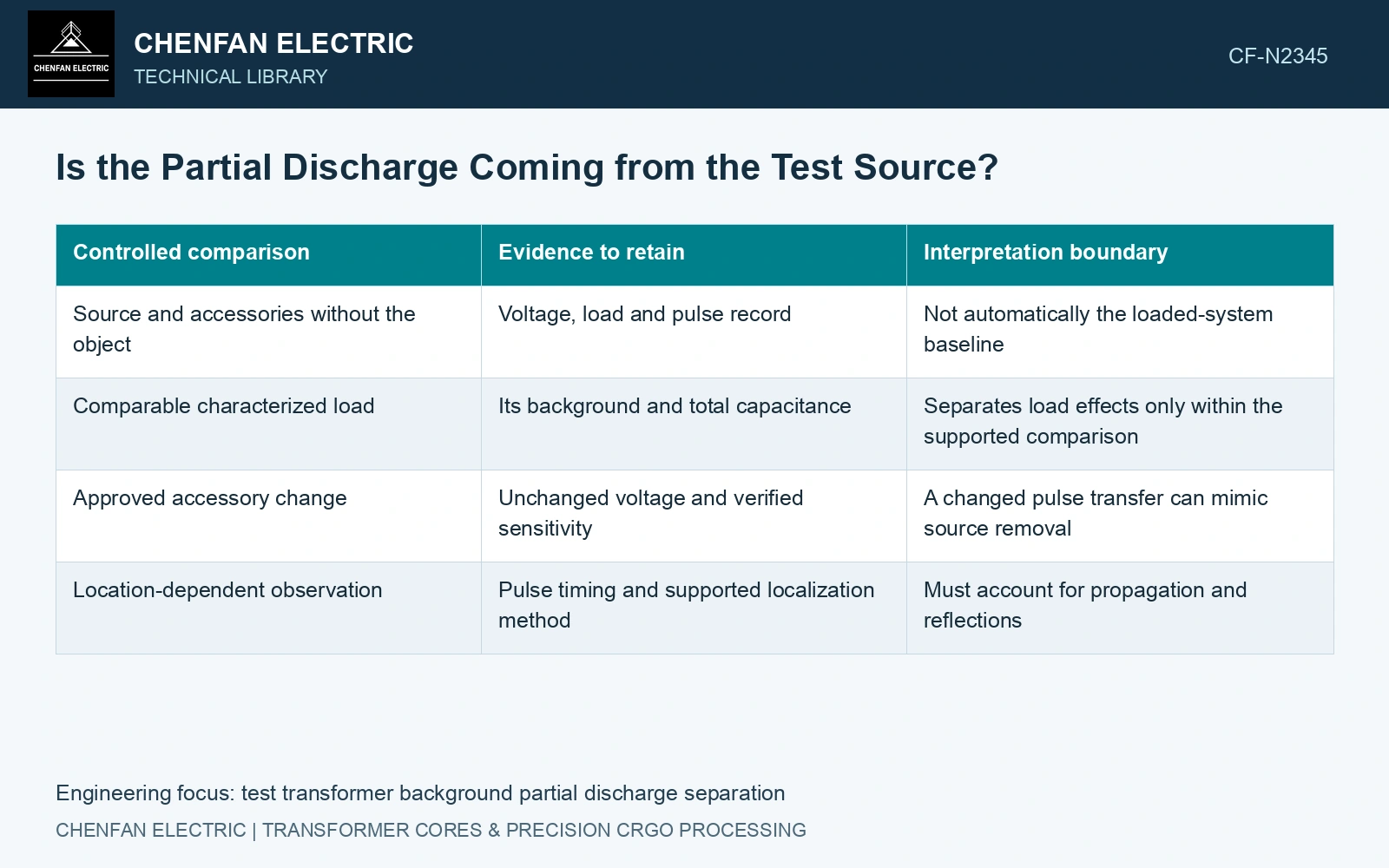
| Controlled comparison | Evidence to retain | Interpretation boundary |
|---|---|---|
| Source and accessories without the object | Voltage, load and pulse record | Not automatically the loaded-system baseline |
| Comparable characterized load | Its background and total capacitance | Separates load effects only within the supported comparison |
| Approved accessory change | Unchanged voltage and verified sensitivity | A changed pulse transfer can mimic source removal |
| Location-dependent observation | Pulse timing and supported localization method | Must account for propagation and reflections |
Use pattern evidence without overclaiming it
Compare pulse phase, repetition, polarity and voltage dependence across the controlled arrangements. Similar patterns can support a common source, but different sources can overlap in a phase-resolved plot. A visually familiar pattern is not a unique fingerprint.
Check whether pulses occur with the HV source de-energized as well. That observation can identify interference needing investigation, although absence in the de-energized state does not prove that energized pulses originate in the object.
Keep the relevant measurement-chain calibration and sensitivity with every circuit configuration. Filters and blocking components alter pulse transmission. A smaller displayed charge after a circuit change may reflect reduced sensitivity rather than reduced discharge activity.
Close the source-isolation map
List the candidate source regions, the comparison that tests each one and the result that would weaken that explanation. Include the transformer, HV connections, coupling components, object and environmental interference rather than stopping at a binary source-versus-object label.
Record intervals with overlapping or unresolved sources. Do not subtract a background number as if all pulses were steady, additive and independently identified; pulse populations and their transfer paths may change with voltage and loading.
Attribute the object’s discharge using controlled evidence and verified measurement sensitivity. Characterise or improve source background wherever it overlaps the required assessment range.
Normalize pulse amplitude after changing the circuit
Keep charge calibration and interference discrimination with each PD measuring configuration [2].
Assume a 10 pC calibration injection gives 100 mV in arrangement A and 50 mV in B. Their sensitivities are 10 and 5 mV/pC. Pulses of 30 and 20 mV therefore correspond to 3 and 4 pC respectively: displayed amplitude falls 33.3% while inferred apparent charge rises 33.3%. Retain the configuration-specific calibration before attributing source removal from a smaller pulse display.
References
- HIGHVOLT Prüftechnik Dresden GmbH, HVAC Test Systems Based on Transformers, 1.10/5 WP, November 2020.
- IEC, IEC 60270:2025, High-voltage test techniques — Charge-based measurement of partial discharges.