

Active residual-current compensation adds a controlled response alongside a Petersen coil’s passive inductive compensation. Define the current each branch is intended to supply and the measurement boundary used by its controller. Assess the combined response over normal operation and fallback states.
Distinguish active residual compensation from the current injection used to identify tuning parameters. Manufacturer documentation for an injection aid establishes a measurement function, not automatically a converter capable of cancelling fault residuals.
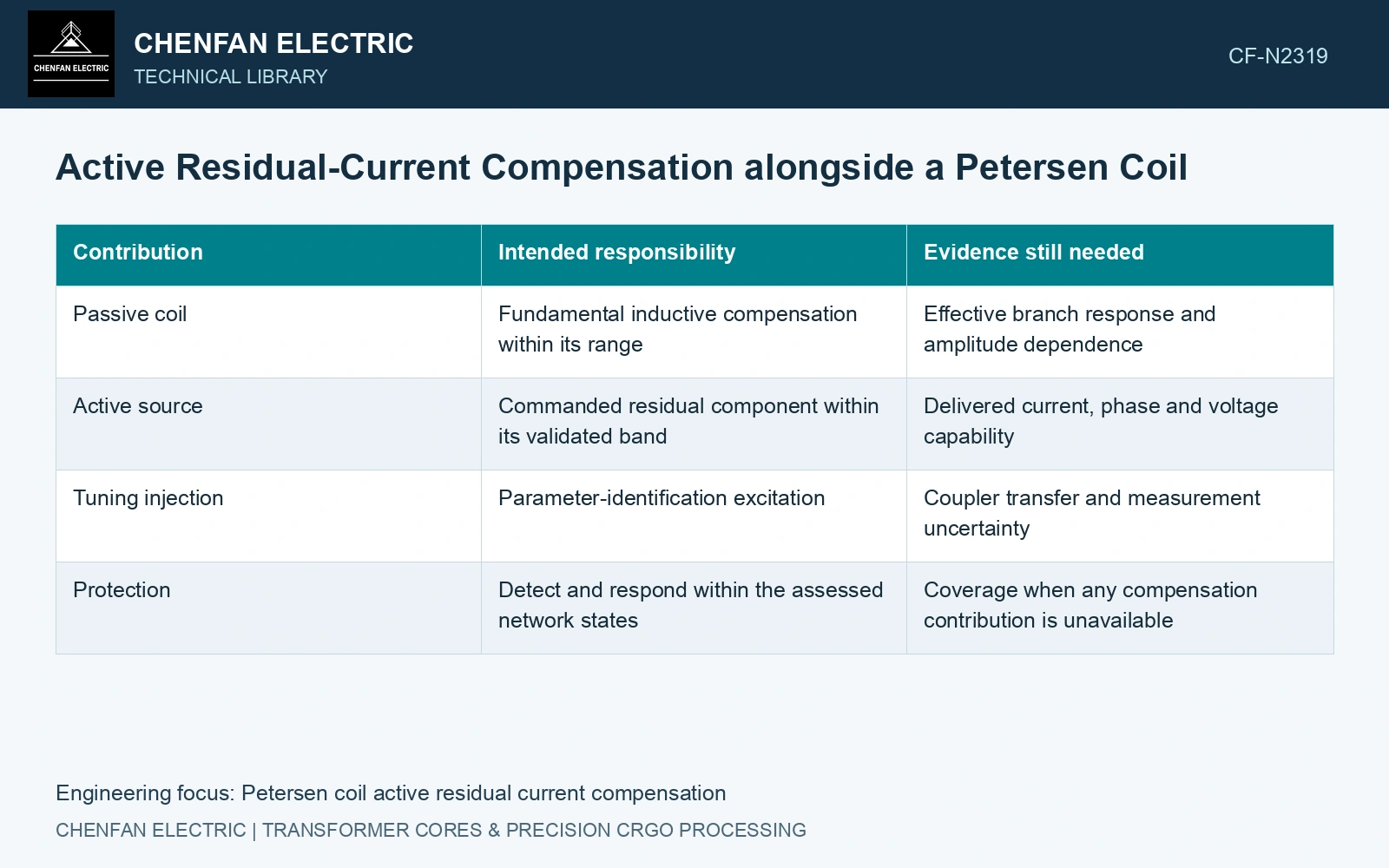
Assign each contribution a defined task
| Contribution | Intended responsibility | Evidence still needed |
|---|---|---|
| Passive coil | Fundamental inductive compensation within its range | Effective branch response and amplitude dependence |
| Active source | Commanded residual component within its validated band | Delivered current, phase and voltage capability |
| Tuning injection | Parameter-identification excitation | Coupler transfer and measurement uncertainty |
| Protection | Detect and respond within the assessed network states | Coverage when any compensation contribution is unavailable |
Write the target current as a waveform or a defined set of phasor components. A statement such as compensate the residual does not specify the measurement location, frequency content or sign. The active current must reach the intended network port through the actual coupling circuit.
Check the source’s feasible response
At a single sinusoidal port, apparent power magnitude is S = URMSIRMS, in volt-amperes when voltage is volts and current amperes. This is only one capacity constraint. Current limit, maximum port voltage, energy balance, thermal duty and control bandwidth can govern separately.
Harmonic cancellation requires the applicable frequency response and measurement accuracy for those components. A fundamental capacity statement does not prove that a source can reproduce a fast or distorted current command. The coupler’s phase and impedance belong in the same feasibility assessment.
Measurement errors can also generate the wrong current request. Keep current/voltage polarity, timing, background changes and the uncertainty in the estimated residual attached to the command. Increasing converter capacity cannot correct an incorrectly identified residual.
Compare available and unavailable states
Evaluate the passive network with the active source unavailable, limited or shut down. Retain the actual isolation or bypass state specified by the equipment design. Do not assume that a failed active source leaves an ideal open circuit or an unchanged passive branch.
Check protection under both the reduced residual achieved in the proposed active state and the residual left in fallback states. A cancellation function can change the quantity that a detection scheme expects to observe.
Check voltage capability separately from apparent power
All inputs are assumptions: the active source must deliver 2.0 A RMS at a 5.0 kV RMS network port, and a proposed source is described as 15 kVA but limited to 3.0 kV at that port. Required apparent power is 10 kVA, below the stated 15 kVA, yet the voltage requirement exceeds capability by 2.0 kV. Do not approve the source from kVA alone [1]. Verify its coupling, current phase and control response; the regulator’s parameter-identification injection function does not establish an active fault-current cancellation capability [2].
Verify the commanded target against the current delivered at the defined port. Coordinate measurement, protection and fallback behaviour over the validated operating range so each branch has a clear control responsibility.
References
- U.S. Department of Energy, DOE-HDBK-1011/3-92, Electrical Science, Volume 3, June 1992.
- A. Eberle GmbH & Co. KG, The Petersen-Coil Regulator, REG-DP/REG-DPA, including Current Injection and High Power Current Injection, Operating Instructions, April 2017.