

A replacement subsea module needs a matched mechanical fit and electrical identity. Verify ratio, phase sequence, winding connection, grounding and controller interpretation against the installed configuration, with pressure and connector interfaces tied to the same revision. [1]
Calculation basis. Project-specific values and gates in the illustrative screens below are assumptions; cited catalogue values retain their source test conditions.
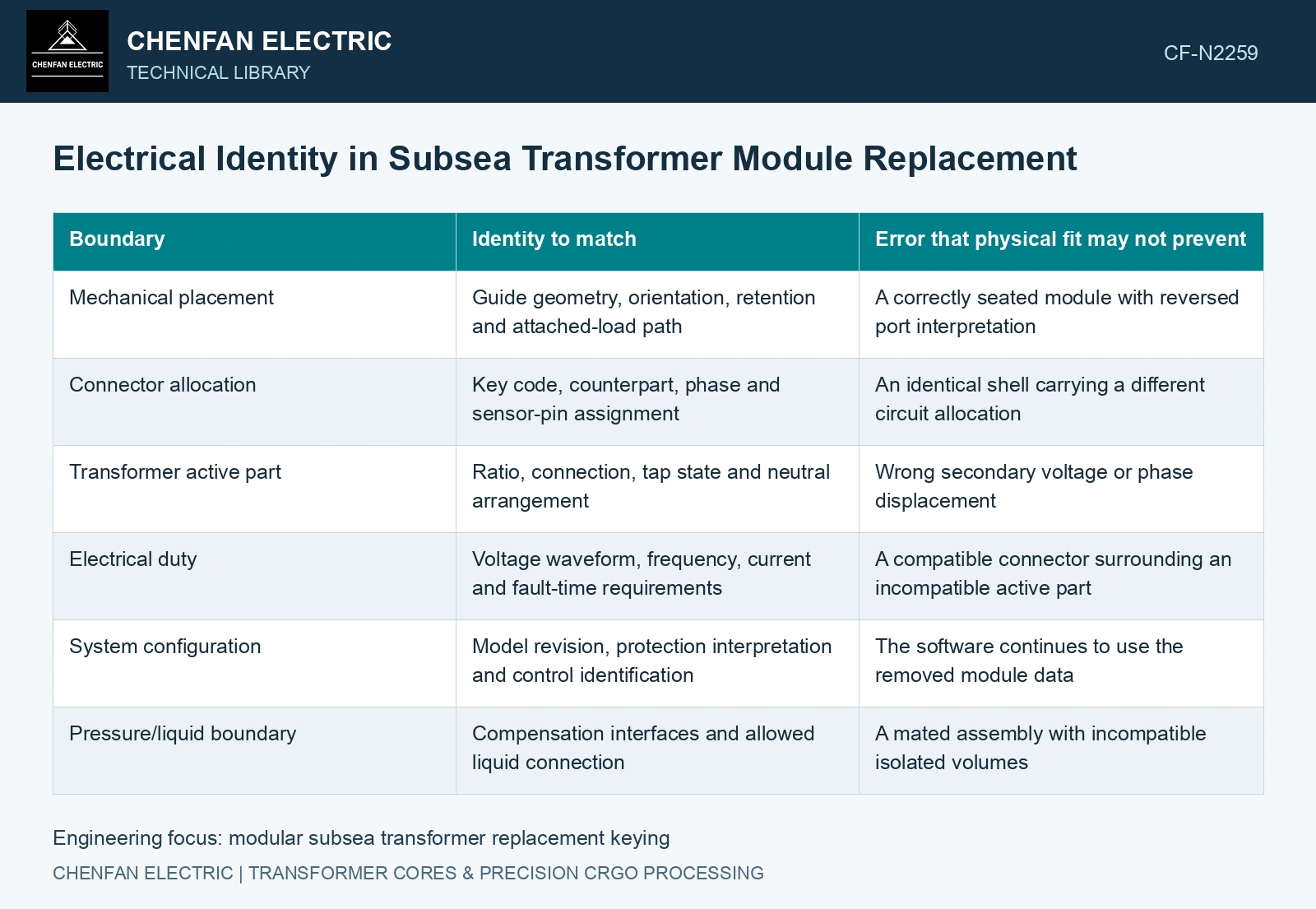
Define compatibility at three boundaries
Separate mechanical location, electrical port identity and system-model identity. Each boundary needs an explicit match to the installed application. A shared housing family or connector shell does not establish that two active parts have the same transfer function or permissible waveform duty.
| Boundary | Identity to match | Error that physical fit may not prevent |
|---|---|---|
| Mechanical placement | Guide geometry, orientation, retention and attached-load path | A correctly seated module with reversed port interpretation |
| Connector allocation | Key code, counterpart, phase and sensor-pin assignment | An identical shell carrying a different circuit allocation |
| Transformer active part | Ratio, connection, tap state and neutral arrangement | Wrong secondary voltage or phase displacement |
| Electrical duty | Voltage waveform, frequency, current and fault-time requirements | A compatible connector surrounding an incompatible active part |
| System configuration | Model revision, protection interpretation and control identification | The software continues to use the removed module data |
| Pressure/liquid boundary | Compensation interfaces and allowed liquid connection | A mated assembly with incompatible isolated volumes |
Bind visible identity to electrical records
Use a unique module identifier linked to the verified drawing, test records and parameter set. Preserve the mapping from the identifier to connector pin allocation and terminal references. If electronic identification is provided, consider an unreadable or incorrect identifier rather than assuming recognition always succeeds.
Define the check that detects a wrong ratio or phase allocation without relying solely on a label. Use the system-specific test and installation procedure for the required ratio and phase-allocation checks.
Review replacements as configurations
A different tap arrangement, liquid volume or sensor interface can alter more than one compatibility boundary. Review the assembled configuration, including any software and protection data that change with the module. Document exactly which combinations have supporting interface and system evidence.
Consider whether a mechanical key uniquely distinguishes all electrically incompatible variants. If two variants intentionally share a key, another verified identity barrier is necessary. Conversely, a key difference should correspond to a defined incompatibility, rather than unexplained part-number variation.
Approve the spare against one matched configuration covering mechanical, electrical, pressure and system interfaces. Bind its visible identity to the drawings, measured transfer characteristics and controller data used for installation.
Quantify a replacement-module ratio mismatch
Preserve liquid condition, sampling history and the identified component boundary when interpreting maintenance evidence [2].
Assume the intended subsea module ratio is 10.0, while a replacement has ratio 9.5 on the same tap and terminal convention. At 10 kV input, ideal outputs are 1,000 V and 1,052.6 V, a 5.26% difference. Reject nominal-power-only equivalence and reconcile ratio, displacement, impedance and connector identity before releasing the module.
References
- IEC/IEEE, IEC/IEEE 61886-2:2025, Subsea equipment — Part 2: Power transformers.
- U.S. Bureau of Reclamation, FIST Volume 3-30, Transformer Maintenance, 2000.