

A subsea transformer FAT establishes performance within the factory test configuration. When the final umbilical is absent, map its propagation, grounding, source-control and load effects into the project acceptance plan. This separates component acceptance from the installed network checks. [1]
Calculation basis. Project-specific values and gates in the illustrative screens below are assumptions; cited catalogue values retain their source test conditions.
Map the factory boundary to the installed boundary
List what was physically present in each test and what was represented by an equivalent. Include jumpers, connectors, termination screens, source impedance and connected loads. A test lead with the correct insulation rating does not automatically reproduce the final cable’s frequency response or pressure-compensation volume.
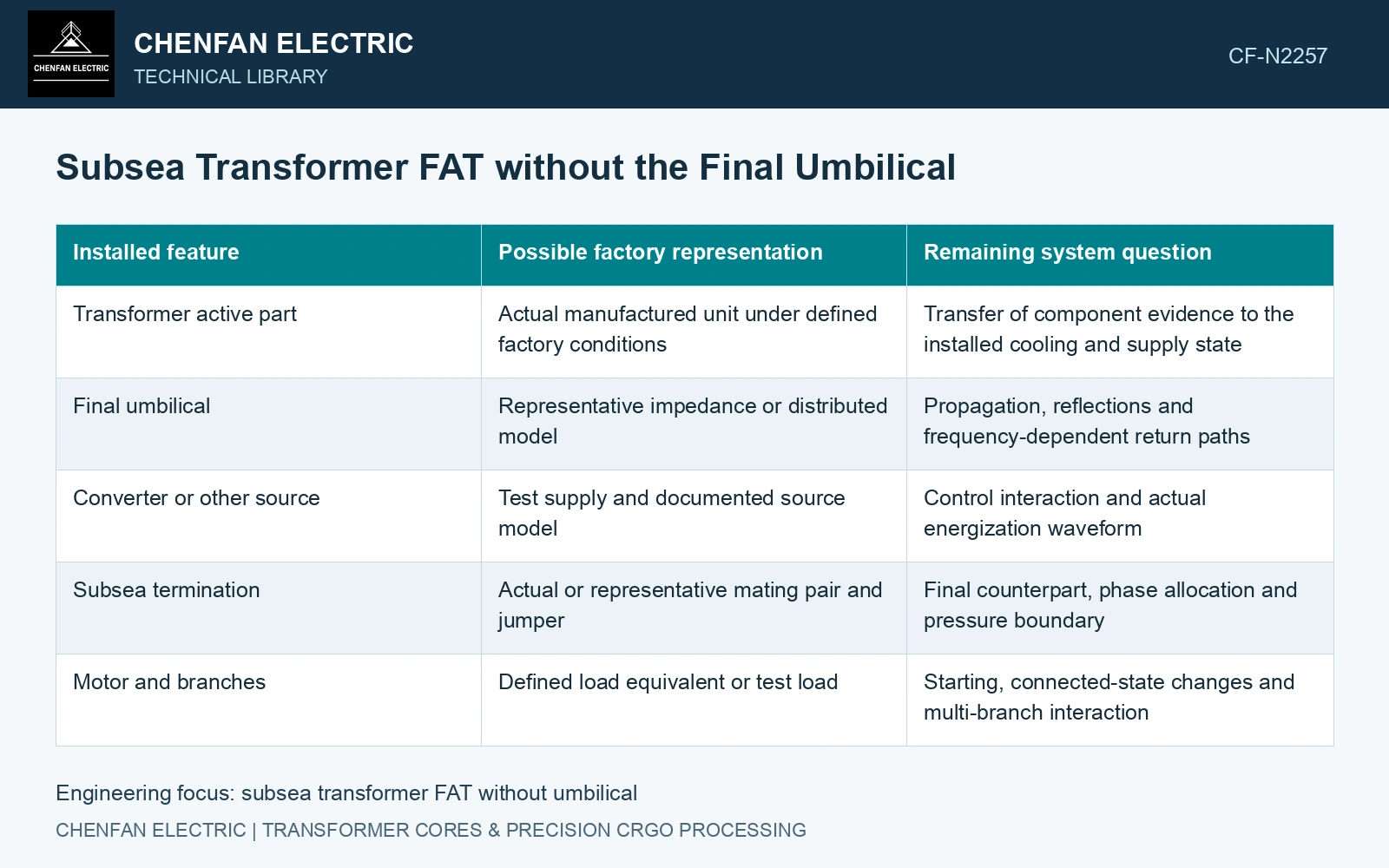
| Installed feature | Possible factory representation | Remaining system question |
|---|---|---|
| Transformer active part | Actual manufactured unit under defined factory conditions | Transfer of component evidence to the installed cooling and supply state |
| Final umbilical | Representative impedance or distributed model | Propagation, reflections and frequency-dependent return paths |
| Converter or other source | Test supply and documented source model | Control interaction and actual energization waveform |
| Subsea termination | Actual or representative mating pair and jumper | Final counterpart, phase allocation and pressure boundary |
| Motor and branches | Defined load equivalent or test load | Starting, connected-state changes and multi-branch interaction |
Choose an equivalent for the quantity being checked
A lumped cable representation may reproduce a selected low-frequency quantity without reproducing fast terminal transients. A load resistor can establish one thermal or electrical condition without representing a motor’s dynamic response. State which observable the equivalent is intended to preserve and compare that observable against the installed-system model.
Validate model parameters from available cable, source and transformer evidence rather than fitting every missing element to the desired factory result. Sensitivity studies can identify which missing parameter affects the conclusion; they do not convert an assumed value into a measured one.
Preserve acceptance layers
Separate the manufactured transformer’s factory evidence, interface verification and integrated-system verification. Identify the residual tests or analyses needed when the actual umbilical and source become available. If a final counterpart differs from the factory mating pair, review the effect on electrical identity and pressure boundaries.
For a disputed result, ask whether the observed quantity belongs to the tested component or to the omitted network. A terminal peak predicted only after adding the final cable cannot be dismissed because a shorter factory lead produced a lower peak. Equally, a model prediction requires its own validation before it is treated as an observed defect.
Use a coverage table to retain valid factory results and assign the remaining cable, source and load checks. Each test then closes a specific project requirement, with a clear owner for the installed-system verification.
Bound the missing umbilical contribution
Keep the specific winding and terminal boundary with dielectric evidence [2].
Assume the omitted umbilical contributes 5 μF per phase at 6.6 kV line-to-line and 50 Hz. Charging current is 2πfCVphase = 5.99 A per phase. If an assumed laboratory substitute is only 1 μF, it draws 1.20 A. Retain the fivefold capacitance difference in transient validation instead of extending a transformer-only FAT to the final cable system.
References
- IEC/IEEE, IEC/IEEE 61886-2:2025, Subsea equipment — Part 2: Power transformers.
- IEC, IEC 60076-3:2013+AMD1:2018, Power transformers — Part 3: Insulation levels, dielectric tests and external clearances in air.