

For a subsea sensor that requires retrieval for replacement, measurement quality and maintainability belong in the same specification. Select the location, drift performance, power supply, communication path and failure indication around the engineering decision the channel must support. [1]
Calculation basis. Project-specific values and gates in the illustrative screens below are assumptions; cited catalogue values retain their source test conditions.
Design around the decision the sensor supports
For each measurement, identify the condition it helps distinguish and the action that would follow a trustworthy result. Then identify the physical measurement location and the paths connecting it to the condition of interest. A sensor with excellent accuracy at an unrepresentative location can give a precise answer to the wrong question.
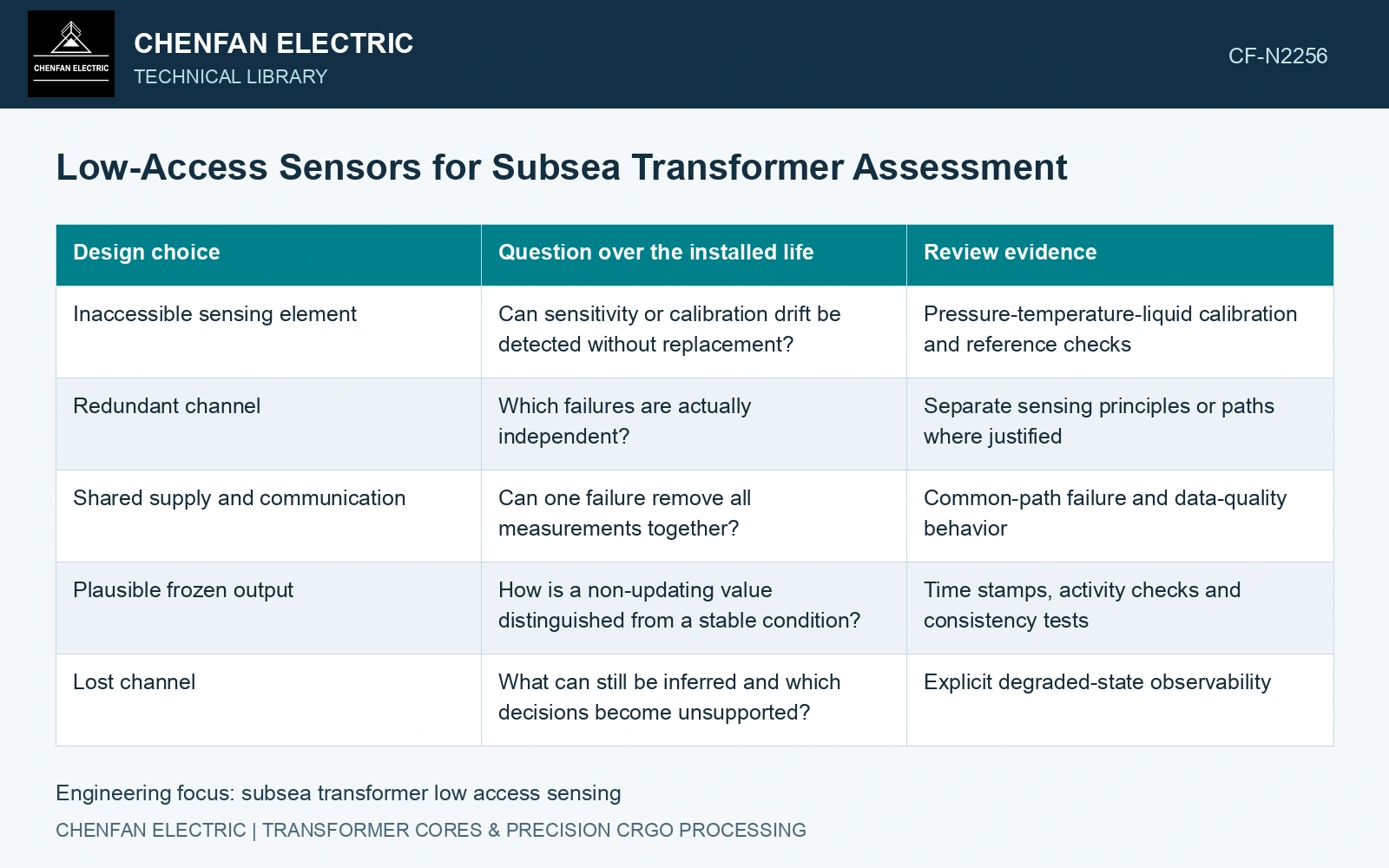
| Design choice | Question over the installed life | Review evidence |
|---|---|---|
| Inaccessible sensing element | Can sensitivity or calibration drift be detected without replacement? | Pressure-temperature-liquid calibration and reference checks |
| Redundant channel | Which failures are actually independent? | Separate sensing principles or paths where justified |
| Shared supply and communication | Can one failure remove all measurements together? | Common-path failure and data-quality behavior |
| Plausible frozen output | How is a non-updating value distinguished from a stable condition? | Time stamps, activity checks and consistency tests |
| Lost channel | What can still be inferred and which decisions become unsupported? | Explicit degraded-state observability |
Two channels can share the same error
In a simple illustrative error model, y₁ = x + bshared + b₁ and y₂ = x + bshared + b₂. Comparing the channels gives y₁ − y₂ = b₁ − b₂; the shared bias disappears from the comparison. Two agreeing readings therefore cannot, by agreement alone, reveal common calibration drift or a common environmental sensitivity.
This algebra is not a failure-rate model. It explains why duplication must be evaluated against the mechanism it is intended to detect. A separate reference, different sensing principle or physically independent observation can sometimes expose a common error, but each alternative adds its own qualification and interpretation requirements.
Specify degraded observability explicitly
Review loss of one sensor, shared power, communication and a measurement whose quality flag remains valid despite a fault. Determine which condition assessments remain supported in each case. Do not assign an automatic operating permission merely because another sensor remains available.
Keep calibration records linked to the installed device identity and range. Pressure survival, long-term measurement stability and compatibility with insulating liquid are different evidence needs. Verify the complete feedthrough and electronics chain, including behavior after pressure cycling or retrieval.
Specify which equipment conditions each channel distinguishes and what information remains available after a failure. Match redundancy to independent measurement paths, then verify the installed calibration, feedthrough and electronics chain.
Check sensor separability before assigning a remote diagnosis
Propagate the stated measurement uncertainties before comparing inferred condition changes [2].
Assume two remote temperature channels have independent standard uncertainties of 1.0 K and 1.5 K at the operating pressure and temperature. Their difference has a combined standard uncertainty √(1.0² + 1.5²) = 1.80 K. An observed 1 K separation is smaller than that uncertainty. Improve the sensor basis or use corroborating evidence before interpreting a local thermal divergence.
References
- IEC/IEEE, IEC/IEEE 61886-2:2025, Subsea equipment — Part 2: Power transformers.
- B. N. Taylor and C. E. Kuyatt, NIST Technical Note 1297, Guidelines for Evaluating and Expressing the Uncertainty of NIST Measurement Results, 1994, sections 5 and 6.