

A subsea wet-mate port needs separately declared mating, electrical switching and pressure duties. Qualify the exact connector pair and connected volumes against manufacturer evidence for each intended state. [1]
Calculation basis. Project-specific values and gates in the illustrative screens below are assumptions; cited catalogue values retain their source test conditions.
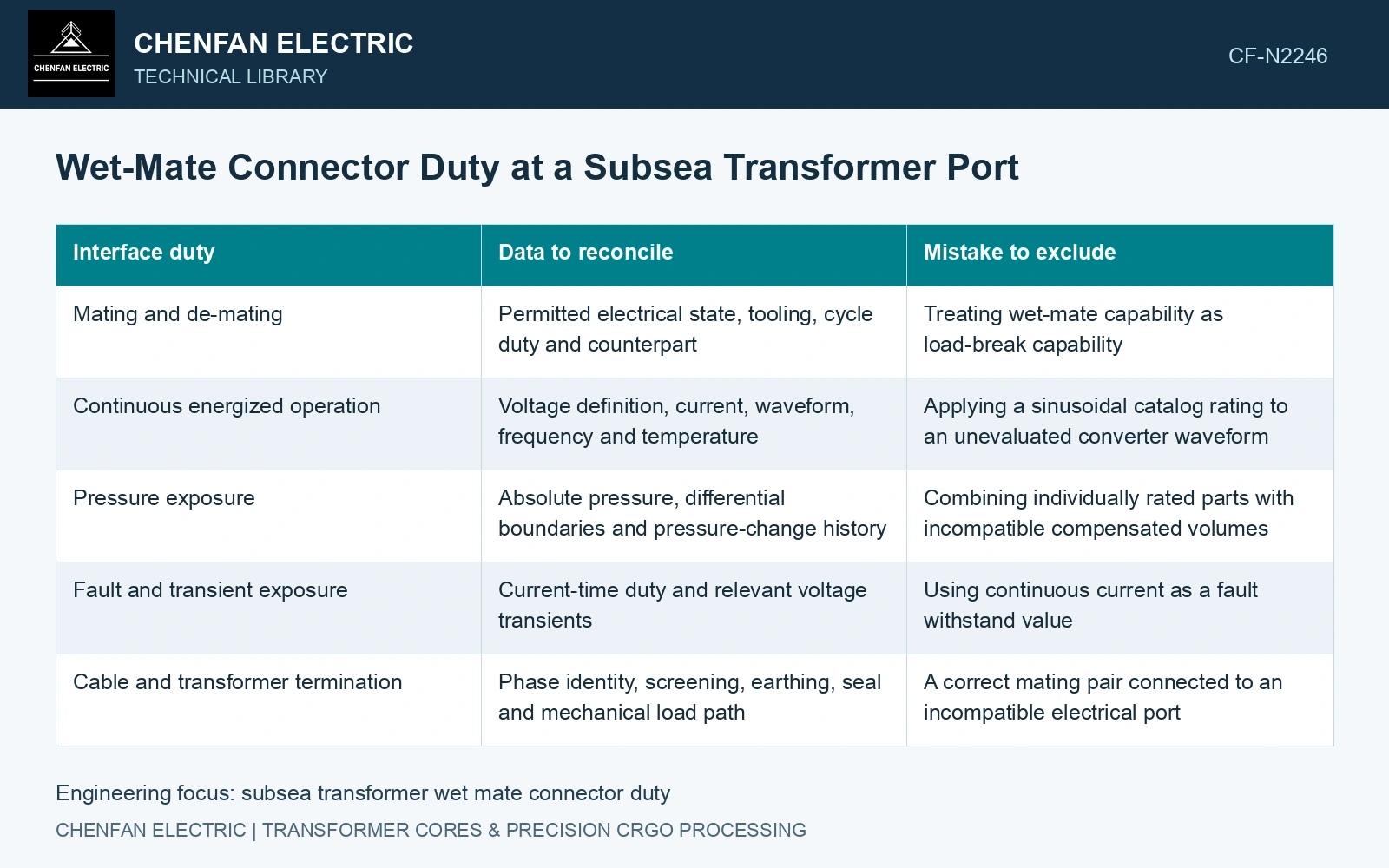
Define duties at the interface
Identify the transformer port, cable termination, penetrator and mating pair as separate items. Record their part numbers, revisions and compatible counterparts. A connector’s catalog voltage or depth rating does not establish the combined assembly’s suitability for the actual waveform, current history or pressure-compensation arrangement.
| Interface duty | Data to reconcile | Mistake to exclude |
|---|---|---|
| Mating and de-mating | Permitted electrical state, tooling, cycle duty and counterpart | Treating wet-mate capability as load-break capability |
| Continuous energized operation | Voltage definition, current, waveform, frequency and temperature | Applying a sinusoidal catalog rating to an unevaluated converter waveform |
| Pressure exposure | Absolute pressure, differential boundaries and pressure-change history | Combining individually rated parts with incompatible compensated volumes |
| Fault and transient exposure | Current-time duty and relevant voltage transients | Using continuous current as a fault withstand value |
| Cable and transformer termination | Phase identity, screening, earthing, seal and mechanical load path | A correct mating pair connected to an incompatible electrical port |
Check voltage definitions before comparing numbers
Distinguish phase-to-earth voltage, phase-to-phase voltage and the highest applicable system voltage. Include grounding behavior during a fault and any converter common-mode component. A numerically higher catalog rating may use a different reference, so direct comparison is unsafe until the definitions agree.
Keep operating current separate from current interrupted by a switching device elsewhere. The connector may need to carry a specified fault history without being intended to interrupt it. Document which equipment establishes the permitted electrical state for mating and how the system verifies that state.
Examine pressure communication and identity together
A penetrator separates pressure regions; a compensated connector or hose may contain its own liquid volume and communication path. Trace those boundaries into the transformer drawing. Trapped pressure, blocked communication or an incompatible liquid system can remain a concern after the main assembly’s pressure has changed.
Confirm mechanical keying, phase allocation and the identification visible during subsea installation. Physical fit is only one compatibility condition. A test jumper also needs a defined electrical and pressure role; it is not automatically equivalent to the installed umbilical termination.
Resolve every uncovered duty with applicable manufacturer documentation and system qualification. Retain the exact mating pair’s permitted electrical state and pressure-test limits in the interface matrix.
Compare connector current with the module load
Keep the specific winding and terminal boundary with dielectric evidence [2].
Assume a 2 MVA three-phase port at 6.6 kV line-to-line. Rated line current is 2 MVA/(√3 × 6.6 kV) = 175.0 A. An assumed connector continuous rating of 150 A at the specified pressure and temperature supports only 1.715 MVA on this current screen. Reconcile the port-specific connector qualification before releasing the 2 MVA module interface.
References
- IEC/IEEE, IEC/IEEE 61886-2:2025, Subsea equipment — Part 2: Power transformers.
- IEC, IEC 60076-3:2013+AMD1:2018, Power transformers — Part 3: Insulation levels, dielectric tests and external clearances in air.