

Subsea cooling qualification needs the weak-flow and obstructed states of the installation. Include seabed clearance, water temperature and heat distribution to establish the duty when natural convection carries the load. [1]
Calculation basis. Project-specific values and gates in the illustrative screens below are assumptions; cited catalogue values retain their source test conditions.
Describe the water-side boundary physically
Specify seawater temperature, local velocity and direction at the cooling surfaces, the seabed clearance and neighboring structures. A regional current measurement may not represent flow through a narrow space beneath the transformer. Separate external forced-flow cases from weak-current cases in which natural convection becomes important.
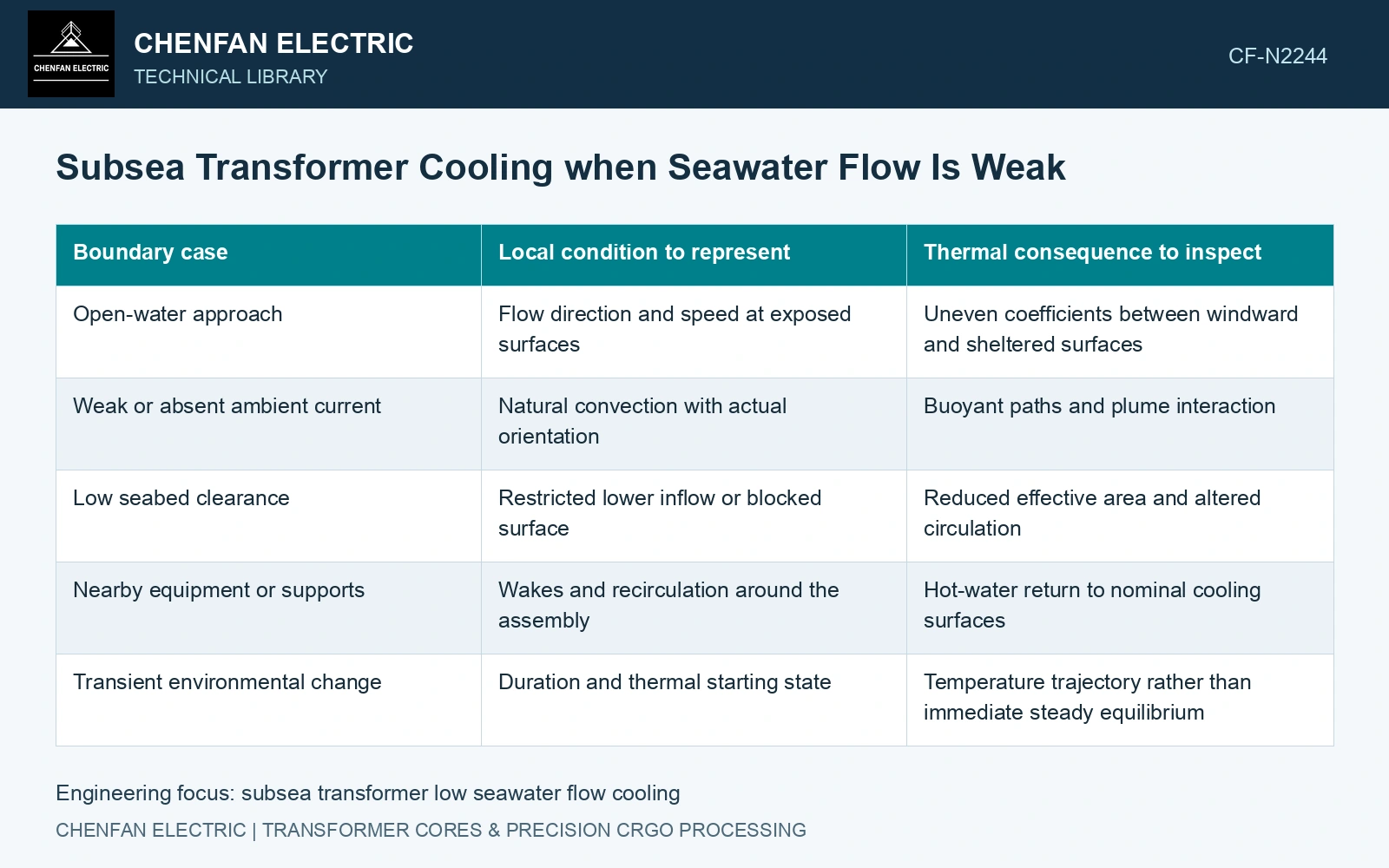
| Boundary case | Local condition to represent | Thermal consequence to inspect |
|---|---|---|
| Open-water approach | Flow direction and speed at exposed surfaces | Uneven coefficients between windward and sheltered surfaces |
| Weak or absent ambient current | Natural convection with actual orientation | Buoyant paths and plume interaction |
| Low seabed clearance | Restricted lower inflow or blocked surface | Reduced effective area and altered circulation |
| Nearby equipment or supports | Wakes and recirculation around the assembly | Hot-water return to nominal cooling surfaces |
| Transient environmental change | Duration and thermal starting state | Temperature trajectory rather than immediate steady equilibrium |
Use resistance sensitivity to expose the dependency
In an illustrative lumped screening model, assume 10 kW of heat, 20 m² of fully effective external area and an internal thermal resistance of 0.0002 K/W. With an assumed external coefficient h = 200 W/(m²·K), the water-side resistance 1/(hA) is 0.00025 K/W. The combined temperature rise is 10,000 × 0.00045 = 4.5 K.
If the assumed coefficient falls to 40 W/(m²·K), the water-side resistance becomes 0.00125 K/W and the combined rise becomes 14.5 K. The ten-kelvin difference illustrates sensitivity; neither coefficient is a seawater design value. The model also omits local winding gradients and any loss-temperature feedback.
Preserve local hot regions in the final analysis
Resolve the internal heat paths and nonuniform external cooling where they affect hotspots. A uniform coefficient fitted to total heat rejection can conceal a sheltered surface near a thermally critical winding region. Compare different current directions and tilt states if installation permits them.
Tie tested and simulated boundaries to velocity, temperature, clearance and heat distribution. Qualify prolonged weak-flow duty and identify conditions still requiring representation.
Convert the weak-flow result into a heat-rejection boundary
Retain the preceding assumptions: 20 m² area, internal resistance 0.0002 K/W and the two water-side coefficients. Combining internal conduction and external convection follows the thermal-resistance model [2]. Assume an 8 K source-to-seawater temperature-difference budget for this lumped screen.
The 10 kW duty gives 4.5 K at h = 200 W/(m²·K), within that budget, but 14.5 K at h = 40 W/(m²·K), outside it. At the weaker flow, allowable modeled heat is 8/(0.0002+1/(40×20)) = 5.52 kW, or 55.2% of the assumed 10 kW heat input.
Require additional cooling evidence or reduce heat input before crediting prolonged weak-flow duty. The 55.2% heat ratio is not a load-current or MVA derating: converting it requires the transformer’s separate no-load, load-dependent and auxiliary loss contributions.
References
- IEC/IEEE, IEC/IEEE 61886-2:2025, Subsea equipment — Part 2: Power transformers.
- U.S. Department of Energy, DOE-HDBK-1012/2-92, Thermodynamics, Heat Transfer, and Fluid Flow, Volume 2, 1992.