

Automatic phase-shifter control restoration needs the actual recovered topology, achieved tap and valid measurements. Reconstruct that state before the approved procedure restores control authority. [1]
Calculation basis. Project-specific values and gates in the illustrative screens below are assumptions; cited catalogue values retain their source test conditions.
Define readiness as a conjunction
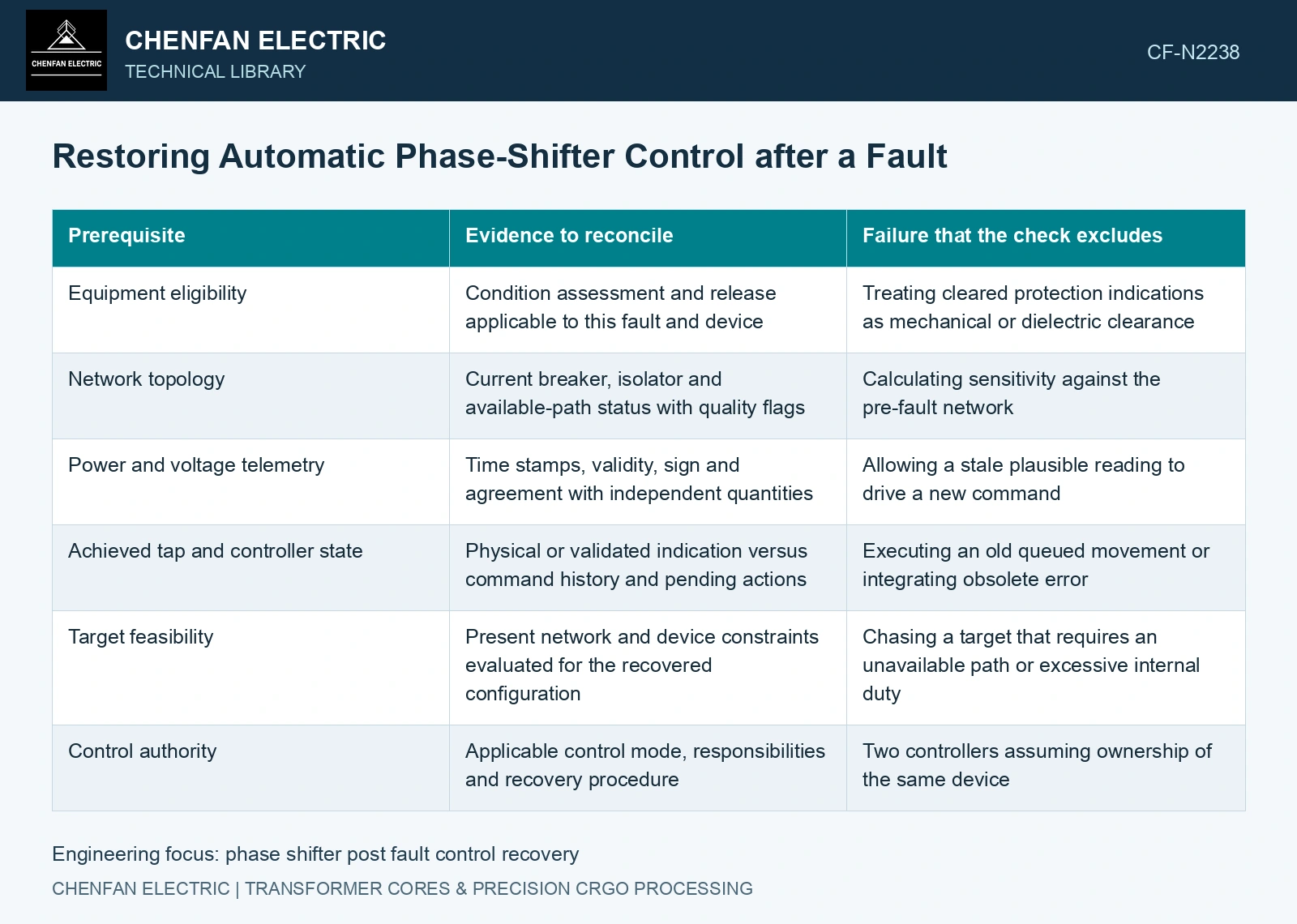
For an engineering review, express control eligibility as a logical conjunction: ready = equipment eligibility AND valid topology AND trustworthy measurements AND reconciled tap state AND feasible target AND authorized control mode. Each term needs a current basis. An alarm reset is evidence about one indication; it is not proof that all six conditions hold.
| Prerequisite | Evidence to reconcile | Failure that the check excludes |
|---|---|---|
| Equipment eligibility | Condition assessment and release applicable to this fault and device | Treating cleared protection indications as mechanical or dielectric clearance |
| Network topology | Current breaker, isolator and available-path status with quality flags | Calculating sensitivity against the pre-fault network |
| Power and voltage telemetry | Time stamps, validity, sign and agreement with independent quantities | Allowing a stale plausible reading to drive a new command |
| Achieved tap and controller state | Physical or validated indication versus command history and pending actions | Executing an old queued movement or integrating obsolete error |
| Target feasibility | Present network and device constraints evaluated for the recovered configuration | Chasing a target that requires an unavailable path or excessive internal duty |
| Control authority | Applicable control mode, responsibilities and recovery procedure | Two controllers assuming ownership of the same device |
Reconstruct the achieved network and device state
A communication channel that has resumed can deliver old cached values. Review data age and update behavior rather than accepting a successful connection as measurement quality. Compare the achieved tap with the model’s tap interpretation, including angle direction. A changed reference or swapped telemetry sign can make an otherwise functioning controller act in the wrong direction.
Review how the particular controller handles accumulated error, pending commands and external setpoints during interruption. Different implementations freeze, reset or retain different states. The recovery design must identify those behaviors explicitly; a generic instruction to reset every integrator is not appropriate.
Verify control recovery against present measurements
Tie the model and acceptance evidence to the specific PST application and tested configuration [2].
Assume the retained pre-fault target is 100 MW but post-fault topology permits an approved 80 MW limit. Restoring the old target would exceed that limit by 20 MW, or 25%. Require current topology, valid measurement and limit confirmation before reenabling automatic tap control; retain event chronology so stale data cannot imitate successful recovery.
References
- B. Cook, M. J. Thompson, K. Garg and M. Malichkar, Phase-Shifting Transformer Control and Protection Settings Verification, 2018. DOI: 10.1109/CPRE.2018.8349815.
- IEC, IEC 62032:2012, Guide for the Application, Specification and Testing of Phase-Shifting Transformers.