

A furnace heat ledger connects stress events to process stage and configuration. Use that common time anchor to find recurring electrical and thermal duty that needs inspection or better operating evidence. IEEE C57.17-2012 is listed as Inactive-Reserved; use its furnace-transformer scope as a historical reference while specifying the contract acceptance basis. [1]
Calculation basis. Project-specific values and gates in the illustrative screens below are assumptions; cited catalogue values retain their source test conditions.
Bind the heat identifier to the actual data timeline, not only to a production report entered later. Retain clock synchronization, stage transitions and configuration changes. A misplaced event can make the wrong heat look severe.
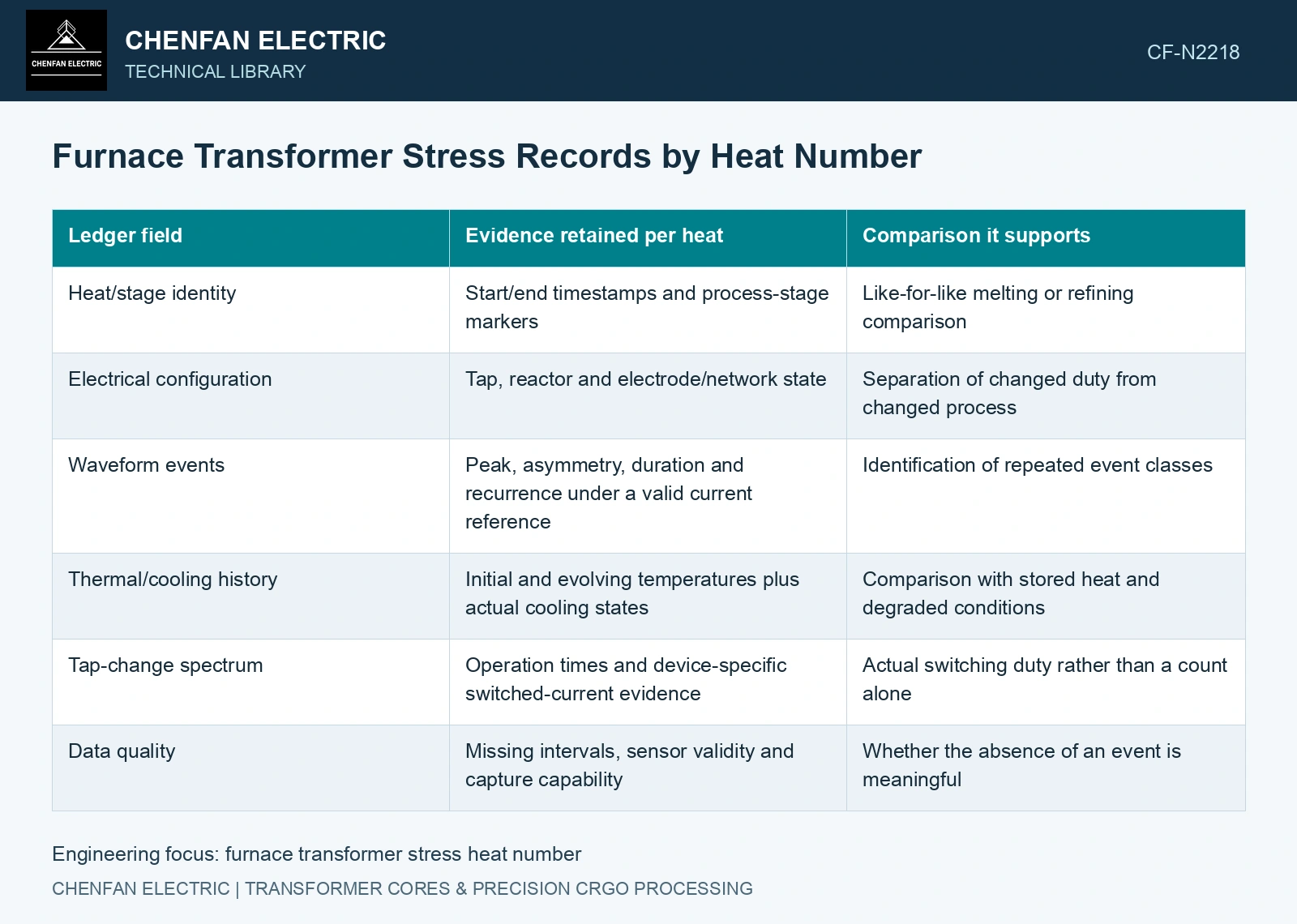
Create a heat-specific stress record
| Ledger field | Evidence retained per heat | Comparison it supports |
|---|---|---|
| Heat/stage identity | Start/end timestamps and process-stage markers | Like-for-like melting or refining comparison |
| Electrical configuration | Tap, reactor and electrode/network state | Separation of changed duty from changed process |
| Waveform events | Peak, asymmetry, duration and recurrence under a valid current reference | Identification of repeated event classes |
| Thermal/cooling history | Initial and evolving temperatures plus actual cooling states | Comparison with stored heat and degraded conditions |
| Tap-change spectrum | Operation times and device-specific switched-current evidence | Actual switching duty rather than a count alone |
| Data quality | Missing intervals, sensor validity and capture capability | Whether the absence of an event is meaningful |
Extract features with their measurement limits
A current-square integral ∫i²dt can describe one event’s resistive-energy input when its current and resistance boundary are defined. Peak current, phase asymmetry and repetition remain separate features. They should not be collapsed into one undocumented stress score.
Identify the recorder’s bandwidth and trigger behavior. A heat with no stored peak may have had no event, or the event may have occurred outside capture. Mark missing or clipped evidence rather than assigning zero stress.
Normalize comparisons by relevant duty
Compare similar stages, configurations and thermal starting conditions. A longer heat can accumulate more total current-square time without having a higher peak. A hotter starting state can be more restrictive even when the electrical waveform appears similar.
Keep process output separate from equipment stress. A production improvement does not prove lower transformer duty. Conversely, a changed waveform may be an intended process shift that needs a revised qualification rather than an unexplained fault label.
Investigate repeated anomalies
Link recurring event classes to tap states, electrode travel or cooling combinations, then test the proposed mechanism with appropriate evidence. Correlation with a heat-stage marker is a lead, not unique causation. Preserve other changes on the same timeline.
Manufacturer tap-changer monitoring research supports recording operation-specific parameters for its devices, but it does not supply a winding remaining-life algorithm. Do not transfer an OLTC wear calculation to the entire furnace transformer.
Use the heat ledger to target repeated stress, inspection and missing data. Calculate life consumption only with an applicable validated model and condition evidence; otherwise retain the result as a stress history.
Keep each heat pulse in the stress ledger
Electrical loss and impedance calculations require one declared current and terminal reference [2]. Furnace tap-changer evidence must retain the current and operating history of each switching event [3].
Assume one heat has ten 10 kA RMS, 1 s pulses and another has two 20 kA, 1 s pulses in the same section. Their sums of I²t are 1,000 and 800 (kA)²·s. At assumed equal, fixed resistance, the first has 25% greater resistive energy despite the lower current peaks. Retain peak-force and cycle-count evidence separately when ranking the two heats.
References
- IEEE, IEEE C57.17-2012, IEEE Standard Requirements for Arc Furnace Transformers (Inactive-Reserved).
- U.S. Department of Energy, DOE-HDBK-1011/4-92, Electrical Science, Volume 4, 1992.
- S. Rehkopf and L. Kirchner, Furnace Applications in the Upper Performance Segment, Maschinenfabrik Reinhausen, F0407400, June 2022.