

Repeated electrode shorts give furnace windings a duty spectrum of amplitude, waveform and recurrence. Relate that history to support response and validated damage mechanisms to assess the specified repeated service. IEEE C57.17-2012 is listed as Inactive-Reserved; use its furnace-transformer scope as a historical reference while specifying the contract acceptance basis. [1]
Calculation basis. Project-specific values and gates in the illustrative screens below are assumptions; cited catalogue values retain their source test conditions.
Build the event record from actual winding-current evidence or a validated transformation from the measured circuit. A secondary line-current maximum alone may not describe every winding branch, particularly across connection and tap changes.
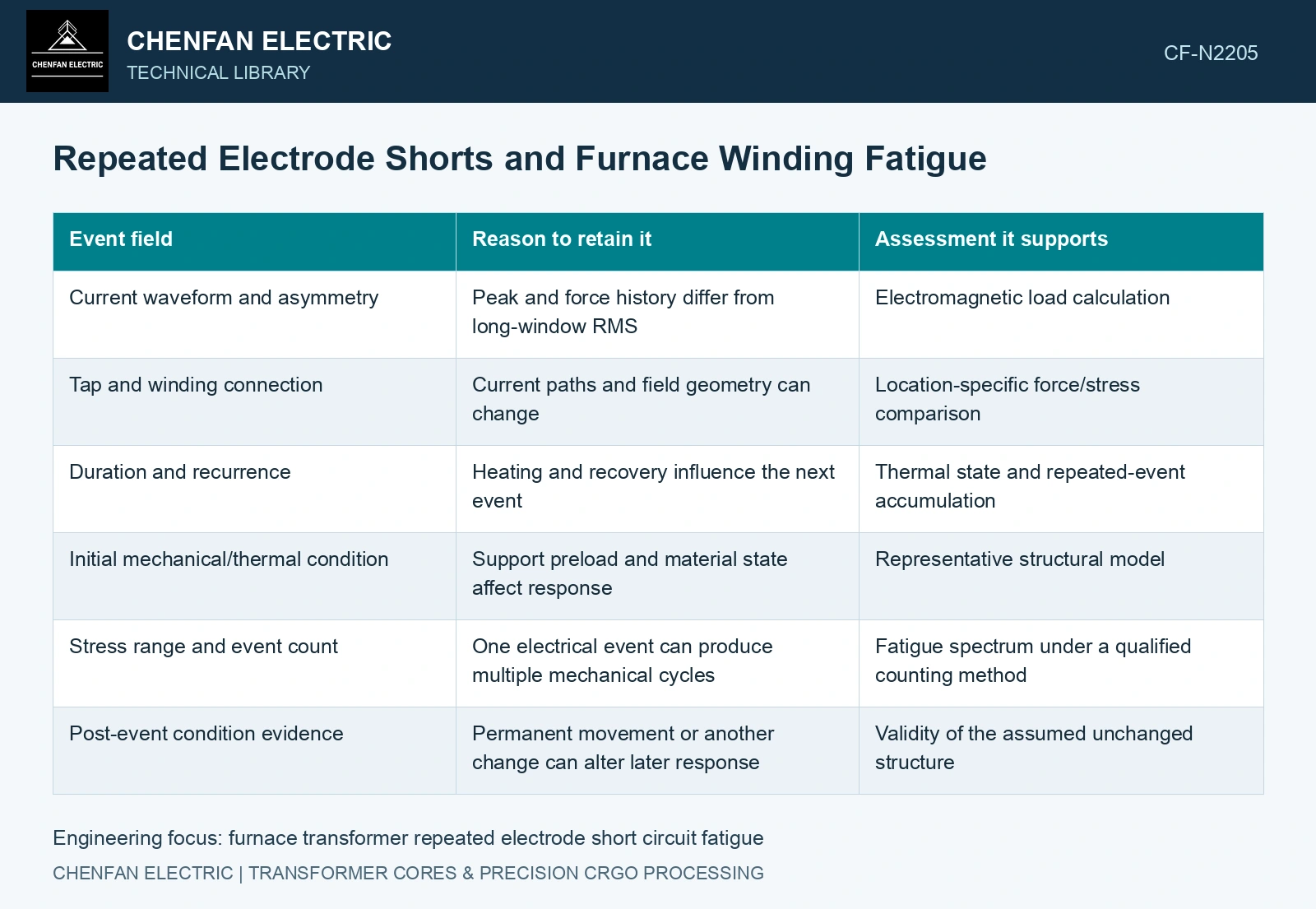
Convert events into a load spectrum
| Event field | Reason to retain it | Assessment it supports |
|---|---|---|
| Current waveform and asymmetry | Peak and force history differ from long-window RMS | Electromagnetic load calculation |
| Tap and winding connection | Current paths and field geometry can change | Location-specific force/stress comparison |
| Duration and recurrence | Heating and recovery influence the next event | Thermal state and repeated-event accumulation |
| Initial mechanical/thermal condition | Support preload and material state affect response | Representative structural model |
| Stress range and event count | One electrical event can produce multiple mechanical cycles | Fatigue spectrum under a qualified counting method |
| Post-event condition evidence | Permanent movement or another change can alter later response | Validity of the assumed unchanged structure |
Keep force scaling within its geometry
For a restricted fixed-geometry, proportionally scaled current/field comparison, force can scale with current squared. An illustrative increase from 80 kA to 120 kA then gives a force-proxy ratio of (120/80)² = 2.25.
This is not a stress or life multiplier. Actual winding forces depend on the complete current and field arrangement; structural motion, nonlinear contact and preload can change the relation to local stress. A force pulse can also excite several response cycles.
Validate the cumulative-damage inputs and mechanism
An explicitly assumed linear damage hypothesis is D = Σni/Ni, where ni is counted cycles in a stress class and Ni is the supported life for that class. It can be considered only with an applicable stress-life basis, counting method and explicit assumptions about sequence and material behavior.
Transformer support systems can involve contact, friction, insulation compression and permanent movement that a simple metal fatigue curve does not represent. The applicable Ni must be established independently for the actual material and stress cycle. An electrical event count cannot be substituted directly for a qualified structural cycle count.
Retain model validity after severe events
If an event changes support or winding position, later events may act on a different structure. Reassess that boundary rather than continuing an unchanged accumulation spreadsheet. Event inspections and relevant condition evidence can help identify the change, within their actual sensitivity.
Specify repeated duty through its actual history and structural response. Retain a single withstand result for its defined event and validate the cumulative-damage hypothesis used for repeated-service qualification.
Keep peak-force cycles separate from accumulated heat
Repeated alternating stress requires material-specific fatigue evidence [2].
Assume 100 electrode-short pulses at 10 kA RMS and 25 at 20 kA, all with 0.10 s duration. Both sets give 1,000 (kA)²·s, but the 20 kA set has four times the current-squared peak-force scale and one quarter the pulse count. Neither equal energy nor cycle count alone establishes winding fatigue equivalence.
References
- IEEE, IEEE C57.17-2012, IEEE Standard Requirements for Arc Furnace Transformers (Inactive-Reserved).
- U.S. Department of Energy, DOE-HDBK-1017/2-93, Material Science, Volume 2, 1993, Plant Material Problems.