

Mixing rate follows the installed oil network, even for miscible liquids. Trace density effects and low-exchange volumes to establish where old composition can persist during circulation. [1]
Calculation basis. Project-specific values and gates in the illustrative screens below are assumptions; cited catalogue values retain their source test conditions.
Identify the liquid densities at the same temperature and composition basis. Temperature itself changes density, so a warm return and a cold tank region can add another buoyancy boundary. Do not assign every observed composition difference solely to the pure products’ density difference.
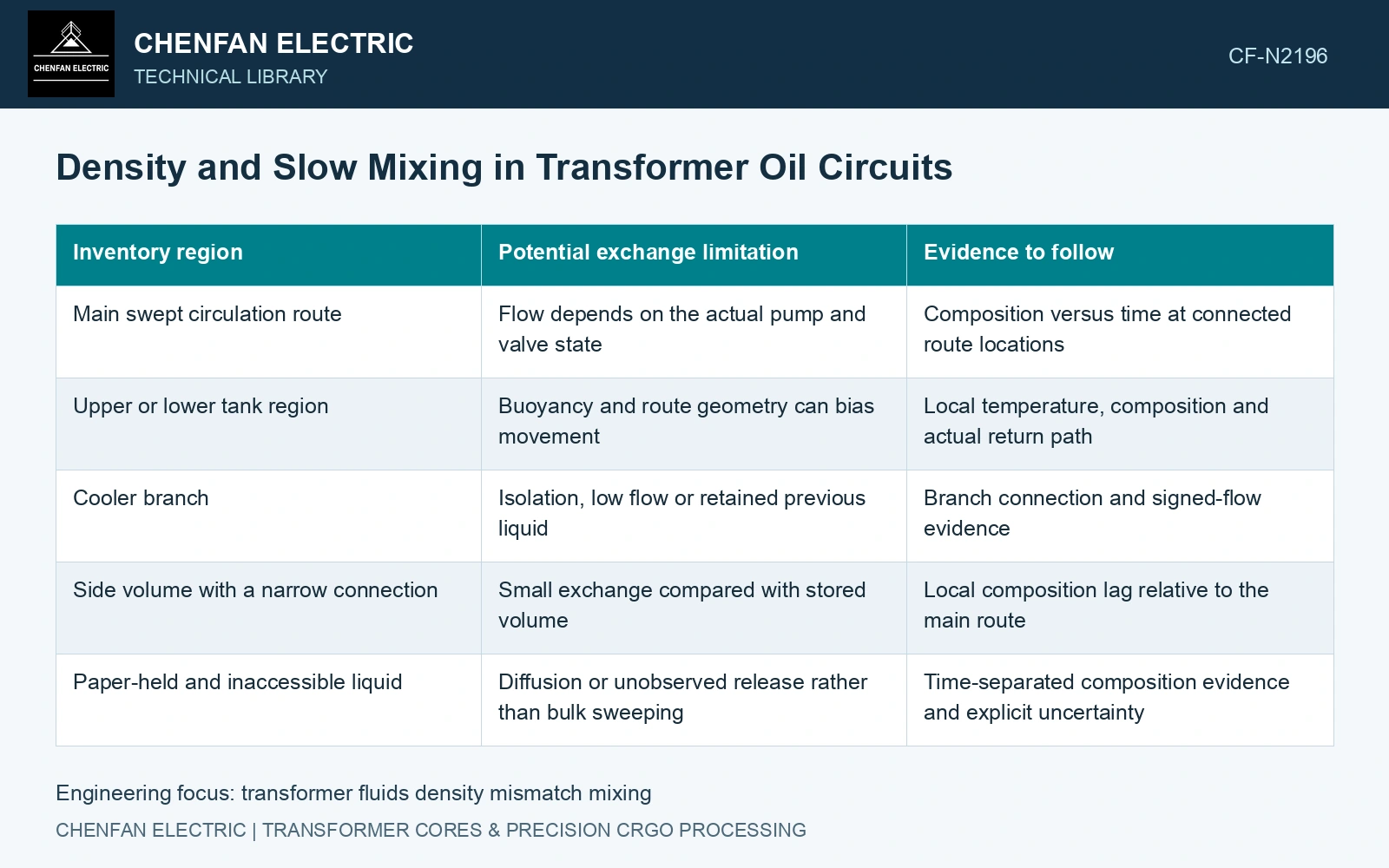
Map the exchange paths
| Inventory region | Potential exchange limitation | Evidence to follow |
|---|---|---|
| Main swept circulation route | Flow depends on the actual pump and valve state | Composition versus time at connected route locations |
| Upper or lower tank region | Buoyancy and route geometry can bias movement | Local temperature, composition and actual return path |
| Cooler branch | Isolation, low flow or retained previous liquid | Branch connection and signed-flow evidence |
| Side volume with a narrow connection | Small exchange compared with stored volume | Local composition lag relative to the main route |
| Paper-held and inaccessible liquid | Diffusion or unobserved release rather than bulk sweeping | Time-separated composition evidence and explicit uncertainty |
Compare exchange with stored volume
For an illustrative well-mixed side volume V exchanging at constant flow q with a main stream of fixed composition cmain, dc/dt = (q/V)(cmain − c). The characteristic time is τ = V/q. This is a restricted compartment model, not proof that the actual side cavity is well mixed.
Assume V = 1 L and q = 0.01 L/min. Then τ = 100 minutes, and after three time constants the model has traversed about 95% of its initial composition difference. The assumed flow and geometry are explanatory; they do not prescribe a circulation duration for a transformer.
Treat buoyancy as part of the flow problem
A denser incoming stream can favor particular routes under some arrangements, while sufficient forced circulation can reshape that pattern. The direction and persistence depend on injection location, temperatures and actual momentum. Two miscible liquids need not form a permanent interface to produce a temporary gradient.
Use composition measurements or an approved analytical marker to follow the identified liquids. A density observation alone may be confounded by temperature or contaminants.
Locate the route that remains slow
Compare time histories from accessible connected regions under documented circulation states. A main return stabilizing before a side volume is evidence about those measured paths, not a contradiction. Keep the sampling delay and port residuals separate from actual compartment exchange.
Where a slow region controls a property or component exposure, include it in the conversion assessment. A total pump-flow number does not establish exchange through every cavity.
Resolve low-exchange routes and verify composition there. Carry possible retained mixture in the property and material assessment where inaccessible volumes remain uncertain.
Bound turnover in a weakly exchanged pocket
Define stored volume and actual exchange flow consistently with the flow balance [2]. The exponential below follows the explicitly assumed well-mixed compartment.
For the assumed 1 L pocket exchanging 0.01 L/min with a well-mixed main circuit, τ = 100 min. Residual composition difference after 300 min is e⁻³ = 4.98%; after 500 min it is e⁻⁵ = 0.674%. Qualify the exchange flow and geometry before using this exponential model to choose a sampling time.
References
- M. Lyutikova, S. Korobeynikov, U. Mohan Rao and I. Fofana, Mixed Insulating Liquids with Mineral Oil for High Voltage Transformer Applications: A Review, IEEE Transactions on Dielectrics and Electrical Insulation, 2022. DOI: 10.1109/TDEI.2022.3157908.
- U.S. Department of Energy, DOE-HDBK-1012/3-92, Thermodynamics, Heat Transfer, and Fluid Flow, Volume 3, 1992.