

Cold blend stability depends on composition and hold history. Map haze, crystals and recovery in the actual mixture to locate the liquid state that governs further equipment assessment. [1]
Calculation basis. Project-specific values and gates in the illustrative screens below are assumptions; cited catalogue values retain their source test conditions.
Retain the actual starting products, condition and ratio basis. Composition changes from aging, retained liquid or later additions can shift the relevant boundary. The cold trial should cover the blend range the equipment can actually contain.
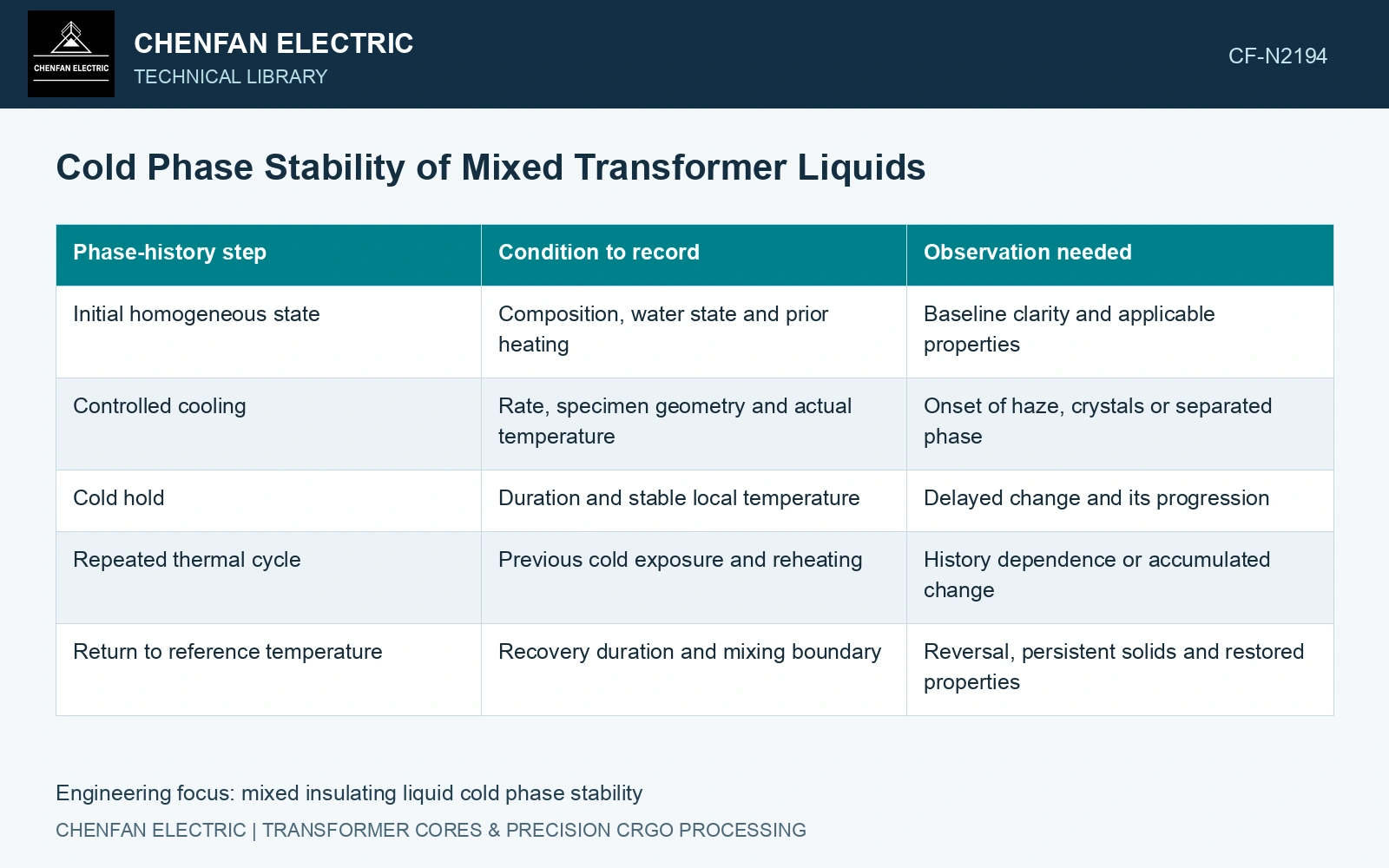
Map cooling, holding and recovery as one sequence
| Phase-history step | Condition to record | Observation needed |
|---|---|---|
| Initial homogeneous state | Composition, water state and prior heating | Baseline clarity and applicable properties |
| Controlled cooling | Rate, specimen geometry and actual temperature | Onset of haze, crystals or separated phase |
| Cold hold | Duration and stable local temperature | Delayed change and its progression |
| Repeated thermal cycle | Previous cold exposure and reheating | History dependence or accumulated change |
| Return to reference temperature | Recovery duration and mixing boundary | Reversal, persistent solids and restored properties |
Identify what the haze actually represents
Haze can arise from crystals, water-related effects, fine particles or another dispersed phase. Visual appearance alone does not identify the mechanism. Use suitable analysis or controlled comparisons to distinguish those candidates before calling the blend immiscible.
Include liquid-only controls and relevant water/contamination evidence. A temperature-induced change present in one starting liquid is different from a new effect that appears only in the blend. A clear warm sample after reheating does not erase the earlier cold state.
Separate phase behavior from flow permission
A specimen may remain capable of some flow while its viscosity and phase distribution change substantially. Conversely, a standard pour-point observation does not fully characterize circulation through narrow transformer passages or accessory movement. Use actual viscosity and relevant equipment evidence alongside the phase observations.
The mixed-liquid review identifies low-temperature cold-start behavior as an unresolved mixture-specific assessment [1]. Do not transfer a pure-product crystal map to an arbitrary blend. The specimen volume, cooling route and hold condition must remain identified.
Track whether the property recovers
After returning to the reference condition, examine clarity, composition where relevant and the properties that control the intended duty. Reversible appearance is not by itself proof that every electrical or hydraulic property returned to baseline.
If material remains deposited, identify it and assess whether the preparation or cooling sequence changed the liquid inventory. If all observations recover, state the exact cycle and composition that were demonstrated rather than declaring unlimited low-temperature stability.
Use the cold-state map to target pump, circulation and dielectric assessment. Establish operating permission on the complete equipment and liquid boundary with its approved conditions.
Sample through the cold hold as well as the warm state
Material/liquid compatibility remains a separate contact-system question [2]; it does not provide a cold-phase stability threshold.
Assume a blend is clear at 20 °C but a controlled −10 °C hold produces 0.50 g separated phase from a 100 g specimen. The separated mass fraction is 0.50%. Warming until the phase disappears does not erase the cold-state observation. Assess the minimum-temperature hold, remixing and flow consequences against the intended duty.
References
- M. Lyutikova, S. Korobeynikov, U. Mohan Rao and I. Fofana, Mixed Insulating Liquids with Mineral Oil for High Voltage Transformer Applications: A Review, IEEE Transactions on Dielectrics and Electrical Insulation, 2022. DOI: 10.1109/TDEI.2022.3157908.
- IEC, IEC 63177:2024, Test methods for compatibility of construction materials with electrical insulating liquids.