

Streaming charge in an oil–ester blend depends on the liquid, contacted wall and flow together. Test generation and relaxation across that matrix to define the region needing equipment-level assessment. [1]
Calculation basis. Project-specific values and gates in the illustrative screens below are assumptions; cited catalogue values retain their source test conditions.
Identify the cellulose surface, prior impregnation, age and liquid history. A new dry coupon and an aged paper channel do not define the same interface. The test must preserve those distinctions alongside flow and temperature.
Separate generation from transport and relaxation
At a defined observation boundary, a restricted steady relation is convected charge density ρq = Icharge/Q, with current in A and volumetric flow in m³/s giving C/m³. This applies only when the measured current represents the relevant transported charge and the stated collection boundary; stray currents or wall leakage can invalidate the interpretation.
A homogeneous ohmic screening timescale is τ = ε/σ, using absolute permittivity and conductivity. It describes a restricted charge-relaxation model, not the complete generation process in an actual channel. Neither equation makes blend behavior linear in composition.
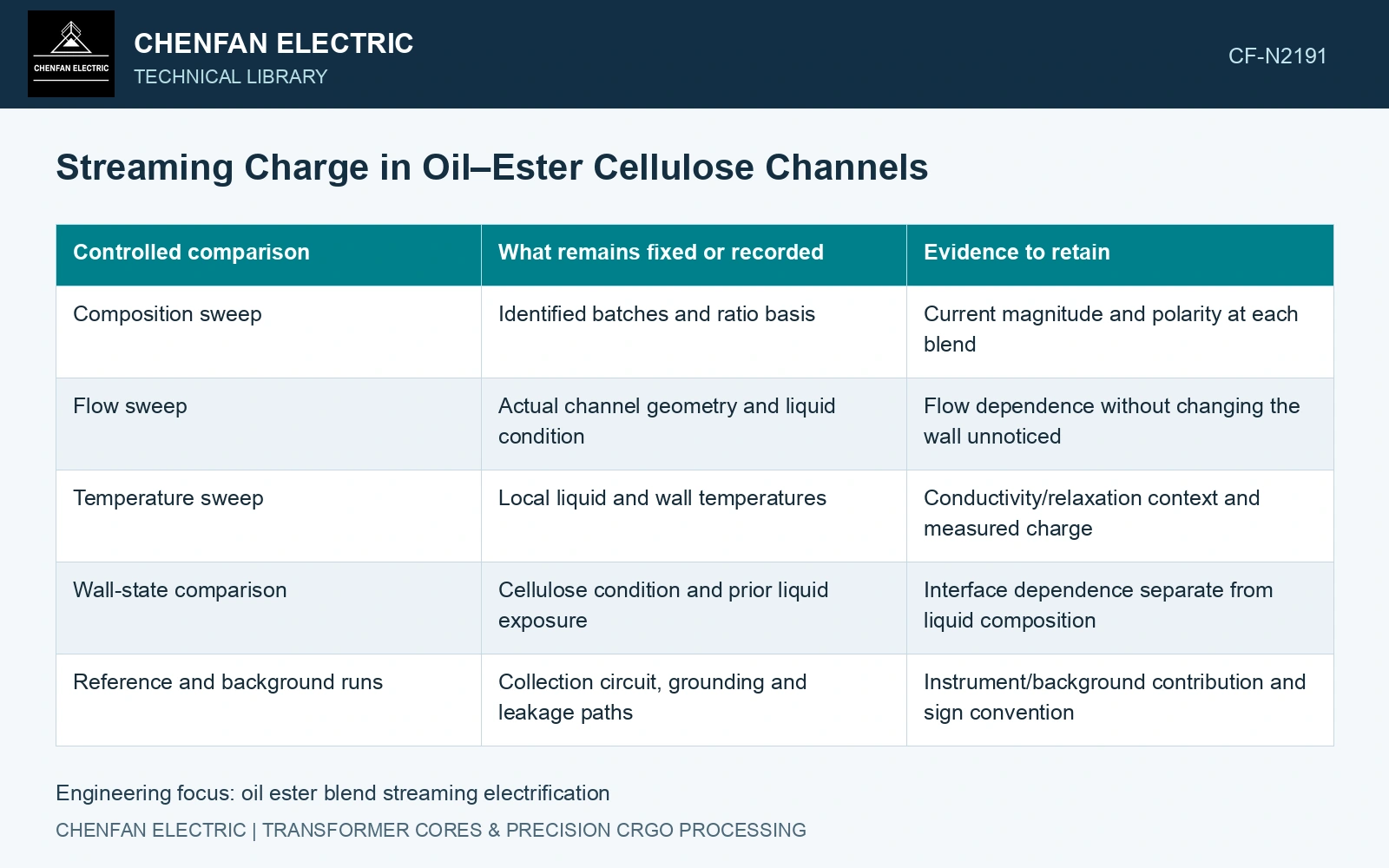
| Controlled comparison | What remains fixed or recorded | Evidence to retain |
|---|---|---|
| Composition sweep | Identified batches and ratio basis | Current magnitude and polarity at each blend |
| Flow sweep | Actual channel geometry and liquid condition | Flow dependence without changing the wall unnoticed |
| Temperature sweep | Local liquid and wall temperatures | Conductivity/relaxation context and measured charge |
| Wall-state comparison | Cellulose condition and prior liquid exposure | Interface dependence separate from liquid composition |
| Reference and background runs | Collection circuit, grounding and leakage paths | Instrument/background contribution and sign convention |
Keep the collection boundary explicit
Record where current is measured and how charge can return or dissipate before reaching that point. A longer transfer route can alter the observed current without changing the upstream generation. Electrical grounding and sensor construction must remain part of the qualified apparatus.
Retain polarity rather than reporting only an absolute magnitude. A composition-dependent sign change is a different observation from a smaller current of the same sign. Repeatability and settling behavior are needed before interpreting either as a material effect.
Control composition while preserving the test boundary
Changing liquids can condition the cellulose and leave retained previous fluid. The next run may therefore differ in both blend and wall state. Use a justified specimen sequence, cleaning/conditioning boundary or separate specimens, and report what cannot be reset.
Control water and contamination relevant to the comparison. A blend prepared from differently conditioned starting liquids can otherwise attribute their moisture or aging difference to ester fraction.
Transfer the laboratory findings through actual flow routes, electrical boundaries and material state. Use the matrix to identify the conditions requiring further equipment assessment.
Put streaming-current results on a flow basis
Keep cellulose/liquid material qualification within IEC 63177’s contact-system scope [2]; the streaming-current comparison below uses an explicitly assumed measurement circuit, not a standard acceptance value.
Assume an identified cellulose channel produces 20 nA streaming current at 1 L/min and 50 nA at 2 L/min under the same liquid temperature and conditioning. Charge carried per volume is I/Q: 1.20 mC/m³ and 1.50 mC/m³ respectively. The 25% increase shows that doubling flow did more than double charge transport. Retain channel state and measurement polarity in the comparison.
References
- M. Lyutikova, S. Korobeynikov, U. Mohan Rao and I. Fofana, Mixed Insulating Liquids with Mineral Oil for High Voltage Transformer Applications: A Review, IEEE Transactions on Dielectrics and Electrical Insulation, 2022. DOI: 10.1109/TDEI.2022.3157908.
- IEC, IEC 63177:2024, Test methods for compatibility of construction materials with electrical insulating liquids.