

Synthetic-ester adhesive qualification needs the actual liquid chemistry and cured joint construction. Verify that system under representative temperature and loading before transferring a material compatibility claim. [1]
Calculation basis. Project-specific values and gates in the illustrative screens below are assumptions; cited catalogue values retain their source test conditions.
Define what the bond does in the transformer: holding a spacer, retaining an insulating part or another specific duty. Liquid exposure can affect the adhesive, substrate or interface, and the failure location determines which element needs attention.
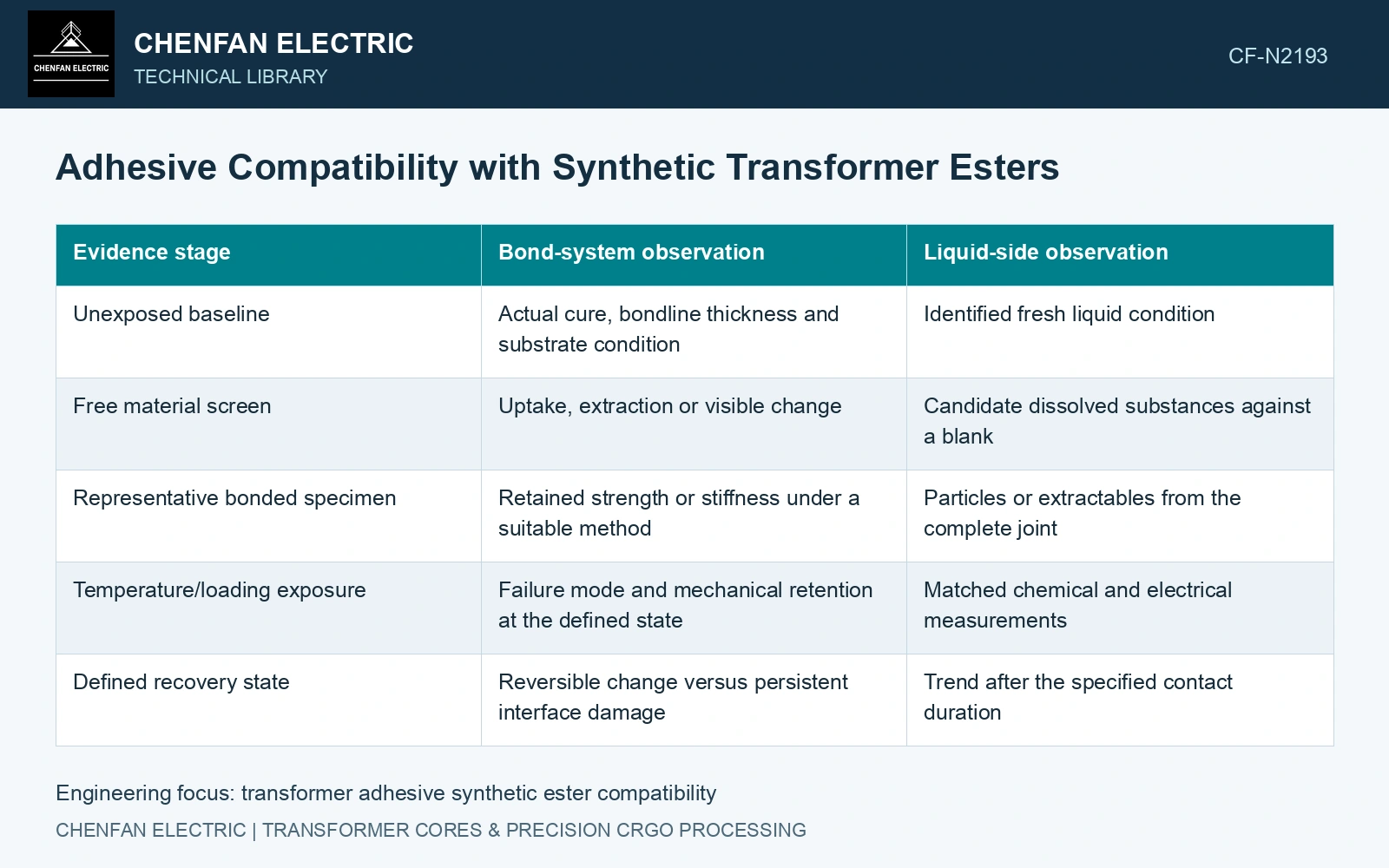
Test the bonded system in both directions
| Evidence stage | Bond-system observation | Liquid-side observation |
|---|---|---|
| Unexposed baseline | Actual cure, bondline thickness and substrate condition | Identified fresh liquid condition |
| Free material screen | Uptake, extraction or visible change | Candidate dissolved substances against a blank |
| Representative bonded specimen | Retained strength or stiffness under a suitable method | Particles or extractables from the complete joint |
| Temperature/loading exposure | Failure mode and mechanical retention at the defined state | Matched chemical and electrical measurements |
| Defined recovery state | Reversible change versus persistent interface damage | Trend after the specified contact duration |
Preserve the mechanical boundary
A lap-shear specimen, peel specimen and loaded spacer joint stress the adhesive differently. Choose a method relevant to the function and retain its limits. An unbonded resin coupon can screen chemical response but does not qualify adhesion to pressboard, metal or another substrate.
A restricted strength-retention ratio is Fexposed/Fbaseline for matched specimen geometry and test condition. The ratio is comparative, not a permissible load for the actual transformer part. Different areas, failure modes or temperatures can invalidate the comparison.
Check cure and exposure history
The supplied adhesive may behave differently when undercured, aged or previously exposed to mineral oil. Residual solvent or unreacted constituents can affect both bond strength and liquid contamination. Use the actual cure evidence rather than assuming every specimen with the same product name is equivalent.
Include the credible liquid composition range if the conversion leaves retained previous fluid. A pure synthetic-ester test and a changing mineral/synthetic blend are separate exposure boundaries. Material evidence from a natural ester remains a different boundary again.
Interpret liquid and bond results together
Measure relevant liquid properties under matched moisture and temperature conditions. A mechanical pass does not demonstrate absence of contamination; a clean-looking liquid does not establish retained bond function. Analytical nondetection also has its stated method limits.
Record whether failure is cohesive in the adhesive, at the substrate interface or within the substrate. A lower measured force caused by pressboard damage should not be described simply as adhesive incompatibility. The joint’s service consequence still needs assessment.
Approve the identified cured joint within the supported liquid, temperature and load range. Add representative joint tests where supplier evidence covers another ester or free resin alone.
Compare bonded strength after the actual ester exposure
IEC 63177 addresses construction-material/liquid compatibility; retain that scope when qualifying the actual contact system [2].
Assume matched adhesive coupons average 20 MPa before aging and 14 MPa after the specified synthetic-ester exposure, with the same loading direction and conditioning. Strength retention is 70%. If the assumed project qualification gate requires 80%, the result misses it by 10 percentage points. Resolve the failure location and variability before approving the bonded component.
References
- M. Lyutikova, S. Korobeynikov, U. Mohan Rao and I. Fofana, Mixed Insulating Liquids with Mineral Oil for High Voltage Transformer Applications: A Review, IEEE Transactions on Dielectrics and Electrical Insulation, 2022. DOI: 10.1109/TDEI.2022.3157908.
- IEC, IEC 63177:2024, Test methods for compatibility of construction materials with electrical insulating liquids.