

A fair manual-versus-robotic core trial compares the same material, joints, restraint and test conditions. Measure loss distribution alongside throughput and rework to choose the assembly route on demonstrated results.
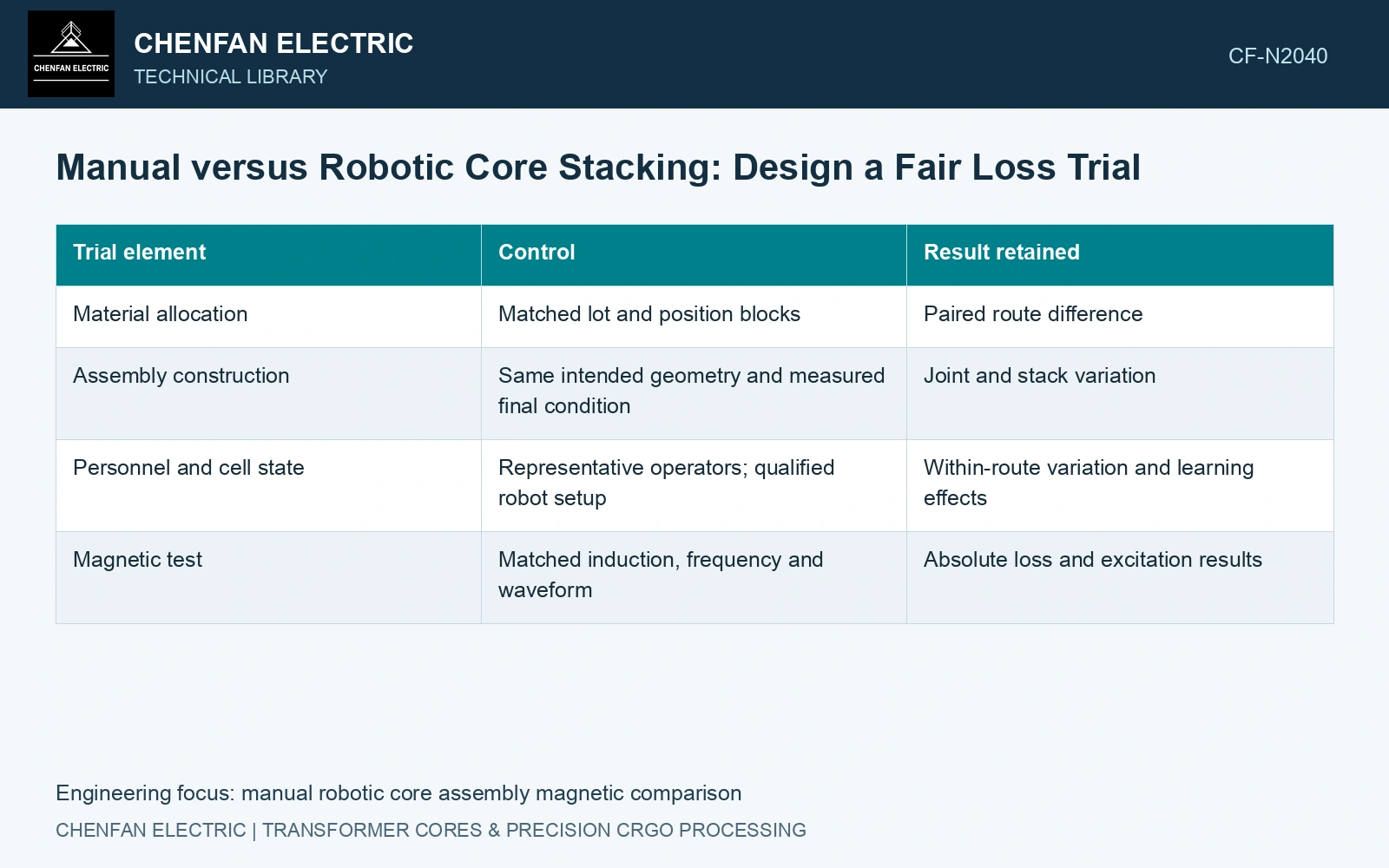
Pair the material and construction
Allocate matched material from the same relevant lots and coil positions to both routes. Retain grade, gauge, treatment, cutting preparation and orientation. Use the same drawing and acceptance targets for joint pattern, gap, stack and restraint.
If each route requires a different fixture or handling step, document that difference. It may be part of the practical route comparison, but it prevents attributing the outcome solely to the act of robotic versus manual placement. Do not silently optimize one route while leaving the other at an unrepresentative condition.
| Trial element | Control | Result retained |
|---|---|---|
| Material allocation | Matched lot and position blocks | Paired route difference |
| Assembly construction | Same intended geometry and measured final condition | Joint and stack variation |
| Personnel and cell state | Representative operators; qualified robot setup | Within-route variation and learning effects |
| Magnetic test | Matched induction, frequency and waveform | Absolute loss and excitation results |
Replicate complete assemblies in the loss trial
Repeating the magnetic measurement on one core estimates test repeatability. It does not estimate assembly variation. Include independent assemblies within each route, or a justified rebuild design that addresses material changes introduced by repeated handling.
Distribute the trial order so that instrument drift, operator learning or changing environmental conditions do not align with one route. Record rejected or reworked assemblies and their reasons. Selecting only the best robotic core and an average manual core would answer a different question.
Compare the distribution as well as the mean
Report absolute core loss, paired differences and the spread within each route. Include excitation if it matters to the decision. A route may reduce variation without a resolvable change in mean loss, or reduce mean loss while introducing occasional alignment outliers.
Use the observed variability and measurement uncertainty to judge whether a difference is distinguishable and practically relevant. An apparently lower average from a small uncontrolled trial cannot establish a production-wide advantage.
Separate robot position/orientation accuracy from the magnetic result of the completed assembly. A route comparison needs matched material and joint construction as well as a qualified metrology chain; neither route earns a lower-loss ranking from its level of automation. [1]
At 1.7 T, 50 Hz, assume matched 1,000 kg 23ZH90 builds; catalogue ≤0.90 W/kg gives a common 900 W strip budget [2], not an assembled-core limit. Assume manual/robot core losses 1,020/1,000 W and standard uncertainty of their paired difference 15 W. The 20 W advantage has a stated ±2u interval −10 to +50 W [3]; zero is included. Do not rank loss performance from this pair. Preserve material/construction blocking, improve discrimination and independently compare defects, throughput and rework before selecting the route.
Match burr state, rolling direction, overlap gaps, sheet sequence and final clamp pressure. Otherwise a route comparison confounds stacking method with a different magnetic construction.
Choose the route using the measured magnetic distribution together with throughput, rework and handling evidence. Keep the magnetic conclusion tied to the material, construction and qualified operating condition that the trial actually compared.
References
- G. Qiao and B. A. Weiss, Industrial Robot Accuracy Degradation Monitoring and Quick Health Assessment, Journal of Manufacturing Science and Engineering 141, 2019. DOI: 10.1115/1.4043649.
- Nippon Steel Corporation, Grain-Oriented Electrical Steel Sheets, catalogue D004je, April 2020, specification and typical-property tables.
- B. N. Taylor and C. E. Kuyatt, NIST Technical Note 1297, Guidelines for Evaluating and Expressing the Uncertainty of NIST Measurement Results, 1994, sections 5 and 6.