

A reject buffer must account for the physical lamination and restore the intended step-lap sequence. Track the sheet from tool to identified buffer and confirm its replacement before production continues.
Separate three state dimensions
Track disposition as pending review, accepted for a defined use or rejected. Track physical location separately: source, tool, production stack, identified buffer position or confirmed removal. Track replacement demand against the exact job and sequence position. These dimensions must agree before the cell advances the affected sequence.
A part awaiting inspection is not yet scrap. A rejected part is not automatically absent from the tool. An empty buffer position in software is not physically empty until the corresponding removal has been confirmed.
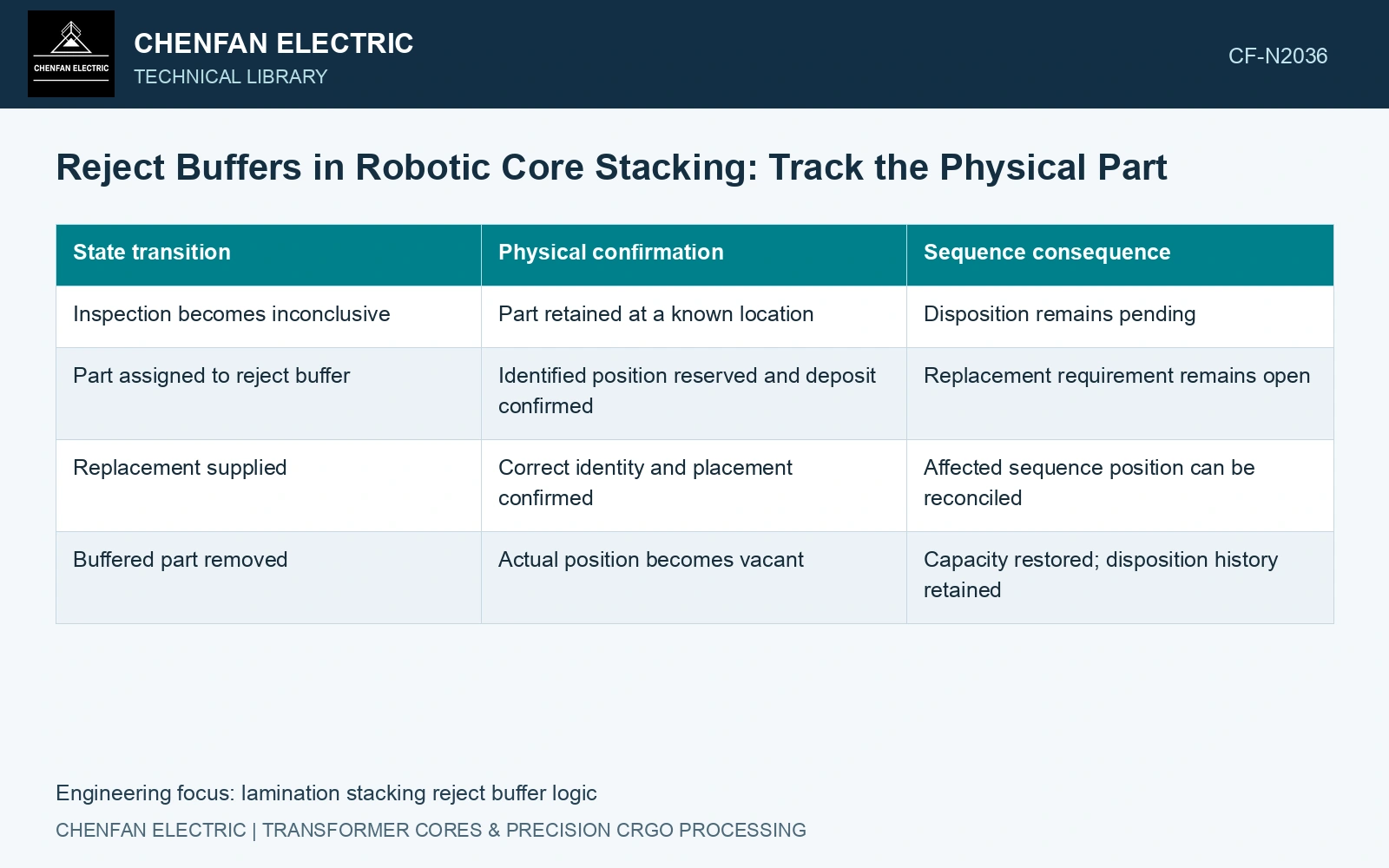
| State transition | Physical confirmation | Sequence consequence |
|---|---|---|
| Inspection becomes inconclusive | Part retained at a known location | Disposition remains pending |
| Part assigned to reject buffer | Identified position reserved and deposit confirmed | Replacement requirement remains open |
| Replacement supplied | Correct identity and placement confirmed | Affected sequence position can be reconciled |
| Buffered part removed | Actual position becomes vacant | Capacity restored; disposition history retained |
Count confirmed occupancy
In a simple buffer, occupancy equals initial confirmed occupancy plus confirmed deposits minus confirmed removals. Reservations also consume planning capacity, but they should not be confused with physically occupied positions. If a transfer stops between reservation and deposit, retain that intermediate state.
Test the full-buffer condition before relying on routine rejection flow. The cell needs a defined response when it cannot allocate a valid destination. Silently placing the part in an overflow area breaks physical identity and may allow it to return to production unnoticed.
Challenge interacting exceptions
Include a pending part while a replacement is being prepared, a buffer removal during a paused job and a transfer interruption after reservation. NIST’s combinatorial-testing overview supports examining interactions between input conditions. It does not imply that isolated successful tests establish all combinations. [1]
Use segregated validation material and the authorized operating procedure. Record the part’s actual location at each transition and compare it with software state. When an operator intervenes, reconcile the physical event before freeing the buffer position or closing the replacement demand.
Use catalogue gauge 0.23 mm and density 7,650 kg/m³ [2]. An assumed 1.0 × 0.20 m sheet is 0.3519 kg; nine/ten sheets are 3.1671/3.5190 kg. Assume corrected weighing result 3.519 kg with expanded uncertainty ±0.020 kg, and negligible mass-model uncertainty in this exercise. Its 3.499–3.539 kg interval excludes nine sheets. If software reports nine, stop the next transfer and reconcile the extra physical sheet and reserved positions. Weight flags occupancy conflict, not part identity or permission to release a rejected sheet.
Buffer control must preserve lamination identity, rejection cause and permitted re-entry state. Keep rejected or doubled picks physically separated from release-ready sheets and from each other.
Close the exception with the rejected part physically accounted for and the correct core sequence restored. Record both outcomes in the buffer history.
References
- NIST, Combinatorial Testing, programme and method overview.
- Nippon Steel Corporation, Grain-Oriented Electrical Steel Sheets, catalogue D004je, April 2020, specification and typical-property tables.