

A load controller acts on a condition that occurred before the action reaches the device. The delay includes more than message transit. Measurement aggregation, queued processing, scheduling intervals and device execution can all contribute. Treating them as one nominal network latency obscures which delay changes the closed-loop behavior. [1]
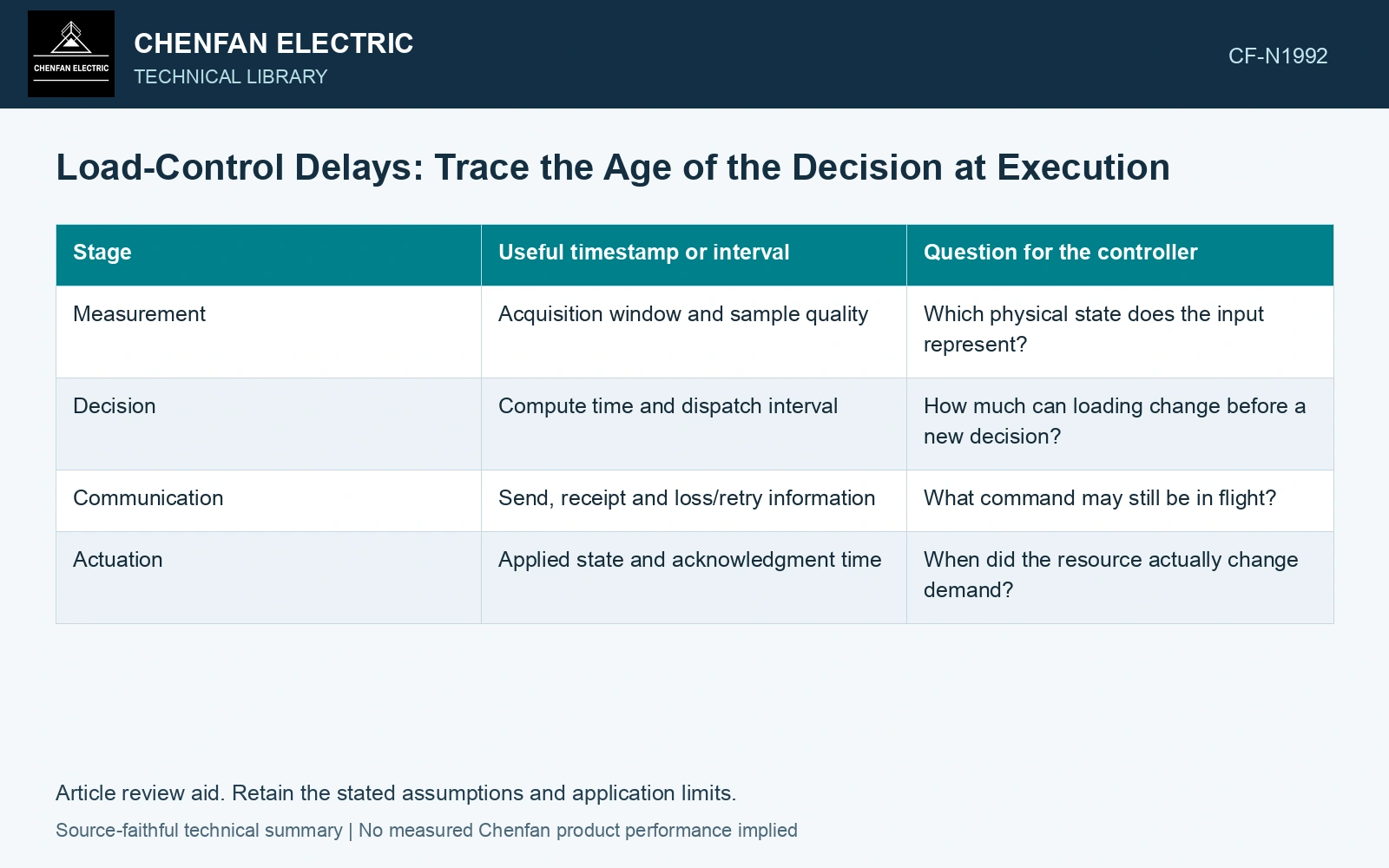
Put every stage on the same time base
Retain acquisition window, receipt, decision and applied-state times on one verified base. NIST OT guidance notes that inaccurate device clocks yield inaccurate event timestamps [2]. Fast message transit cannot recover information already delayed by a measurement window.
| Stage | Useful timestamp or interval | Question for the controller |
|---|---|---|
| Measurement | Acquisition window and sample quality | Which physical state does the input represent? |
| Decision | Compute time and dispatch interval | How much can loading change before a new decision? |
| Communication | Send, receipt and loss/retry information | What command may still be in flight? |
| Actuation | Applied state and acknowledgment time | When did the resource actually change demand? |
Test delay variation, not just one fixed delay
Use the recorded or specified range of delays, including a credible loss-and-retry case. Examine both increasing and decreasing uncontrolled load while commands are pending. A controller tuned for a constant delay may respond differently when the delay changes between intervals.
Research on recursive EV reactive-power control demonstrates that delay must be included in the particular controller model. Its stability conditions belong to that model and its assumptions. They cannot certify a different dispatch algorithm, sampling interval or actuator response simply because both systems communicate slowly.
Keep pending actions in the state estimate
If the estimator assumes a commanded reduction has already occurred, it can authorize another load increase before the reduction is applied. Track the distinction between requested, acknowledged and measured response. Avoid counting the same pending relief twice when another scheduling cycle begins.
Review whether delayed responses produce overshoot or synchronized correction. A proposed change in gain, scheduling interval or minimum hold time needs evaluation with the actual delay and device population. A generic fixed setting would conceal the dependency rather than resolve it.
Local protection remains a separate boundary
The communications controller should have a defined degraded mode and a way to identify stale decisions. Equipment protection should not depend on the scheduling service remaining available. The trial output should pair current and thermal trajectories with the measured timing chain, pending commands and fallback transitions.
That record distinguishes a slow but predictable control path from one whose latency or execution state is uncertain. It also identifies the change with the most value: a shorter measurement window, a corrected clock, a better acknowledgment or a controller that explicitly accounts for pending actions.
References
- A. Jain and M. Karimi-Ghartemani, Mitigating Adverse Impacts of Increased Electric Vehicle Charging on Distribution Transformers, Energies 15, 9023, 2022. DOI: 10.3390/en15239023.
- K. Stouffer et al., NIST SP 800-82 Revision 3, Guide to Operational Technology (OT) Security, September 2023, sections 3.1 and 6.2.12. DOI: 10.6028/NIST.SP.800-82r3.