

A screened oil-paper build can have restricted edge routes rather than one direct surface-to-centre path. The impregnation review describes liquid replacing gas through the porous cellulose structure [1]; map the actual foil, overlap and compressed bend before assigning a cycle.
For an HV instrument transformer, start the impregnation review with the actual layer and screen arrangement. An external vacuum record cannot identify a region that the process fluid reaches only through a long or restricted route.
Distinguish evacuation from penetration
Evacuation reduces gas pressure within connected voids. Liquid admission and subsequent pressure changes then act on a structure whose permeability, wetting behaviour and remaining gas pathways vary locally. An acceptable chamber pressure is evidence of the chamber condition; it is not a direct reading of every enclosed microscopic void.
Map where gas can leave and liquid can enter. A metallic layer may block through-thickness penetration over much of its area, leaving edge routes important. Paper orientation, overlaps and compaction can create different flow resistance along and across layers.
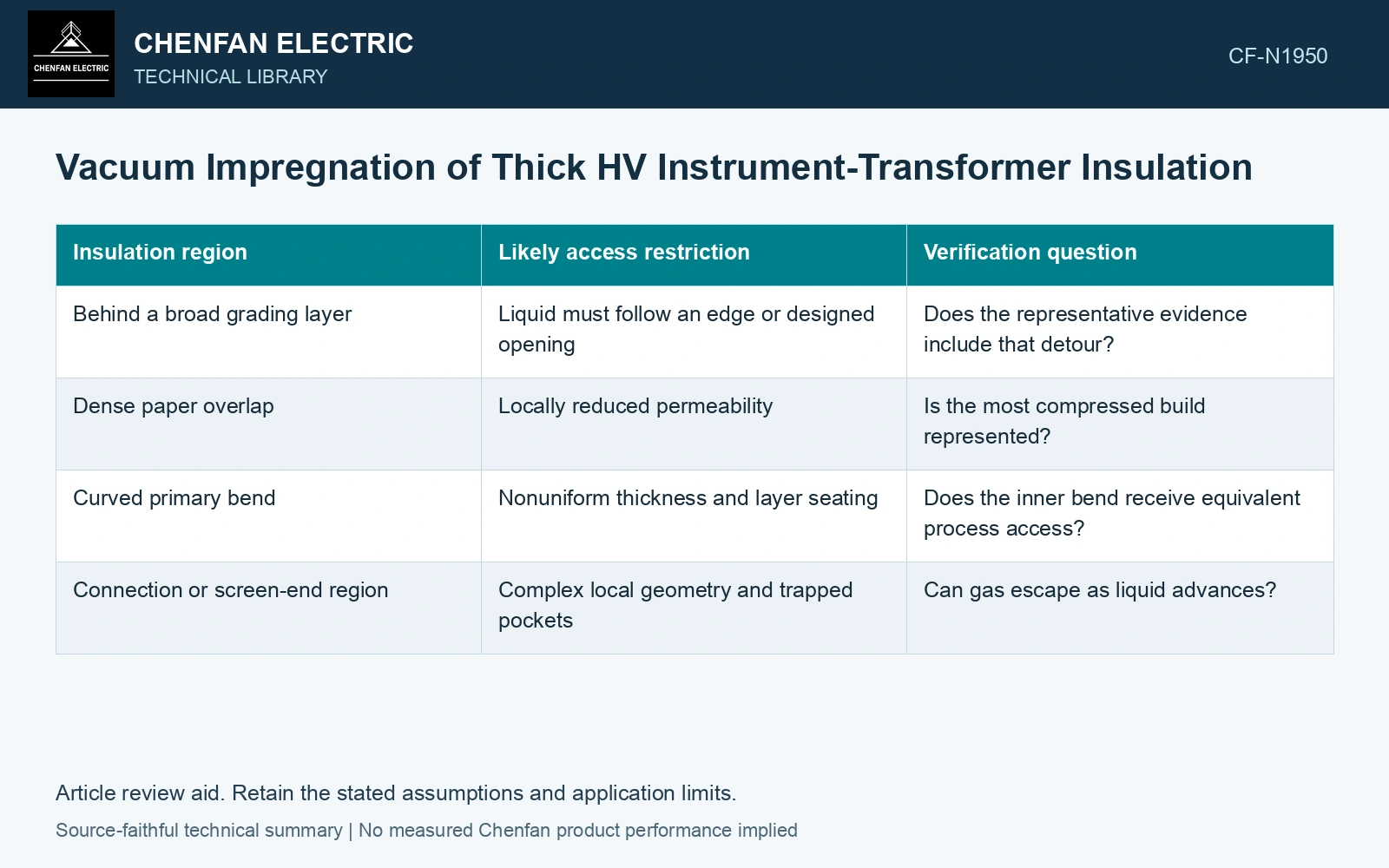
| Insulation region | Likely access restriction | Verification question |
|---|---|---|
| Behind a broad grading layer | Liquid must follow an edge or designed opening | Does the representative evidence include that detour? |
| Dense paper overlap | Locally reduced permeability | Is the most compressed build represented? |
| Curved primary bend | Nonuniform thickness and layer seating | Does the inner bend receive equivalent process access? |
| Connection or screen-end region | Complex local geometry and trapped pockets | Can gas escape as liquid advances? |
Interpret pressure restoration with the internal geometry
Restoring pressure can encourage liquid movement and compress remaining gas, but its effectiveness depends on the connected pathways and the equipment’s permitted process state. It does not convert an isolated pocket into a verified liquid-filled region by definition.
Use the manufacturer’s qualified process with recorded liquid state and temperature. ABB’s insulation discussion identifies voids and manufacturing control as relevant to local dielectric stress [2]; a chamber-pressure record does not measure occupancy of every restricted pocket.
Seek evidence at the difficult region
Process records establish that the approved sequence was followed. Representative samples, development sections or validated physical models can establish why that sequence is adequate for the geometry. Their similarity must include thickness, compression and screen obstruction, not only the same paper material.
Finished dielectric measurements provide another level of evidence, with their own sensitivity and limitations. A passing aggregate result cannot directly reveal the liquid occupancy of every small region. Conversely, an unusual dielectric result may have several causes and needs investigation before being labelled failed impregnation.
For a liquid-penetration teaching screen, use a straight circular capillary, constant pressure difference ΔP and viscosity μ, with freely vented gas and no gravity/capillary-pressure variation. Combining Poiseuille flow with front volume gives L² = r²ΔPt/(4μ) [1]. Assume r = 0.10 μm, μ = 0.010 Pa·s and ΔP = 100 kPa: reaching 5/10 mm takes 1,000/4,000 s. A 30 min dwell reaches only 6.708 mm, covering the first route but not the second. Hold the thicker screened geometry for representative qualification; tortuosity, pressure buildup, wetting and blocked exits invalidate direct use as a factory cycle. This is liquid ingress, not moisture diffusion.
The controlling penetration path is the one the process qualification needs to cover. A shorter route through a loosely packed sample cannot qualify a screened, compressed bend. Chamber pressure and soak time become meaningful only when the evidence connects them to that restricted internal geometry.
References
- J. Sanz, C. J. Renedo, A. Ortiz, P. J. Quintanilla, F. Ortiz and D. F. García, A Brief Review of the Impregnation Process with Dielectric Fluids of Cellulosic Materials Used in Electric Power Transformers, Energies 16, 3673, 2023, section 2. DOI: 10.3390/en16093673.
- ABB, Instrument Transformers: Technical Information and Application Guide, 1VAP420003-TG, revision A, December 2004.