

A GIS gas result does not establish a power transformer’s winding thermal rating. Wu et al. study an actual gas-insulated transformer’s heat dissipation [1]. IEC 60376 concerns technical-grade gas for electrical equipment [2]; sharing that gas specification does not merge transformer and switchgear apparatus qualifications.
A power transformer changes voltage through magnetic coupling and carries winding and core losses continuously under its duty. GIS connects, isolates and, for appropriate components, interrupts circuits. Sharing an insulating gas does not merge these functions or their qualification records.
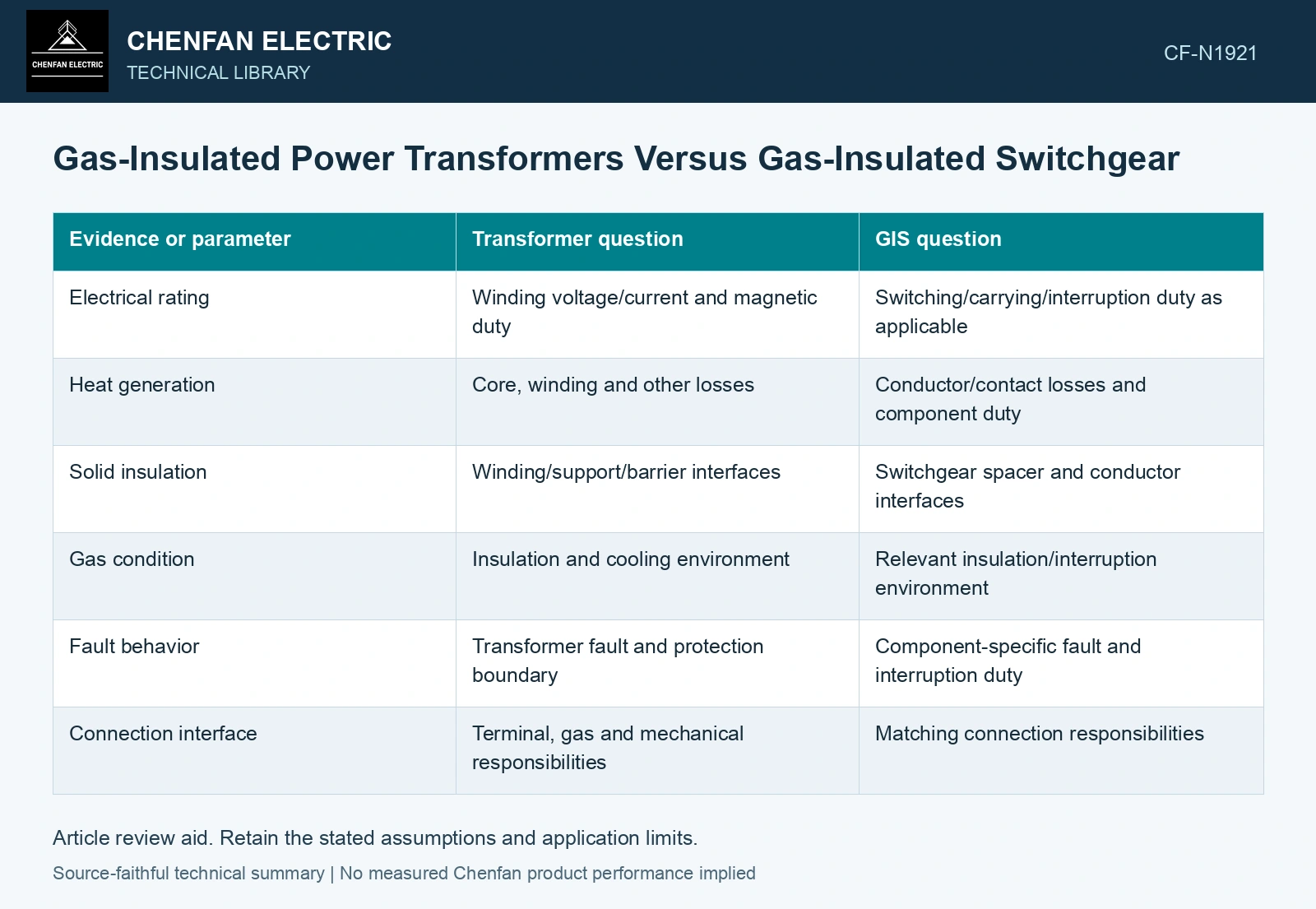
Match evidence to the apparatus
| Evidence or parameter | Transformer question | GIS question |
|---|---|---|
| Electrical rating | Winding voltage/current and magnetic duty | Switching/carrying/interruption duty as applicable |
| Heat generation | Core, winding and other losses | Conductor/contact losses and component duty |
| Solid insulation | Winding/support/barrier interfaces | Switchgear spacer and conductor interfaces |
| Gas condition | Insulation and cooling environment | Relevant insulation/interruption environment |
| Fault behavior | Transformer fault and protection boundary | Component-specific fault and interruption duty |
| Connection interface | Terminal, gas and mechanical responsibilities | Matching connection responsibilities |
Use the table when a source is offered as proof. A result can answer one column’s material question while leaving the other column’s apparatus duty unresolved.
Keep gas and solid insulation together
The transformer does not rely on gas alone. Its conductors, solid insulation and gas interfaces form a combined dielectric and thermal structure. A gas withstand figure from another geometry cannot define the field at a winding support or the heat path through its insulation.
Review the shared connection separately
Direct coupling can reduce the space occupied by terminals. It still needs a defined compartment boundary, pressure relationship, insulation interface and mechanical load path. The gas systems may be shared or separated according to the actual design.
A connection drawing should identify the scope of each supplier’s evidence. A GIS pressure label cannot silently qualify the transformer tank, nor can a transformer thermal test establish the attached switching equipment’s duty.
Use the terminology precisely in procurement
Specify gas-insulated power transformer when that is the equipment being purchased, then identify the GIS connection if present. Request transformer-specific design and test evidence for winding, core, cooling and insulation performance.
Assume a transformer compartment continuously rejects 20 kW while an adjacent GIS compartment rejects 1 kW under its assessed duty. A room cooling system qualified only for the GIS’s 1 kW cannot accommodate the 21 kW combined source; the missing 20 kW remains regardless of a shared insulating-gas family. Keep transformer winding/core losses, gas circulation and interface pressure states in its own equipment qualification. Use the connected-system review to close interfaces rather than transferring switchgear thermal limits to the transformer.
This prevents a plausible gas-technology argument from becoming an unsupported equipment claim. The practical decision is whether the evidence covers the actual apparatus and interface. A common medium can support a compact installation; it cannot substitute one family’s qualification for another’s.
References
- Y. Wu et al., Research on Heat Dissipation Performance of Eco-friendly Gas insulated Transformer with i-C4F7N/CO2 as the Insulation Medium, Journal of Physics: Conference Series 2527, 012011, 2023. DOI: 10.1088/1742-6596/2527/1/012011.
- IEC, IEC 60376:2018, Specification of technical grade sulphur hexafluoride (SF6) and complementary gases to be used in its mixtures for use in electrical equipment.