

Joining stainless and carbon steel in an accessory creates a metallurgical and environmental interface. The filler, dilution and thermal history depend on the exact materials and process. A generic instruction to use a particular filler cannot qualify an unknown joint. [1]
Identify both base materials from certificates and tie them to the drawing. Record thicknesses, joint preparation, filler and the applicable qualified procedure. Keep any coating, insulation or oil-contact function of the accessory visible.
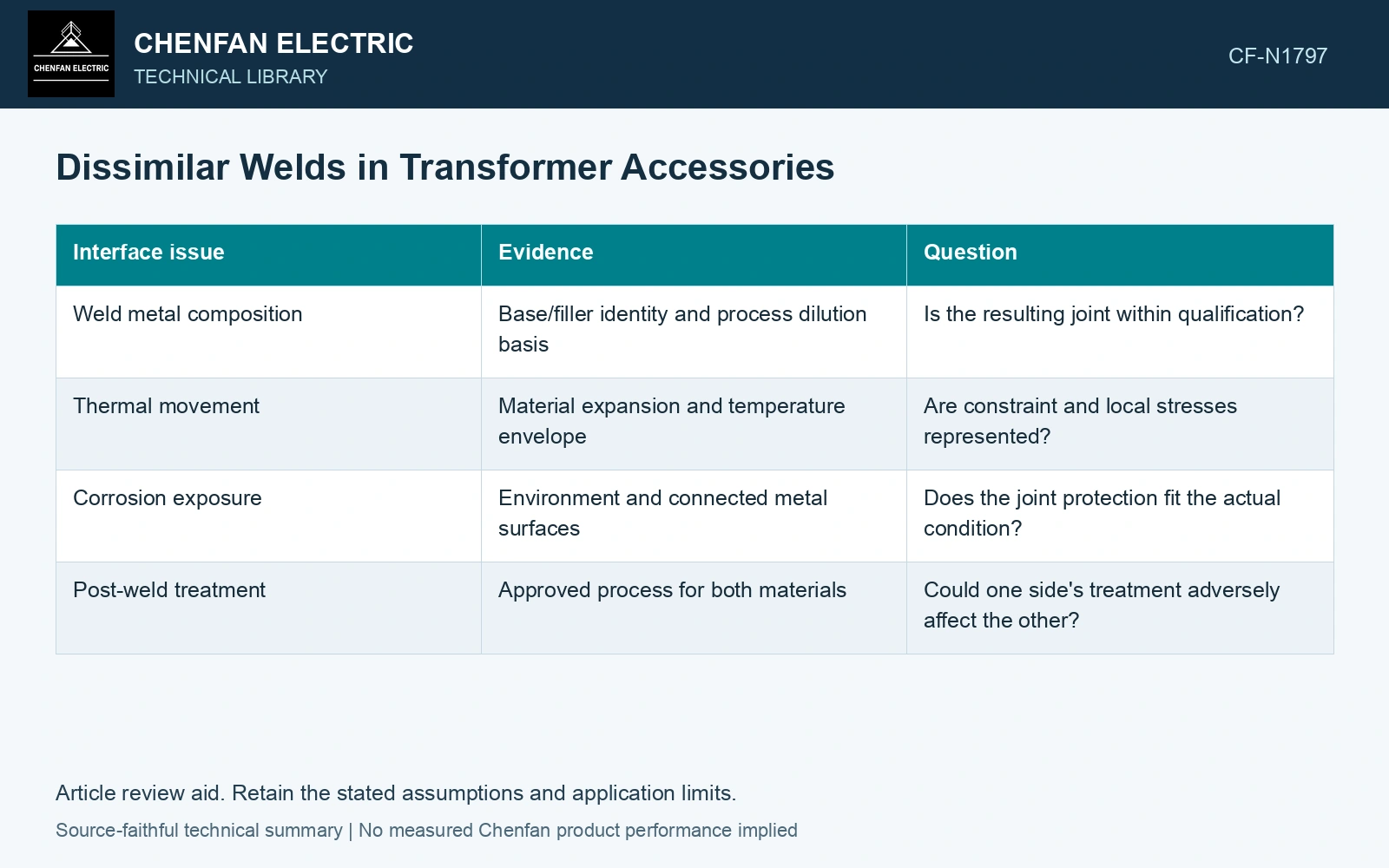
| Interface issue | Evidence | Question |
|---|---|---|
| Weld metal composition | Base/filler identity and process dilution basis | Is the resulting joint within qualification? |
| Thermal movement | Material expansion and temperature envelope | Are constraint and local stresses represented? |
| Corrosion exposure | Environment and connected metal surfaces | Does the joint protection fit the actual condition? |
| Post-weld treatment | Approved process for both materials | Could one side’s treatment adversely affect the other? |
Keep dilution as a process-specific quantity
A simple composition estimate can weight the melted base and filler fractions, but real weld structure and properties require qualified evidence. The fractions depend on penetration and process. The filler label alone does not describe the resulting deposit.
Likewise, a thermal expansion mismatch does not automatically imply failure. Restraint, joint geometry and temperature range determine its mechanical consequence.
Kotecki and Armao explain how base-metal dilution can change the alloy and why filler selection must consider the resulting deposit. Chromium alone does not establish ferrite/austenite balance, cracking resistance or service corrosion performance. Keep NDT acceptance separate from those metallurgical questions. [1][2]
Use dilution only as a composition screen
Assumptions by mass: filler has 20% Cr, stainless base metal 18% Cr and carbon steel 0.2% Cr. A deposit containing 60% filler plus 20% of each base gives 0.60×20 + 0.20×18 + 0.20×0.2 = 15.64% Cr. Against an assumed project composition screen of at least 18% Cr, it fails by 2.36 percentage points. If the two base metals continue to contribute equally, CCr = 20f + 9.1(1 − f); meeting that screen requires filler fraction f ≥ (18 − 9.1)/(20 − 9.1) = 81.65%, or total base dilution ≤18.35%. Reject the proposed 40% dilution condition for that screen. Qualify the complete alloy, phase structure, joint and corrosion duty before selecting a welding procedure. [1]
References
- D. Kotecki and F. Armao, The Lincoln Electric Company, Stainless Steels Welding Guide, 2003, selection of filler metals and joining stainless and other steels.
- ISO, ISO 17635:2025, Non-destructive testing of welds — General rules for metallic materials.