

A radiator header weld can be accessible before a cap, tube row or attachment is installed and difficult to examine afterward. An inspection plan written only for the finished component may discover that the critical region is already hidden. [1]
Divide the weld into numbered segments and draw the available surfaces at each manufacturing stage. Identify the method’s required probe, viewing or radiation access. A method name without a reachable path is not a coverage plan.
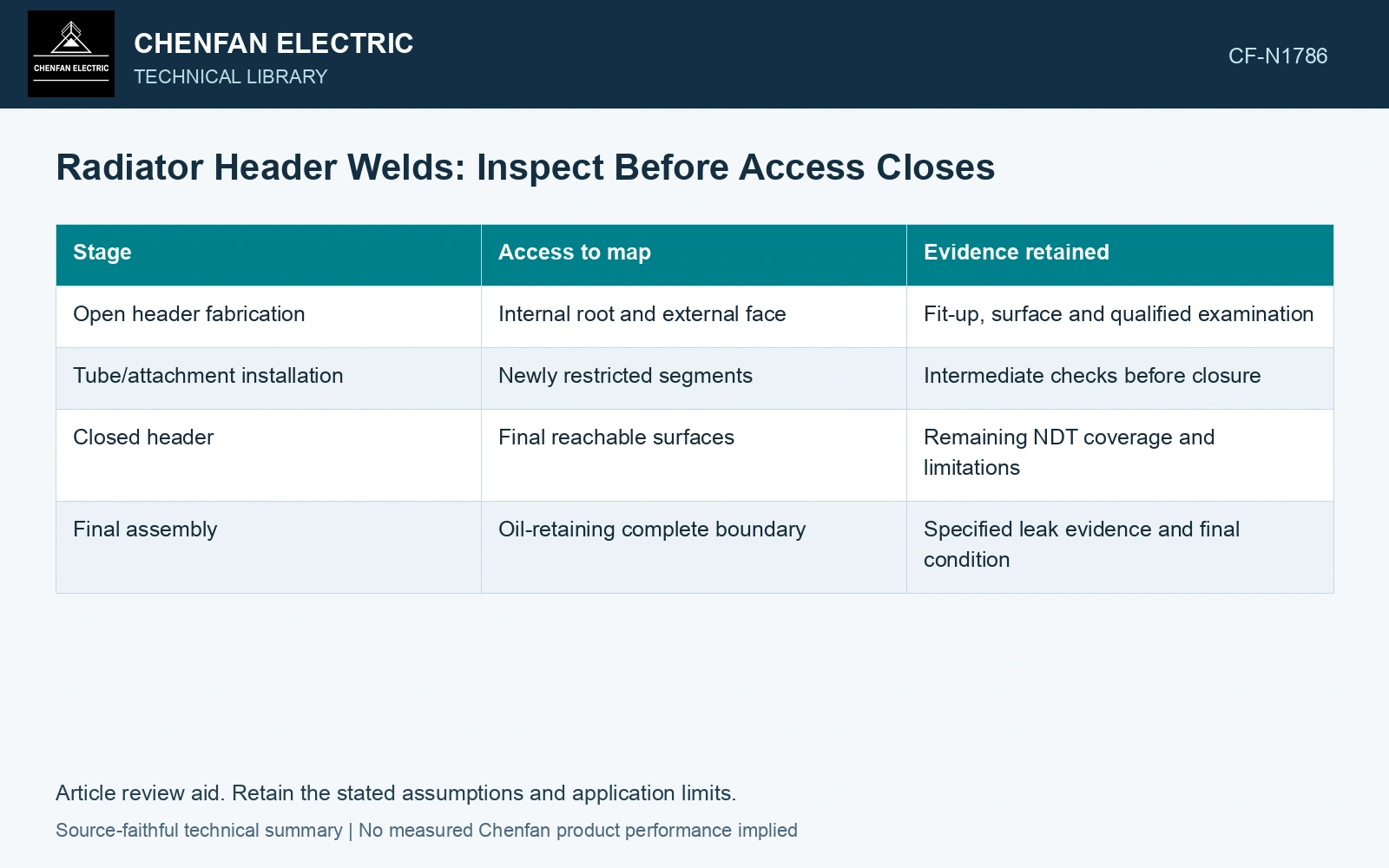
A staged inspection record
| Stage | Access to map | Evidence retained |
|---|---|---|
| Open header fabrication | Internal root and external face | Fit-up, surface and qualified examination |
| Tube/attachment installation | Newly restricted segments | Intermediate checks before closure |
| Closed header | Final reachable surfaces | Remaining NDT coverage and limitations |
| Final assembly | Oil-retaining complete boundary | Specified leak evidence and final condition |
Do not let an early check cover a later change
Subsequent welding can affect an already examined region through heat, distortion or repair. Identify which earlier evidence remains valid and which area needs reexamination. Retain the final configuration in the weld record.
Likewise, an intermediate visual check cannot substitute for all required internal defect evidence. Match each method to the feature and geometry it can detect.
Choose NDT using material, weld thickness, welding process, quality requirements and demonstrated coverage. NDT acceptance levels are not a detailed one-to-one translation of weld quality levels. [2]
Quantify the preclosure inspection hold point
Assume a 1,200 mm header seam has 900 mm accessible after assembly. The remaining 300 mm is 25% of its length. Schedule and retain examination of that region before access closes, then evaluate subsequent heat/repair effects. A final report restricted to accessible weld cannot claim full-length coverage.
References
- U.S. Federal Highway Administration, Bridge Welding Reference Manual, FHWA-HIF-19-088, 2019.
- ISO, ISO 17635:2025, Non-destructive testing of welds — General rules for metallic materials.