

An oil-retaining tank seam must carry its specified loads and prevent an unacceptable leak path. A welding procedure qualification addresses a defined range of materials, thicknesses and joints. It does not replace inspection of the final seam’s oil integrity. [1]
List each joint type from the fabrication drawing: panel seams, corners, nozzles and attachments that enter an oil boundary. Identify which procedure and qualification cover it under the contract’s applicable requirements.
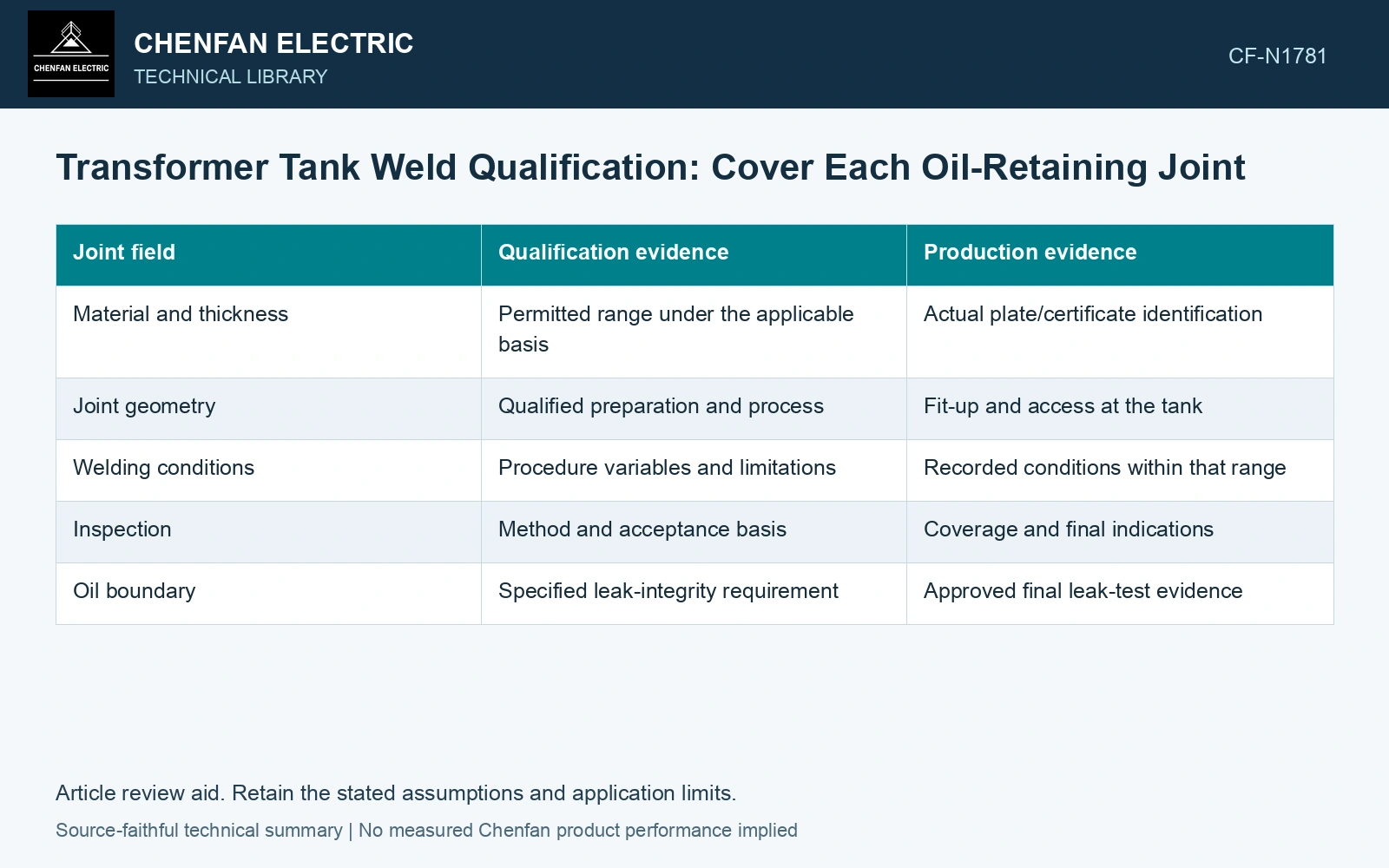
Build the coverage matrix before fabrication
| Joint field | Qualification evidence | Production evidence |
|---|---|---|
| Material and thickness | Permitted range under the applicable basis | Actual plate/certificate identification |
| Joint geometry | Qualified preparation and process | Fit-up and access at the tank |
| Welding conditions | Procedure variables and limitations | Recorded conditions within that range |
| Inspection | Method and acceptance basis | Coverage and final indications |
| Oil boundary | Specified leak-integrity requirement | Approved final leak-test evidence |
A visible bead is not the complete evidence
Procedure compliance also needs actual production variables. A qualification certificate belonging to the shop does not demonstrate that a changed corner joint or later attachment used a covered arrangement.
Choose NDT using material, weld thickness, welding process, quality requirements and demonstrated coverage. NDT acceptance levels are not a detailed one-to-one translation of weld quality levels. [2]
Reconcile procedure coverage with the joint register
Assume a tank has 12 oil-retaining joint families. The supplied qualification dossier demonstrably covers 10 of them, leaving 2 unresolved. Identify their material, thickness and geometry against the actual qualification range before fabrication acceptance; a common procedure number on all drawings does not establish coverage.
References
- U.S. Federal Highway Administration, Bridge Welding Reference Manual, FHWA-HIF-19-088, 2019.
- ISO, ISO 17635:2025, Non-destructive testing of welds — General rules for metallic materials.