

A coating tested for a stated number of salt-spray hours has evidence for that laboratory exposure and its evaluation criteria. The number does not directly establish years of outdoor transformer service. Field moisture, drying, sunlight, contamination and mechanical damage follow another history. [1]
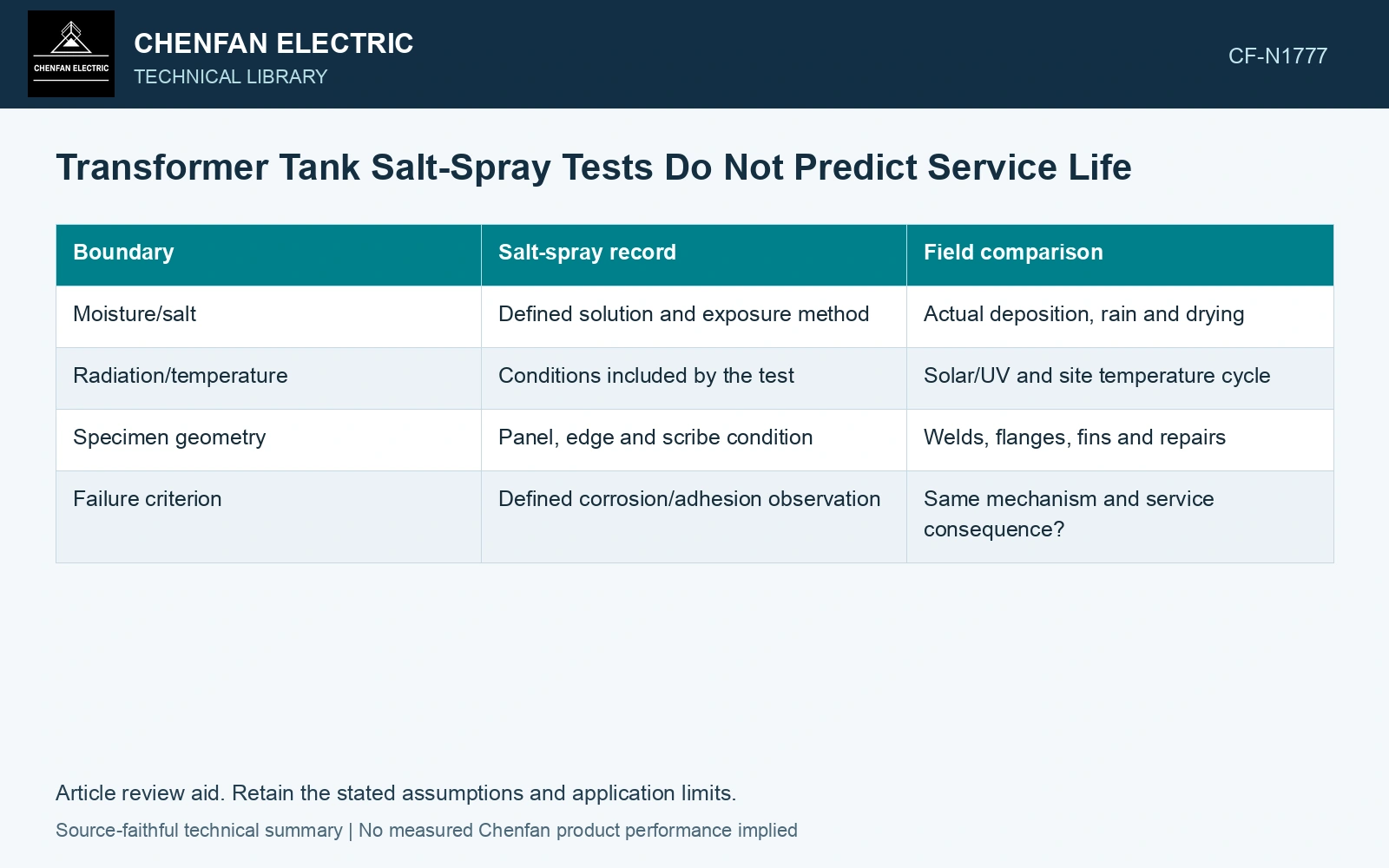
| Boundary | Salt-spray record | Field comparison |
|---|---|---|
| Moisture/salt | Defined solution and exposure method | Actual deposition, rain and drying |
| Radiation/temperature | Conditions included by the test | Solar/UV and site temperature cycle |
| Specimen geometry | Panel, edge and scribe condition | Welds, flanges, fins and repairs |
| Failure criterion | Defined corrosion/adhesion observation | Same mechanism and service consequence? |
Use the test for a question it can answer
Under matched preparation and evaluation, a test can compare coating systems or screen a process variation. It can reveal weaknesses around a defined defect. The comparison needs the whole coating system, substrate and cure history; hours alone cannot rank unlike specimens.
Keep paint execution and supervision tied to the actual product and coated region; a finished appearance does not recover missing process evidence. [2]
Reject an hours-to-years conversion
Assume two qualified specimens show 1 mm and 3 mm underfilm advance after the same 1,000 h laboratory exposure. The second advance is three times larger for that test. No conversion to outdoor years follows. Compare the specified exposure, defect geometry and evaluation method, then obtain relevant service or multi-mechanism evidence before a durability claim.
Require a basis for any acceleration claim
A service-life extrapolation needs evidence linking the laboratory and field mechanisms, with uncertainty and relevant site conditions. A fixed “hours equal years” multiplier is not established by the test duration itself.
References
- ISO, ISO 9227:2022, Corrosion tests in artificial atmospheres — Salt spray tests.
- ISO, ISO 12944-7:2017, Paints and varnishes — Corrosion protection of steel structures by protective paint systems — Part 7: Execution and supervision of paint work.