

Tank colour is a visible property. Solar absorptance describes how much incident solar energy the surface absorbs across the relevant spectrum. These quantities are related through the coating but are not interchangeable measurements. [1]
Use the property needed by the thermal model
For a simple direct-beam contribution, the heat-input term is Q̇solar = αsGAproj, with dimensionless solar absorptance αs, beam-normal irradiance G in W/m² and projected exposed area Aproj in m². The result is watts. Orientation, shading and time variation determine the appropriate G and projected area. Diffuse sky radiation requires a separate treatment using the exposed surface and relevant view geometry.
This is absorbed input, not the resulting temperature. Convection, long-wave radiation and internal heat flow also affect the tank. Surface thermal emissivity is another property and should not be equated automatically with solar absorptance.
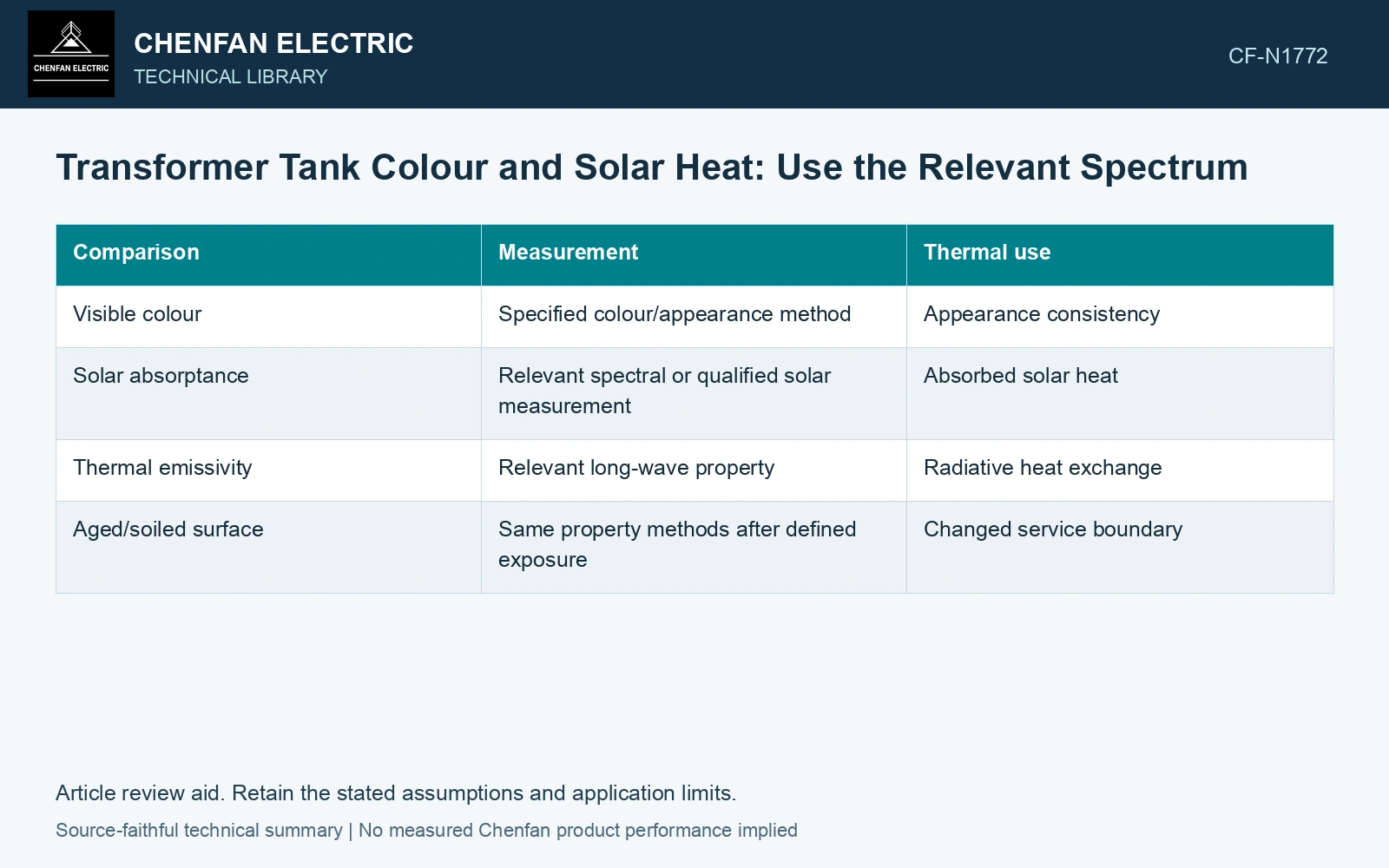
| Comparison | Measurement | Thermal use |
|---|---|---|
| Visible colour | Specified colour/appearance method | Appearance consistency |
| Solar absorptance | Relevant spectral or qualified solar measurement | Absorbed solar heat |
| Thermal emissivity | Relevant long-wave property | Radiative heat exchange |
| Aged/soiled surface | Same property methods after defined exposure | Changed service boundary |
Levinson, Berdahl and Akbari distinguish solar spectral reflectance from long-wave thermal emittance and show optically dark coatings with different near-infrared behavior. Use both properties in the relevant heat balance. [1][2]
Compare absorbed solar input on one basis
The LBNL presentation shows opaque dark optical examples with solar reflectance 0.47 for perylene black over white and 0.04 for iron blue over white. [1] Their absorptances, α = 1 − R, are 0.53 and 0.96. For assumed beam-normal irradiance 800 W/m² and projected area 10 m², absorbed powers are 4.24 and 7.68 kW. Assume a uniform surface node receives another 20 kW internally, ambient is 40 °C, effective heat-removal conductance is 0.50 kW/K for both options, and its project surface gate is 90 °C. The node temperatures are 40 + (20 + 4.24)/0.50 = 88.48 °C and 95.36 °C. Screen out the higher-absorptance option for this duty. Qualify the actual tank coating’s solar/long-wave properties, corrosion performance and aged surface. [1][2]
Compare the same surface condition
New clean paint and weathered or soiled paint can differ. Retain film system, preparation and exposure in the property record. A colour chip or marketing colour name does not establish a thermal coefficient.
References
- R. Levinson, P. Berdahl and H. Akbari, Lawrence Berkeley National Laboratory, How to Design a Cool Nonwhite Coating, 12 May 2005.
- U.S. Department of Energy, DOE-HDBK-1012/2-92, Thermodynamics, Heat Transfer, and Fluid Flow, Volume 2, 1992.