

A corrugated transformer wall gives the thickness probe different curvatures and access at crests, valleys and bends. Coating application differs there as well. An overall average can conceal a thin valley or an unreliable measurement at a tight radius. [1]
Divide the wall into repeatable geometric zones. Tie every reading to a corrugation number and position. Use a probe and adjustment method demonstrated for the substrate, thickness and curvature range.
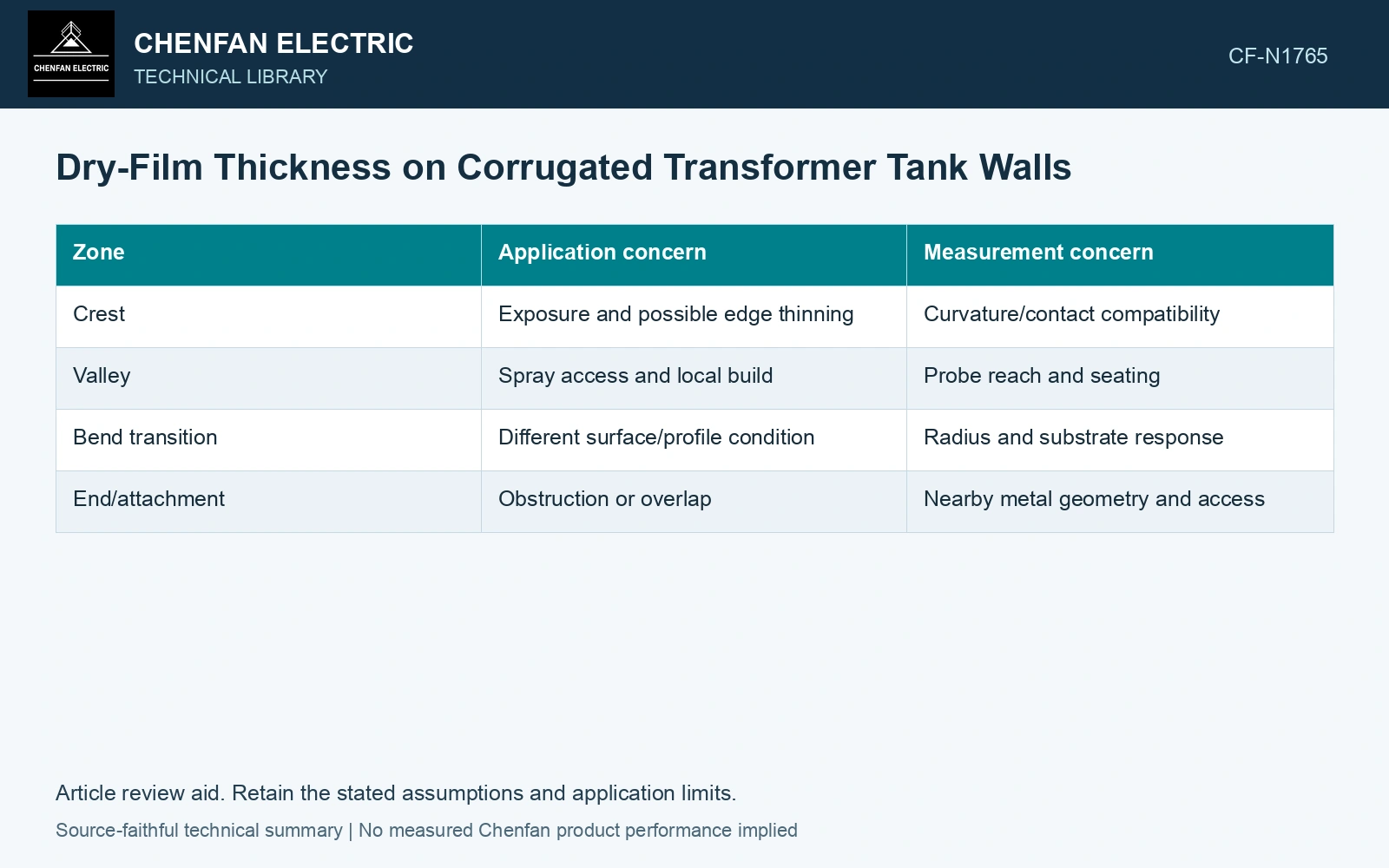
A geometry-aware reading grid
| Zone | Application concern | Measurement concern |
|---|---|---|
| Crest | Exposure and possible edge thinning | Curvature/contact compatibility |
| Valley | Spray access and local build | Probe reach and seating |
| Bend transition | Different surface/profile condition | Radius and substrate response |
| End/attachment | Obstruction or overlap | Nearby metal geometry and access |
Separate an invalid reading from a thin film
Check the instrument response on a representative uncoated or reference geometry under the approved method. If probe seating or curvature lies outside capability, mark the region unresolved rather than entering a convenient number.
A thin reading needs confirmation with the valid method and location. Repeated measurements with the same unsuitable probe can be repeatably wrong. Likewise, deleting every low value as “curvature” can hide a real application problem.
Keep paint execution and supervision tied to the actual product and coated region; a finished appearance does not recover missing process evidence. [2]
Keep the valley result outside the overall mean
Assume valid zone means are 120 μm on crests and 70 μm in valleys with equal sampling weights. Overall mean is 95 μm. If the project-specific assumed local minimum is 80 μm, the valley remains 10 μm below it despite that mean. Confirm curvature capability and apply actual sampling rules before acceptance.
References
- ISO, ISO 2808:2019, Paints and varnishes — Determination of film thickness.
- ISO, ISO 12944-7:2017, Paints and varnishes — Corrosion protection of steel structures by protective paint systems — Part 7: Execution and supervision of paint work.