

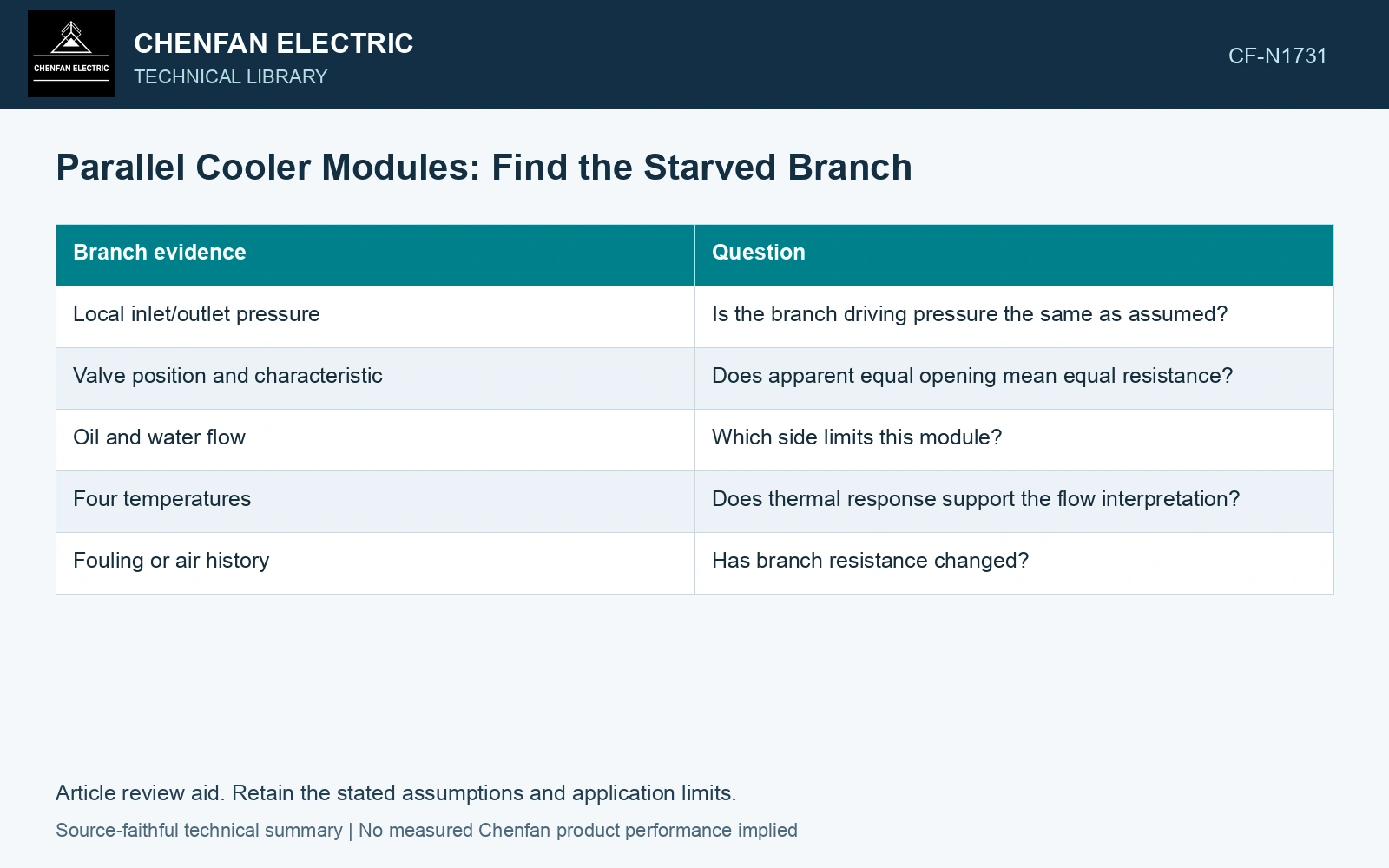
A parallel cooler system can deliver its specified total flow while one module receives too little. Another branch may take the difference. Cooling depends on local oil and water flows, so a common-header meter alone cannot verify every module’s duty. [1]
Compare branches under the same header conditions
For a simplified turbulent-flow branch, Δpk ≈ KkQk². For Q in m³/s and Δp in pascals, K has units Pa·s²/m⁶. Parallel branches between truly common nodes share the same differential pressure; unequal K then gives unequal flow. Real headers can produce different pressure at each takeoff.
| Branch evidence | Question |
|---|---|
| Local inlet/outlet pressure | Is the branch driving pressure the same as assumed? |
| Valve position and characteristic | Does apparent equal opening mean equal resistance? |
| Oil and water flow | Which side limits this module? |
| Four temperatures | Does thermal response support the flow interpretation? |
| Fouling or air history | Has branch resistance changed? |
Separate header imbalance from module resistance
If branch driving pressures differ, review the header arrangement and takeoff positions. If pressures are similar but flows differ, investigate valve characteristics, fouling, trapped gas or module geometry. Use the measured pattern to choose the next inspection.
The same percentage valve opening does not establish equal K. A balance adjustment should follow the approved system design, preserving minimum flow and pump constraints rather than simply making temperature readings match.
Maintenance guidance warns that apparent valve position can conceal a broken stem and obstructed cooling path [2]. Check actual local flow and the physical valve state when one branch is starved.
Find the starved parallel branch
Assume two branches share 40 kPa driving pressure and obey Δp=KQ². With K values 0.4 and 1.6 kPa/(L/s)², flows are 10 and 5 L/s. The total 15 L/s conceals the twofold branch difference. Verify both fluids at each module and assess the actual pump point before accepting the common-header flow.
If both branches instead require an assumed minimum 8 L/s, the first branch passes and the second fails despite that total. With unchanged K, the restrictive branch alone would need 1.6 × 8² = 102.4 kPa. That pressure would drive 16 L/s through the other branch, so increasing common pressure alone is not a balanced remedy.
References
- U.S. Department of Energy, DOE-HDBK-1012/3-92, Thermodynamics, Heat Transfer, and Fluid Flow, Volume 3, 1992.
- U.S. Bureau of Reclamation, FIST Volume 3-30, Transformer Maintenance, 2000.