

A model can match a measured noise spectrum after enough parameters are adjusted. That achievement may show flexibility rather than predictive capability. If each mode receives its own arbitrary frequency shift and damping value, the model can lose a physical relationship to the assembly.
Decide which measurements calibrate the model and which will test its predictions. Keep the validation conditions out of parameter fitting until the predicted results have been compared.
Tie parameters to physical observations
Use independently measured geometry, material source data, support conditions and contact behavior where available. Bound uncertain parameters with defensible evidence. A fitted parameter should represent a plausible physical quantity, not merely cancel a discrepancy elsewhere in the chain.
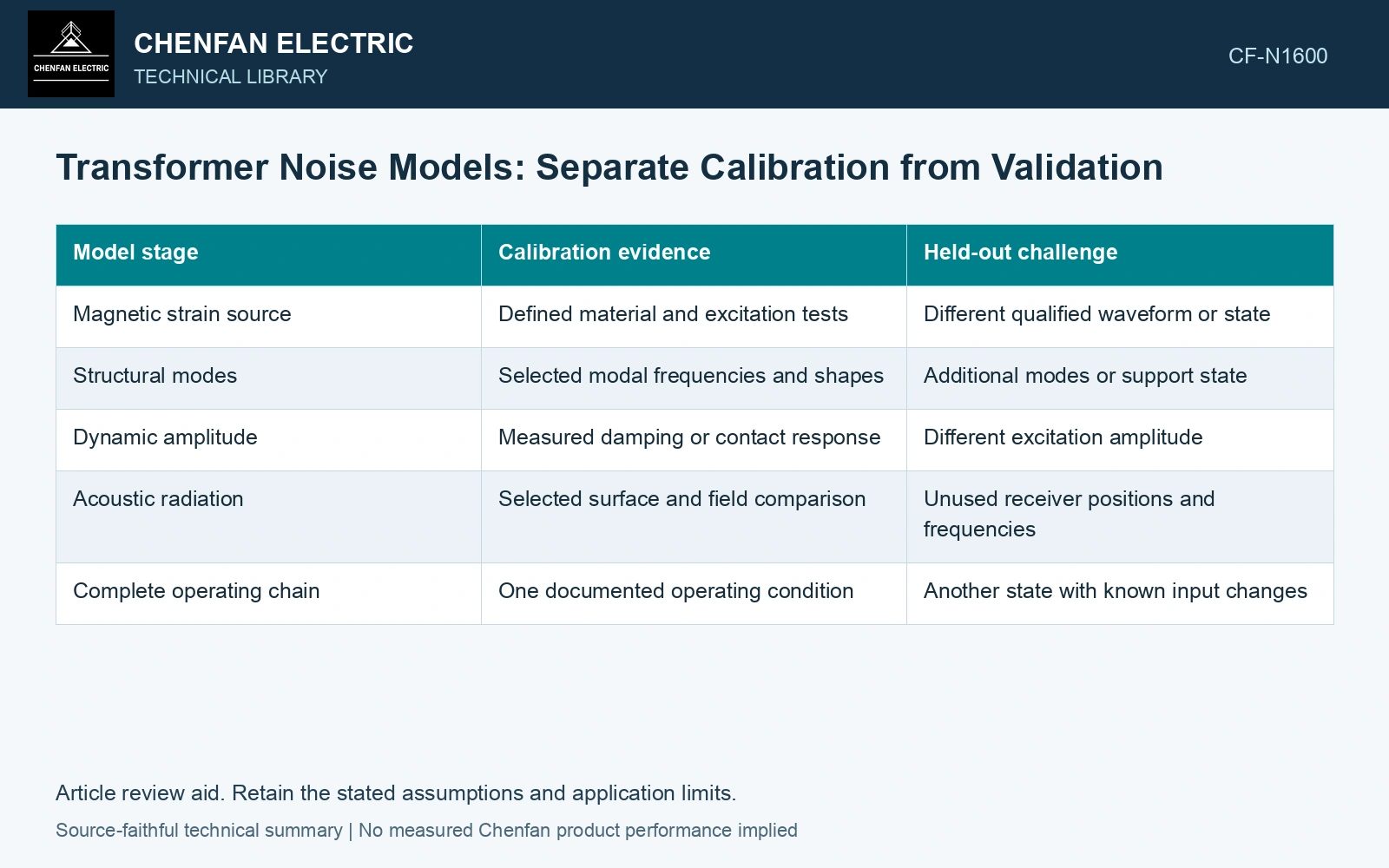
| Model stage | Calibration evidence | Held-out challenge |
|---|---|---|
| Magnetic strain source | Defined material and excitation tests | Different qualified waveform or state |
| Structural modes | Selected modal frequencies and shapes | Additional modes or support state |
| Dynamic amplitude | Measured damping or contact response | Different excitation amplitude |
| Acoustic radiation | Selected surface and field comparison | Unused receiver positions and frequencies |
| Complete operating chain | One documented operating condition | Another state with known input changes |
The matrix is a planning example, not a mandatory test list. Choose challenges that expose the assumptions most important to the intended prediction.
Compare more than peak frequency
Frequency agreement does not establish the correct mode shape. Shape agreement does not establish damping or source magnitude. Check spatial response, complex phase and amplitude alongside the resonance locations.
For acoustic outputs, inspect directional response and band power as appropriate. A model can match one microphone through cancellation while predicting the surrounding field poorly. Reserved positions provide a useful challenge.
Separate measurement uncertainty from model discrepancy. If the difference exceeds the combined measurement capability, do not automatically widen uncertain parameters until every point is covered. Identify whether the error appears in the source, transfer or radiation stage.
Revise one physical hypothesis at a time
If a held-out amplitude fails while modes agree, investigate damping and source strength before shifting geometry. If mode shapes disagree, an amplitude scale factor will not repair the structural model. If surface velocity agrees but acoustic pressure fails, inspect radiation boundaries and spatial sampling.
Document any revision and repeat the relevant held-out comparisons. Once a validation state is used for refitting, it becomes calibration evidence; reserve another challenge where the prediction claim requires it.
State the frequency range, mounting conditions and operating states over which the model agrees with independent observations. A proposed change is credible only within that demonstrated range or after the new assumptions have been tested.
Challenge an unused microphone with a declared residual rule
Assume a 100 Hz tonal prediction is calibrated at one receiver, then tested at an unused receiver under the same load, temperature and cooling state. Prediction is 0.100 Pa RMS and observation is 0.130 Pa RMS. The difference is 0.030 Pa, or 30% of prediction, equivalent to 20 log₁₀(0.130/0.100) = 2.28 dB. With independent assumed standard uncertainties of 0.005 Pa for each quantity, combined standard uncertainty is 0.00707 Pa; the residual is 4.24 times that value [1]. Investigate source or transfer discrepancy before accepting the prediction. If this point is used for refitting, select another independent validation point. Use transformer and cooling-device sound measurements with defined operating and measurement conditions [2].
References
- JCGM, JCGM 100:2008, Evaluation of measurement data — Guide to the expression of uncertainty in measurement, 2008.
- IEC, IEC 60076-10:2016, Power transformers – Part 10: Determination of sound levels, 2016, official public scope.