

Removing a GOES coating changes more than the presence of that coating. The procedure may alter surface roughness, cause oxidation, remove some steel, introduce heating or leave chemical residue. A magnetic difference between coated and stripped material can contain all of those contributions.
If the research question concerns coating tension, build an experiment that tests the competing explanations. The objective is attribution, not a recommendation to remove production insulation. The original coating serves functions that the research comparison deliberately disturbs.
Reserve an untouched reference
Take matched specimens from identified material and document initial thickness, surface condition and magnetic response. Allocate them to untouched, sham-treated and removal-treated groups where a defensible sham is possible. Keep handling and subsequent measurement conditions comparable.
A sham treatment follows relevant procedure steps without producing the intended coating removal. Its exact usefulness depends on the method. It may isolate heating or rinsing while failing to reproduce a reaction that occurs only when the coating is removed. State that limitation.
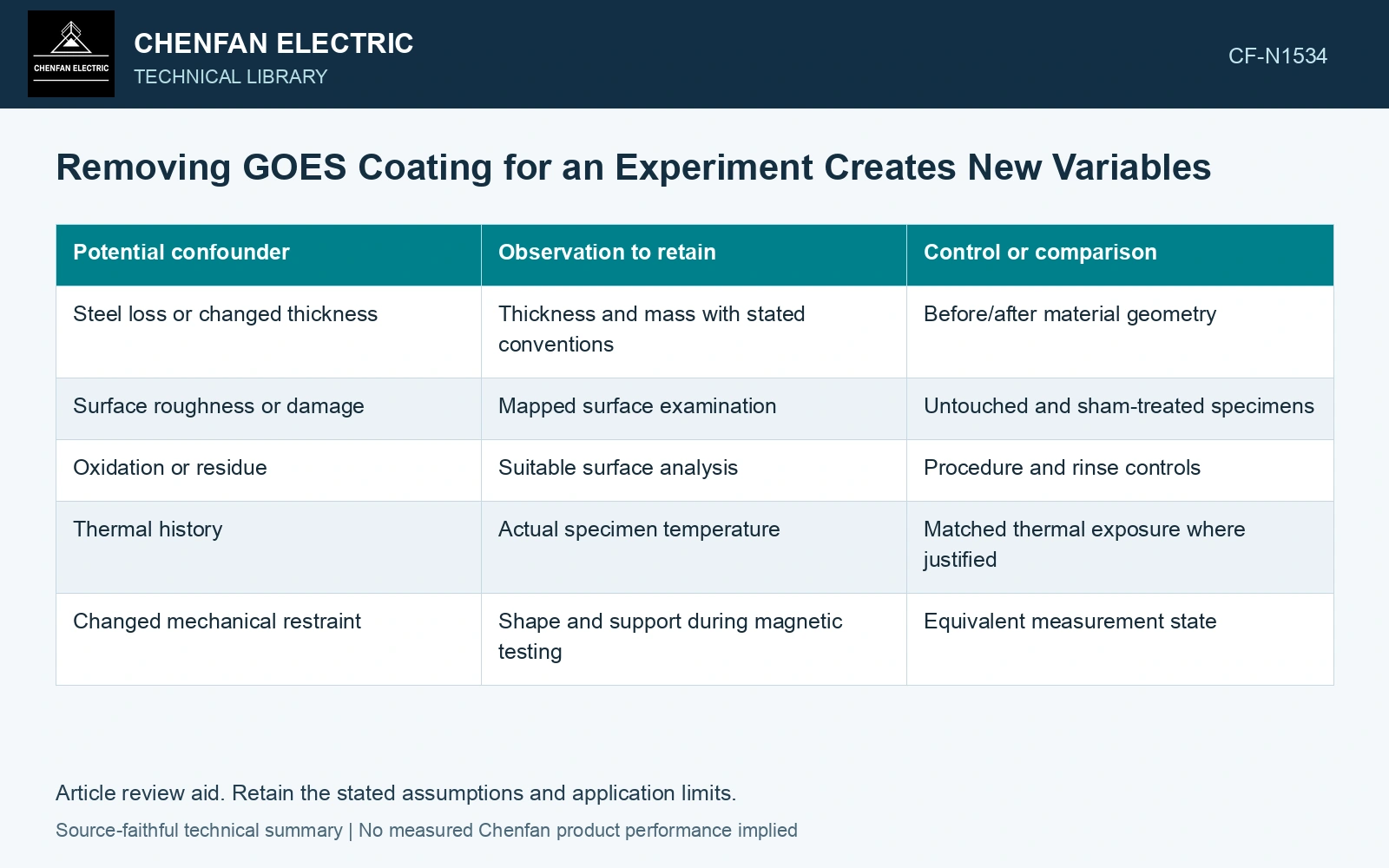
| Potential confounder | Observation to retain | Control or comparison |
|---|---|---|
| Steel loss or changed thickness | Thickness and mass with stated conventions | Before/after material geometry |
| Surface roughness or damage | Mapped surface examination | Untouched and sham-treated specimens |
| Oxidation or residue | Suitable surface analysis | Procedure and rinse controls |
| Thermal history | Actual specimen temperature | Matched thermal exposure where justified |
| Changed mechanical restraint | Shape and support during magnetic testing | Equivalent measurement state |
The observations need not all be identical after removal. They need to reveal which differences remain possible explanations for the magnetic change.
Avoid geometry errors in the magnetic comparison
If thickness changes, update the magnetic cross-section using the appropriate material measurement. Otherwise an unchanged physical response can appear different because the calculation uses an obsolete area. Preserve the distinction between steel-only thickness and total coated-sheet thickness.
Keep excitation, orientation, temperature and magnetic preparation consistent. Removing a coating can change the specimen’s contact with the tester or support, which can alter both mechanical restraint and magnetic-circuit conditions. Check those interfaces independently.
Use more than one line of evidence
A change that occurs in both removal-treated and sham-treated specimens points toward a procedure contribution. A change restricted to the removal group narrows the explanation but does not isolate coating tension if the removal group also has unique roughness or chemical changes.
Where feasible, relate magnetic observations to an independently characterized mechanical change. A causal claim about tension is stronger when the experiment establishes how restraint changed, rather than inferring it solely from loss.
The final comparison should state which confounders were controlled, measured or unresolved. It may support a coating-related effect under the tested conditions while leaving the exact contribution of tension uncertain. That is an informative research result. A before/after difference without these controls cannot justify a broad claim that stripping coating improves transformer cores.
Technical references
- Materials / MDPI. Magnetostrictive Properties of the Grain-Oriented Silicon Steel Sheet under DC-Biased and Multisinusoidal Magnetizations.
- NIST. NCAL: Diffraction Stress Measurement Under Applied Load.